



Danny Paisley photo by Michael G. Stewart
Danny Paisley Sets Himself New Challenges for Bluegrass State of Mind
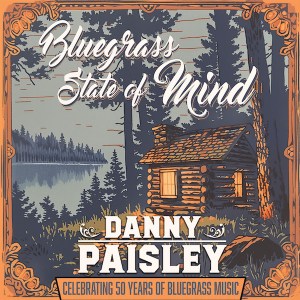
This summer, the International Bluegrass Music Association’s Male Vocalist of the Year, Danny Paisley, released Bluegrass State of Mind, at the same time celebrating 50 years in bluegrass. He also recently had a memorable solo debut at the Grand Ole Opry. Though this is just the next chapter in a lifetime of work in music for Paisley, it’s a particularly poignant one, since he recorded it after surviving a battle with cancer, and even more pointedly, a battle with throat cancer that might have meant halting his further performances as a vocalist.
The album, even more surprisingly, is a push in new vocal directions for Paisley, and a close collaboration with his son, Ryan Paisley, as well as a continued partnership with favorite songwriters in his life. With a bevy of friends and family members supporting him, and buoyed by some confidence-boosting discoveries about his own voice, Danny Paisley was ready to take on some new styles and wider ranges that even longstanding fans will be wowed by. I spoke with Danny Paisley about the striking relevance of many of these songs to life at the moment, his family’s Southern roots, and how he found his way into new territory for this album.
Americana Highways: I think this album sounds fantastic.
Danny Paisley: I appreciate that very much. We worked hard on it. It’s a little bit of a step out of the norm for me, but my son had some ideas, and it’s now time for another generation, so I said, “Son, I’ll let you handle things.”
AH: Did he help you pick out songs?
DP: Yes, he helped me pick out songs, and make the arrangements. He and the producer had a lot of great ideas. I let them steer me. I said, “I’ll sing it my way, and you all just tell me what you want to hear.” I’m very pleased, because they respected my tradition and my way of doing things, but also brought in their ideas.
AH: Well, you certainly did sing it in your way. Every track is very powerful. The energy is very high throughout the album, too.
DP: We typically do that in our live shows. Our music has a lot of energy, and we play very “upbeat,” I say. Some folks call it “hard-driving.” I say that we have a lot of punch, and we keep things moving along.
AH: Some of the attitudes and the themes in the songs are very relatable. I think it was a really sensitive choice of songs. I feel these are topics that people will feel really “hit” them.
DP: Yes. There’s one song, particularly, “Two Old Church Pews,” which is a Gospel-leaning song, that to me seemed like what we see happening. The neighborhood church is closing down. Some people come and take remembrances out of the church, and this particular person chose two old church pews, because his belief is that God is with you every day, no matter where you are. You don’t have to be in church. That’s, personally, how I feel. Some people pray standing at the kitchen sink, or cooking dinner, or just in a moment of reflection. [Laughs] It doesn’t have to be Sunday morning.
Then, another great song, and it’s done well, is “Till Lonesome Comes Around.” There’s a little story behind it, which is that the gentleman who wrote it, David Stewart, though he wrote it along with Mark Brinkman, owns a historic hotel out in Wyoming, called The Occidental Hotel. In the hotel, it has a restaurant, and bar, plus rooms. He’s restored it, and it’s just beautiful, in this Western town. He was tending bar one night, just closing up, and one of the older fellows came in.
David said, “How are you doing tonight?” And the gentleman said to him, “Well, I’m alright ‘till lonesome comes around.” He said, “Oh, my goodness, you just wrote a song for me!” [Laughs] What a line! He said, “As soon as I heard that, I grabbed it.” I told him, “Yes, we’ve all been that way, whether it’s being isolated, as an old person, or with a loss of love. We’ve all had those nights. I told him, “That’s a great song!” Once they sent it to me, there was no question in my mind that I wanted to record that song.” David has quite a history in Country music, also.
AH: Yes, that’s true! I noticed that a few of these songs were at least partly his work, so I gathered that you like his songs a lot.
DP: Yes, I do.
AH: It also reminds me, this idea of having a hotel or inn, that music is often a part of that. These gathering places are also where music has often been kept alive, like in Appalachia.
DP: I live in the Mid-Atlantic states, in the south-east corner of Pennsylvania, Maryland, and Delware. New Jersey is another little bit further. Baltimore, Maryland, has a huge population of Southerners who moved up from Virginia and North Carolina to work in the steel mills and boating around Baltimore. They were hard-working people, and hard living, and a lot of the music was preserved in these old tap rooms, clubs, and bars. In this day, there’s still a big scene of Appalachian-style and related musical forms playing in these taprooms. Some of the best musicians you’ve ever heard in your life are still there, and they’ll never leave the area. They’ll just stay there, playing, and they are content. It’s preserved a lot of the music over the years.
AH: That’s wonderful, thank you for sharing that.
DP: It is! I’ve always thought it was wonderful. The other thing around my area are these country music parks, though they are pretty much extinct now, which is where on Sunday, they’d have country, bluegrass, and musical entertainment. Right near my home was one. It’s noted in Ken Burns’ documentary as “Sunset Park.” There’d be a gathering of local Southern groups, and they’d have jams, or picking sessions, and a show. They’d have Hank Sr. to Bill Monroe, and it catered to these Southern people, which my family was. They were part of this migration.
AH: That helps me understand the situation, because I’ve always wondered why so much music was coming out of that area. I didn’t realize it was from people who had moved North. My family are from North Carolina, but they never totally left.
DP: A lot of people here came from Ash Couny, North Carolina. When you get into Southern Virginia, a lot of those people moved into Southeast Pennsylvania, Maryland, and Delaware, and brought their music with them. Now, it’s third-generation Southerners who have roots in that part of the country.
AH: Now your son is part of that tradition, too.
DP: Yes, my son is a very talented musician, and I’m very proud of him. He’s also involved in his local state, town, and county government, and he’s doing a lot of great things.
AH: When you have a lot of these songs from one person, for instance from David Stewart, do you talk to him about interpretation, or send him recordings that you are working on, or is it done separately?
DP: David and I have worked together so long on different projects, we talk about it. With the song “Till Lonesome Comes Around,” as soon as he started to write it, with his co-writer Brink, he said, “This song is for Danny Paisley.”
AH: Aww, that’s so sweet.
DP: He knows what my style is! I’ll sometimes express that I’m looking for certain types of songs, and he’ll send me three or four. He’ll say, “What are you looking for?” It might be a year or so later, but I’ll get it! He knows a network of writers, plus he has a co-writer, and different people. I’ve been very lucky in our relationship.
AH: It’s so interesting when songwriters know who they are writing for. It seems like it would be low stress when you know exactly who you’re writing for.
DP: I believe you’re right, because you know their feelings. David knows how I feel when I present a song. He’s tapped into that. I appreciate that, but then he also challenges me with some different stuff. He had a song, which I recorded it for this album, and I said, “I’m not quite sure.” But my son Ryan was pushing me. He said, “It’s just different enough. I think it’s going to capture something.” David kept saying, “Try on this!”
Actually, in the studio, both of them had to coach me on how to sing it. It was the song, “Cream In My Coffee.” It’s different! It’s a different kind of song for me to do! They both said, “We can hear you doing it. We want you to try.” I can wander round on a song, which I call “whining,” or I can make my words really clippy, and cut them off. They said, “Clip your words like that. Like you’re marching, in a band.” I said, “Okay.” [Laughs] So David has challenged me.
AH: I was actually going to ask you if ever sang songs that seemed out of the way for you, but that challenged you to find your own sound.
DP: Right now, that is probably the top one! That was one that I worked hard to try to get, and practiced really hard to get. It took me a little while to catch it, but I got it!
AH: You certainly did, because that’s one of the ones that I thought of as showing your range on this album. It’s different! But a lot of them are different. I think “Till Lonesome Comes Around” is in its own pocket, too.
DP: You’re exactly right. That’s exactly what I was going for. I wanted to step out of the norm, and also out of my comfort zone. I wanted to take a little challenge at this time in my career.
AH: I’m so glad that did. “Cream in My Coffee,” because even though it’s a cute and funny song, it also speaks to me about our times. I feel like it’s relevant.
DP: Yeah! We often don’t take time for ourselves, or our relationships. We just go, go, go. That’s how I took that song. But “Now it’s time for us.”
AH: Right, if you don’t choose those aspects of your life, they will pass you by.
BP: Right. Some people want to get, get, get, and that requires them to go, go, go.
AH: Given the different vocal approaches that we hear, that you developed for this album, that’s even more surprising given the health challenges that you faced. A lot of people would then make an album that was kind of “safe.” That’s so impressive that you instead tried new directions.
DP: I think that once I got over my treatments, I had to reevaluate the way that I sang with some help from a vocal coach. It also gave me a sense of confidence to do that. I could physically feel it in my voice, and hear it, so that I then got enough confidence in my voice to really step out. That’s what I really felt like. Boy, I didn’t know that I was physically capable of doing some of these things until I was shown how to physically reach, and get to that point. I had to change my mouth, and my presentation of how I say words and sing words. That’s what really helped me with this. And, that was from me, just feeling that it was time, in my music, to broaden myself a little bit.
AH: Wow. I don’t want to say that was a silver lining to have to work with a vocal coach, but you sure turned it into one.
DP: Yes, I did! Thank you! That’s sort of the way that you’ve got to live life. You’ve got to take what you’ve been given, and fix it, and keep going. You’ve got to do the best you can with what you’ve got. That’s what you do. Each day’s got its own challenges, but it’s also a good day.
Website: https://www.dannypaisley.com/