





Jamie James on The Ever-Present Blues and His Solo Debut Straight Up
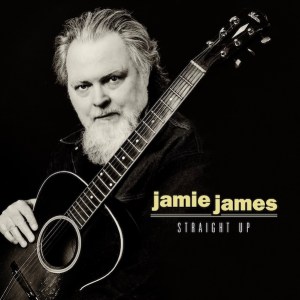
Jamie James is a songwriter and musician who has been making music his whole life, and this Spring, he released his debut solo album, Straight Up, recorded with some longtime bandmates. James has always been into the blues and blues rock, and he’s known for his work with Dennis Quaid & The Sharks, longtime collaborations with the late Harry Dean Stanton, and as the frontman of the ‘80s rockabilly trio The Kingbees.
Rejoined with friends Tom Walsh (drums), Ken Stange (organ), and Tom Mancillas (bass), James took a group of songs that he wrote during the pandemic while recovering from open heart surgery to Kitten Robot Studio in Los Angeles. They recorded the ten songs on Straight Up live in the studio in one day only, capturing their years of experience playing together for the album. As an artist now in his 70s, James has a lifetime of perspective to bring not only to his songwriting, but to how he makes and records music, and the big lessons seem to be: Stay creative, stick to what you love, and make music with the people who bring you energy to do more. I spoke to Jamie James about his approach to Straight Up and his love for the blues.
Americana Highways: How does it feel, having a little time since your debut solo album has come out? Do you have further plans?
Jamie James: I have already been working on some new songs for another album, and that’s what’s kept me going all these years. I just keep moving forward, artistically, all the time. I hope people like it. I loved making it. It was a wonderful, magical afternoon when we recorded. There isn’t really any difference in my life. My dog pushes me around as usual. Little dogs are like that! He’s a Yorkshire terrier and he’s noisy and lively.
AH: There are some benefits to just keeping the status quo in your life and not being overly tied to the album release cycle. I’m sure it’s better for continuing to make new music.
JJ: It can have such an impact on your creative life, and psychologically. It’s funny that you say that because when I was younger, when The Kingbees’ first album came out in 1980 on RSO Records, we got lucky and it had a lot of regional success. It was different than anything else on the radio, and it started catching on. I was obsessed. I would get Billboard and Cashbox magazines every week to see how it was moving up the charts. I haven’t thought of that in years, but I remember that. I became kind of manic about it. What happened, creatively, is that instead of moving forward, I was kind of stuck. Consequently, with the second album, it felt like something was lacking. I hadn’t been able to shift gears and focus on new material.
Now that I’m an old guy, in my 70s, since it came out, I’ve just been moving on. We shot the video for “Let The Praying Begin” one morning, and since then, I’ve just been working on new songs. I don’t know if anyone will ever hear them, but since I started writing songs at 13 years old in 1966, that’s how it’s always been! You never know if anyone’s going to hear, but you just write, because it’s what you do. It’s what I do.
AH: Was there a time when you knew that this album was going to be created, and when you started consciously working towards it? Or is it that since you’re always writing, you were able to just select from existing material?
JJ: It’s a combination and a little bit of both. A couple of the guitar riffs for songs on this album had been swirling around in my brain for like ten years. But for this record, what happened is that I have to have a life-changing open-heart surgery in 2020, a quadruple bypass. I had been feeling tired and I went to the doctor, and all of the sudden they were saying, “We need to give you open heart surgery right away.” It ended up that my heart was 90% blocked and wasn’t getting the oxygen it needed. I was very close to death. The wonderful doctors and the surgeon saved my life in February, and then Covid hit in March.
I was already recovering from this devastating surgery, and couldn’t really do anything. When Covid hit, I was just beginning to be able to play the guitar again without pain. So during the lockdown, for me, it was creatively what I needed. There were no distractions, no opportunities to do anything else, and no guilt about it. I like to stay home and do nothing but work on music! You start to feel guilty because there’s a world out there, and I go out there just out of guilt. But during Covid, I sat down like a regular job with my guitar, a pen, and a notebook, and just start writing. I ended up with 31 or 32, and I chose these ten for the album.
I chose these for the guys, who I have been playing with for almost 20 years already. I wanted to utilize that and chose the songs that I thought would be the most fun for those guys to groove on. That’s how this came about.
AH: Where did you go to record?
JJ: We went into this great studio in downtown LA called Robot Kitten, and we worked with the wonderful producer Paul Roessler. He said, “What would you all like to do today?” I said, “I’d like to do all 10 songs.” He said, “Nobody does that!” But he turned on the record button and let us go. And that’s what we did. On the record, you hear all the original vocals, and we just sat down and did it like a show, like a gig! Then I went back in a couple days later to redo some harmonica parts and add some minimal vocal harmonies here and there. That was it! It was very organic, I guess you could call it that. It wasn’t growing out of the ground, but it was growing out of our hearts and our souls.
AH: It’s growing out of humans, for sure.
JJ: Yes! Well put.
AH: I’m a fan of Paul Roessler and I’ve spoken with him a few times, and I’m familiar with Robot Kitten, too. I’m happy to hear that you worked with him. He comes over from the Punk world.
JJ: Oh, I love him! I can’t wait to go back in and do more. That’s how much fun it was, which is a rare thing to say. It was just so magical. It was funny, because as soon as he heard the quality of the musicianship, he said, “Okay!” I would’ve done more. I would’ve done 11 or 12 songs. I knew it was magical at the time, because we’d been playing together for so long. I know those guys. We can get by on our technical skills, sure, but there’s something different when something magical happens. I think because we hadn’t played together at a gig or anything for about a year or so, we were just busting, like an animal, to get out and run loose. It was just beautiful. Paul caught it all in the studio, and that’s what on this record.
AH: What was your songwriting headspace like having just come out of that serious surgery? Did that change your outlook and the kind of songs that you wrote?
JJ: For this record, I felt like I was able to go back in time. There was no pressure on me, not from a record company or elsewhere. This was just about raw communication. What did I want to write about? What was I feeling? What memories were coming up? Then, my other consideration was: What would be a fun groove for the guys to play to? Otherwise everything would sound the same. You have to change things up a bit. Then, the creative juices started to flow. It takes me a long time to craft a song. The songs on this record started as a seed, and then I go through hours and hours of voice memos on my iPhone, just developing them.
AH: I’ve heard before how energizing it can be to write for specific musicians who you know well. That really seems to be a positive thing for a lot of songwriters. Musically, you could otherwise call it a blank canvas, but it seems like if you have someone in mind, that’s an imaginary first step that you can take.
JJ: Very good point. That’s exactly right. It gives you a little bit of a direction. Especially when you’ve got the caliber of the guys I’m working with. I’ve played with some amazing musicians, but these guys feel like the best.
AH: These songs do lean towards blues music, though there’s a wide variety of sounds that connect through rock ‘n roll. Is that something that you feel can reach fans across the board?
JJ: That’s a great point, and the question I’m still asking myself to this day is: What is the blues? If I use my imagination, as an amateur musicologist, I look at where music was coming from, from the late 1920s on. I think that, if you just look at a person with a six-string guitar who wants to express what they are going through in life at that time, whether it’s emotions from relationships, or just hardships trying to clothe your children, it’s a life experience. It’s an emotional and mental life experience that you want to express, but there are only a few ways to do that with six strings. Then as the music moved up out of the South, you get Memphis Blues, and St. Louis Blues, and Chicago Blues. You get to see all these different elements that influence what we call the Blues.
But I always go back to the initial thing, which is a state of mind. The Blues isn’t just about suffering, it’s also about celebrating. I think the Blues is something that’s there beneath any certain era or any certain time. I think you can feel the Blues whether you’re in Mexico City, or whether you’re in India, Montreal, New York City, whether you’re a billionaire or struggling. The Blues is everywhere, and I love that. Does it influence all the music we hear? You bet it does. It permeates everything today.
Thanks very much for chatting with us, Jamie James! Find more information on Facebook here: https://www.facebook.com/RSOrecordingArtistsTheKingbees
Find the music here: https://lnk.to/StraightUp