Jock Bartley of Firefall on The Freedom of 1970s Songwriting and Friends and Family 2
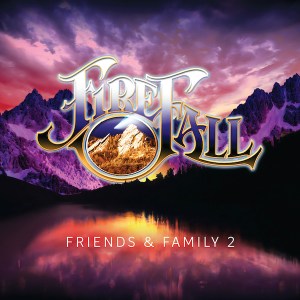
On May 23rd, 2025, the Colorado-based group Firefall will follow their beloved 2024 Friends and Family album with a second volume. As a classic band from the 1970s that has continued to tour, recording the music of their colleagues and close friends has been particularly rewarding for Firefall, and they have done so in a way that points out their historical and creative overlaps with bands like Fleetwood Mac, The Beach Boys, Kenny Loggins, and many more. Special guests on the second Friends and Family album even include Wynonna Judd, Buffalo Springfield co-founder Richie Furay, and former Elton John/Hall & Oates bassist Kenny Passarelli, all sharing their love of excellent songwriting from the late 60s through late 70s.
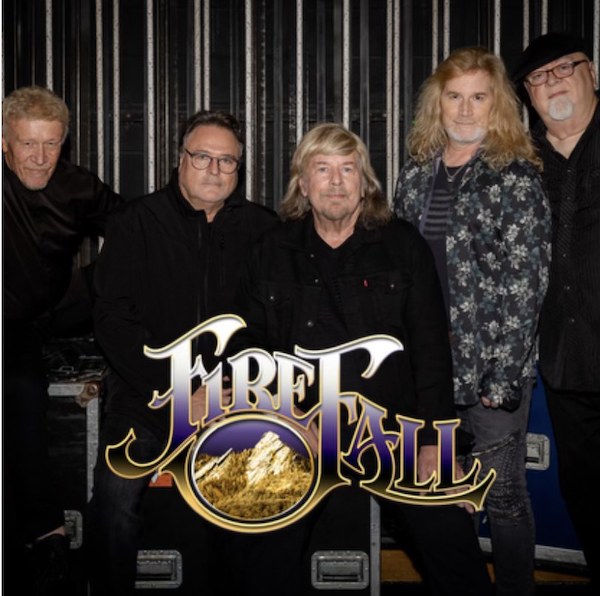
For Firefall founding member and guitarist Jock Bartley, the appeal has not only been to trace those touring and band member connections they have always celebrated, but to focus in on a rare breed of excellent songs written during that period. Bartley feels that bands of the era had a creative freedom in writing and recording that soon disappeared from the commercial music business, but accounts for the enduring power and appeal of many songs originally released during that heyday. I spoke with Jock Bartley about Firefall’s dive into a second collection focusing on Friends and Family, how they selected the tracks, and about great songwriting.
Americana Highways: How did you pick the songs for this second collection? Were they recorded at the same time as the first album, or later on?
Jock Bartley: We did them later. For the second one, we already had one song in the can, but in the process of picking the songs for the second record, and making sure that we had the right ones, it made us realize, “Oh, we don’t have a Beach Boys song.” And I wanted to do another Fleetwood Mac song and another Doobie Brothers song, but it was “What do we pick?” For instance, on the Fleetwood Mac song, one of our two lead vocalists, John Bisaha said, “I could sing the heck out of ‘Go Your Own Way.’”
In the picking of the songs, to me as the lead guitar player and the producer of these albums, I kind of thought that some songs were off limits and we wouldn’t want to do them. Like, someone had suggested for a Heart song that we do “Barracuda,” but I said, “No, that’s a hard song to do.” And frankly, I had thought “Go Your Own Way,” which is one of my favorite Fleetwood Mac songs, that was written by Lindsey Buckingham, was off-limits too. When John told me that he could really sing that one, I said, “Bingo! Here we go.” I wanted to make sure that it was as at least a 12-song album, so we went about picking and recording them. For me, that was so much fun.
AH: How did you approach the songs to make sure it was fun for you?
JB: We already had the versions that were from the original artists, so it was wondering, “Okay, do we keep this right down the pike, and don’t change anything?” For instance, on the Dan Fogelberg songs, we kept them just like Dan did them. Now, they sound different because they are by a different singer, other than Dan, and it’s me playing the guitars, and not Dan playing his parts. But those songs are right down the middle. Then there were songs where we changed things up a little, like featuring a second guitar lick as opposed to the primary on the original, which was great fun. I’m a painter, too, and these things are kind of similar. When you’re starting an album, and you’re in the studio, it’s kind of like having a blank canvas in front of you. You have an idea of what you want to paint, but you haven’t started yet. Recording some of these songs was such great fun for me, because we had the original to use as a copy or as a guideline.
AH: I remember from talking with you about the first collection that something that you would do would be to look at the people in the band, and in your extended circle of friends, and see, “What is their thing? What is it that they might want to do, that they would be good at?” And that kind of shaped the ideas that you brought to the song interpretations. I thought that was cool.
JB: Yes. That pretty much only extended to the people on the band. We had a fair amount of guest stars on both records, too, though. On our first single from Friends and Family 2, Stephen Stills’ song “Love the One You’re With,” I’d asked my friend from Boulder, drummer Cactus Mosher, who is married to Wynonna Judd, if he would play drums on it. He’s such a kick-ass drummer, and the original didn’t have drums on it. Cactus said, “Yes.” Then I realized that I know Wynonna a little bit, since she’d been involved in one of my suicide prevention benefits in Nashville.
So, I called Cactus back and said, “You know, would your lovely wife be interested in singing on ‘Love the One You’re With’?” He said, “I think her producer would really agree with that, so, yes! Of course, I’m her producer.” I said, “There you go!” We got Wynonna and Cactus to play on that song. We had some other guest appearances, but it was pretty in-house with Firefall on this second record, too. It was such a pleasure to treat these songs in special ways, and with respect to honor the original versions.
AH: This also comes down to the enthusiasm that you all feel for the music. It’s the music that sells it too, because these are such meaningful songs. They were so well-written and they are so full of rich ideas and sounds.
JB: I like that, because they are rich ideas. It’s not so much that the lyrics had deep meanings, but these songs by original artists, like Fleetwood Mac, Stephen Stills, or Crosby, Stills, and Nash, were just phenomenal. I got into the spirit on Friends and Family, and it continued into Friends and Family 2, not only of honoring and respecting those artists, but also the fact that the late 60s and into the 70s were pretty much a time that will never be duplicated. The decade from about 1968 to 1978 was just so fertile and there were so many bands. The difference between the 70s and the 80s was that in the 70s, if you had a band that had good songs, and a singer, record labels would sign you. And they would put your album out, and see how it went. If it started getting attention, or making sales, they’d push the heck out of your albums.
Whereas in the 80s, it suddenly kind of changed, and suddenly record labels, which are kind of obsolete now, started saying, “We don’t hear a single. We’d like you to do this song, or that song.” They wanted to get in the middle of the creative, picking process. A lot of times, record guys didn’t really know music, but they got in the middle of artists picking their material. I remember, in the 80s, making a Firefall record, and there was a guy from Atlantic in the room trying to figure out how to do it. I said, “Get the heck outta here!” [Laughs]
AH: Especially, by then, you’d had a fair amount of experience doing that!
JB: Yes, and that’s not to say that everybody back then knew how to make great records, and there were a lot of bad records made, too. But bands like Firefall, like Dan Fogelberg, like The Eagles, like Little River Band, we were all about the great songs. It was songs first, the singers that sang them second, and down at number three was the band, or the lead guitar player, or what the music sounded like. But all those bands that I just named made some great records. That’s one of the reasons that I say that the music of the 70s will never be duplicated.
AH: There are a number of things about that which I think have impacted our culture a lot. First of all, I’m glad those records were released in such high numbers back then because you can still find them. But related to how important the songs were, there seems to have been an attitude back then which is less common now, which is that people would perform each others’ songs if they liked them. Though that’s becoming more common in Americana music.
JB: Right! Americana music has really opened things up. I’m not someone to usually name genres, and say that one is more important than another, but Americana is such a great genre name, because it encompasses that great American music, whether it came from a bluesy base, a jazzy base, or folk rock. There are a lot of bands are putting new Americana music out that sounds fresh, and timeless, and I’m really just happy that Firefall played the small role that we did in the 1970s. Heck, I’ve been making a living off our songs, and the success we had, with gold and platinum records I’ve got on my wall, for the last 30 or 40 years.
AH: A lot of people credit the origin of Americana, as an idea, to the music of the early 70s. Though people may mention The Byrds, for instance, you guys easily fit into that.
JB: Oh yes, well that’s true. And Firefall has a direction connection to The Byrds. Michael Clarke was our drummer for many years, and he was the drummer of The Byrds and The Flying Burrito Brothers. I played with Chris Hillman for a while, so did other members. I had the great fortune to have fallen into Graham Parsons, Emmylou Harris, and The Fallen Angels as a guitar player, and toured with them for a month-and-a-half. That really set me along my path towards what would become Firefall and what would become Americana music. The songs were the main thing, and that was the great thing about the 70s, when record labels were kind of hands-off with the process, and would let the bands write and record songs.
AH: When you chose this group of songs, did you try to have differences in subject matter to spread things out, or was it more about diverse sounds?
JB: Not the subject matter, really. It could have been 12 love songs, for all I cared. What I really did try to do was diversity in music. I’d have a slow, acoustic song, and then a rocking song. One of our songs, in fact, our second single, is the Eddie Money song, “Shakin’.” Again, John came to me and said, “If we’re going to do an Eddie Money song, I want to do ‘Shakin’.” I said, “Bingo! Let’s go!” I’m really glad that Sunset Blvd. Records put that one out, because, frankly, I’ve been fighting the misconception that Firefall is just a soft rock band ever since the 70s. We’re really a rock ‘n roll band, and had some great ballads. But it’s back to that genre thing. I’m really glad that “Shakin’” features John’s vocal, and I got to play lead guitar on that. It’s a smokin’ thing.
AH: It may reassure you to know that I never thought that Firefall was a soft rock band. I have always thought of you, Jock, as a rock ‘n roll guitarist, not only with Firefall, but with other people.
JB: [Laughs] Well, thank you! I think fans, the buyers of record, and the listeners to the radio decided, that “You Are The Woman” in 1976, and in 1977, “Just Remember I Love You” were the really big hits off of our rock ‘n roll albums. Then a lot of people said, “Firefall? Oh, that soft rock stuff.”
AH: Are you all going to be out playing some shows related to this album?
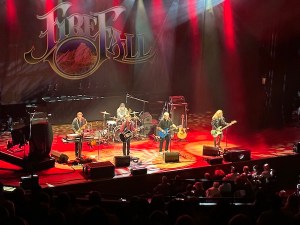
JB: We have been pushing the albums, and were working a lot harder a couple of years ago than we are this year for various reasons. Touring is fun, but the only part of that which is really fun and fulfilling are actually when you’re on the stage, playing. airports, hotels, and rent-a-cars are the drag about touring, but to play in front of an audience who spent their hard-earned money buying tickets to come and hear their favorite songs is amazing, and it’s amazing that it’s still happening for Firefall.
AH: And there’s a tremendous love for this music that you all have been working on. I imagine that gets a big reaction.
JB: When we’re headlining, and we’re playing a 90-minute set, or two one-hour sets, we’ll put one or two of these Friends and Family songs into our tour set, for sure. When we’re playing on a bill with three other bands, like with Pure Prairie League or Atlanta Rhythm Section, and it’s a 45-minute set, I know the songs that we have to play. Those are the hits from the 70s, since that’s what the people are there to hear. On a 45-minute set, there’s no time to play from our Friends and Family album, so it’s kind of a balancing act, but we always give people what they need to hear.
Thanks so much for chatting with us Jock Bartley! Check out Firefall tour dates and more here on their website: https://officialfirefall.com/