




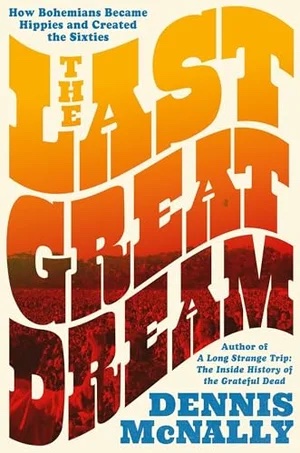
Dennis McNally The Last Great Dream
I’m usually fairly critical about books like this because each author paints with a broad brush. Some make it look more glamorous than it truly was. I’ve read dozens of detailed & comprehensive publications. But many of those are only good for the die-hard aficionado, the dedicated reader, curiously interested in what made that era have a finger-snapping appeal. It was filled with the kind of artists & characters that were exciting (or so we thought from a safe distance).
However, Dennis McNally’s pages have a stolid assemblage of decisive factors with an evaluation not in textbook style. It flows with an entertaining, informative charm in an easy-to-understand language. It doesn’t get bogged down in the jargon of the era to the point where you need a slang dictionary.
It’s a clear roadmap that prevents the subject from sounding dated, old-fashioned & not as cool as some of us remember it. I don’t feel this well-researched book, The Last Great Dream – By Dennis McNally (Releases May 13/Grand Central Publishing-Hachette Book Group) needs a review as much as simply an assessment & an appreciation. It’s a trip down a well-lit memory lane with all the lights flashing green. To some younger readers, it may be a strange trip & it was. It began post-war & not entirely in the 1950s.

Some people credited the word “beat” to resources such as author Jack Kerouac. But in reality, it was more than likely the hustler Herbert Hunke who was the originator of the term. Ironically, he had little to do with the Bohemians & Beat Generation honchos. Hunke was on its fringe — not a Beat Generation alumnus or player — nor was poet Charles Bukowski. They played a role.
The pages of “The Last Great Dream” are an accessible patchwork of informative, concise paragraphs. There are good historical references, & the narrative reads like literature with a pinch of pop culture lore. A book of discovery. It details the intricacies that lead to things other than the Beat Generation. Some chapters focus on the people who shaped Bohemian landscapes before the Beats. The writers, poets, artists, actors, comedians, prominent personalities & a few fringe individuals back as far as the ‘20s. The book touches on colorful characters & personalities like actor/director of The Living Theater Julian Beck (who also played the creepy Rev. Kane in Poltergeist II). Beck’s wife, actress/writer Judith Molina, Lenny Bruce, Ken Kesey, John Cage & Allen Ginsberg make for a consistent, compelling read. Some names are recognizable — others not so much.
The chapters are relatively brief, with topics intelligently explored. Reading remains interesting & swift. What’s described is how the Hippie-era wasn’t the result of a “big bang” in culture, or new generation but a slow development through many layers & processes that germinated into what became at the start, by chance, from the Algonquin Round Table (1919-1929), the Lost Generation (1920’s Hemingway & Fitzgerald), the Beat Generation (late 1940s-1950s Kerouac, Ginsberg, & Burroughs), & the big splash of the Rock n’ Roll years that led to the ‘60s flower power Hippie mentality that, later, became rooted in counter-culture ideas & philosophies.
How far off is a flower child from a Bohemian gypsy anyway? An Allen Ginsberg from Walt Whitman? An ‘on the road’ writer like Kerouac, from Woody Guthrie? An Elvis from Valentino? Or the Grateful Dead from the Bowery Boys & even Randy Newman from a Hoagy Carmichael. How far off?
When I saw the Clint Eastwood film “Kelly’s Heroes,” I doubted there was a character during WWII like Donald Sutherland’s tank commander, Sgt. Oddball. He resembled a hippie in WWII. But my dad, who fought during WWII, said yes, there were men like that: outcasts, wanderers, & free spirits.
There were many routes taken to get to the way things became. There’s an unmasking of puritanical practices & by Chapter 14, when Dennis sculpts New York City in the late ‘50s, the copy goes from educational & informative to cool, collected, & can’t put the book down. The real content of the character of an era develops.
I frequented many of the unique places in the Village (The White Horse, Chumley’s, the Figaro) & they reek of the ghosts of the ‘20s through the ‘60s. All those decades had exciting, creative & challenging times. Every page of Dennis’s book allows you to feel it. You don’t have to be an “insider” to understand Mr. McNally’s descriptive words. He makes it understandable. One just has to realize that most cultural formations didn’t happen overnight. Many events had to take place, albeit some cosmically. Beats into Hippies, Elvis into Beatles, Cary Grant into George Clooney (well, that morphing didn’t take shape as it should have).
The author condensed the more controversial tributaries of the era into tight chapters. Nothing “new” but the book offers clarity without being too long-winded. Despite some episodes being a rehash — for the more learned of the subject, the pages are smartly concentrated, fat trimmed, confusions clarified, with the information always enlightening. The era was collected & organized.
Too bad all the “peace & love,” goodwill, & harmony that era tried to embody were never truly or realistically realized. The generation miscalculated the future & didn’t predict or expect terrorism. You can’t make an omelet without cracking eggs. Even an inebriated Jack Kerouac knew this on The William Buckley Show in 1968.
Reading the book made me want to watch episodes of “Route 66” & “Then Came Bronson.” It made me return to a tough time, but a memorable one.
Color image courtesy of Dennis’ website. Book Available @ Barnes & Noble + Amazon + https://www.dennismcnally.com/books/the-last-great-dream-how-bohemians-became-hippies-and-created-the-sixties/ & https://www.hachettebookgroup.com/titles/dennis-mcnally/the-last-great-dream/9781668649701/
Enjoy our previous coverage here: Bentley’s Bandstand: March 2025