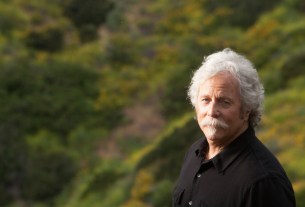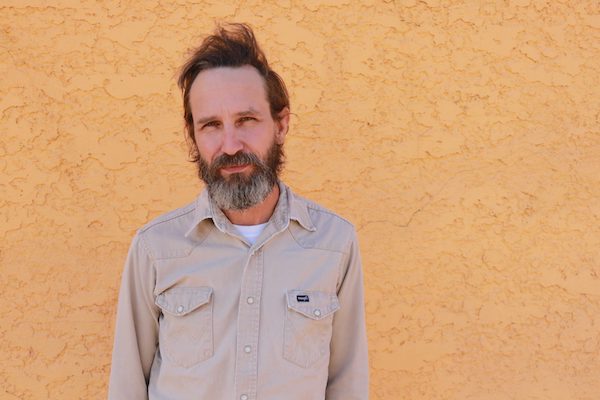
Will Johnson photo by Todd Wolfson
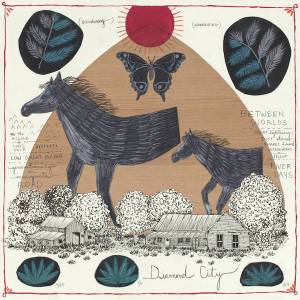
Will Johnson is kind of the hyphenate of all hyphenates. The singer-songwriter-multi-instrumentalist-novelist-painter (seriously – he creates beautiful art, often centered around baseball) is currently touring with Jason Isbell and the 400 Unit, but his multi-tendrilled career goes back decades, including bands Centro-matic and Monsters of Folk, as well as making a record with the late Jason Molina and a slew of his own solo albums. The latest of those, Diamond City, is a spare, haunting affair, recorded primarily in his Texas farmhouse on a TASCAM 424 Mach III. I spoke to Johnson as he was wrapping up chores around home the day before he left Texas to join the 400 Unit for a swing through Colorado.
Americana Highways: I noticed the 400 Unit is on a bit of a break. Where are you – are you back at home?
Will Johnson: I’m at home, yeah, but I fly out tomorrow for three weeks with the 400 Unit, so I’m kinda trying to knock out all the chores today. Sometimes I buy into the myth that I’m gonna have a mellow day before tour, but that never…it doesn’t work that way.
AH: Yeah, you think, “I have all day to get stuff done,” then all you do is get stuff done.
WJ: That’s exactly right. It ends up being the most high frequency, high octane kind of day that you hope to avoid for a few days at home, but nonetheless, I’m in it!
AH: So, listening to the new album, Diamond City, there are a lot of highways, a lot of ghosts along the way. Are the songs informed by flashbacks to your life on the road, moments on the road?
WJ: Sometimes, yeah. Sometimes particular drives, a certain drive that I just remember vividly, even a tour drive in recent memory that just sticks out. Sometimes, there’s melody, or there’s imagery, or even characters that I might interact with along the way that can inform the songs. And sometimes it’s instrumental pieces, sometimes it’ll break down to that. It’s sort of like snapshots in my mind, and every once in a while I kinda time travel a little bit back to solo tours or solo drives, and that can sometimes bring about inspiration.
AH: They were all recorded on a TASCAM four-track and filled out by Britton Beisenherz. Listening to them, they feel crafted without being fussed over. How happy are you with the finished product? Is that what you were looking for?
WJ: Definitely. I mean, really, when I started out, I was trying to make as serviceable and as clean home recordings as I could. I always try to make them at least presentable enough to potentially be released somewhere down the line, either as a seven-inch or extra tracks or an EP or something like that. With this particular batch, I was writing toward a record, there’s no question about it. I just didn’t totally know at the time that I was writing these songs, that this would end up being the record. So what Britton and I have is kind of a tradition – once I have a batch of four-tracks put together, I’ll go over to his studio, and we’ll bounce ‘em down to Pro Tools, in which case he oftentimes will kinda tidy ‘em up or clean ‘em up, bring out certain frequencies, maybe in the vocals, just little things like that, and turn ‘em back over to me. What happened with this particular batch is, over the course of a few months, he started adding electric bass, synthesizers here and there, certain keyboard parts, piano parts, even drums on a song or two, and kind of rounding them out and making them a little bit higher fidelity than just my standard four-track batches. I was out on the road pretty much constantly with the 400 Unit at that point, but every few days, I would just get this new mix with his new additions sent to my phone, and it was kinda like receiving these little gifts, these little Easter eggs over the course of the summer. And by the end of that summer, which was 2023, I remember listening through all the songs and all of his great additions and just thinking, “This is cohesive enough, and it speaks to me enough, to be the record. I think this is the record.” And in my heart of hearts, I’d been wanting to make a four-track record for a few years, kind of at the urging of my good buddy David Bazan from Pedro the Lion. So, it turned out that, after Britton made his additions, it kinda fell into our laps, where we had a record. It wasn’t particularly fussed over at all. We kinda took our time with it, and it came together in a really natural way.
AH: Is it a process you think you’d like to do again? I know part of it happened because of being out on the road so much, but it came out so well. Is it something you might do again in the future, do you think?
WJ: I would love to! Yeah, definitely. I don’t think that the next one will be that way, but I am quite certain that I’ll circle back to it at another point down the line again. I mean, for one thing, I can do it on my own time here at the house, and I’m not booking studio time. It’s affordable! (Laughs) I mean, nobody grabbed at me for the studio time or anything like that, which was pretty awesome. Not that they ever do, but this was literally the cost of Britton’s and my time and one 90-minute cassette, and that’s it.
AH: It sounds economical financially, but time-wise, too.
WJ: Yeah, for sure. I mean, I don’t know if I kill it in any other respect in life, but I kinda killed it on the overhead with this one. I’m pretty proud of that, at least.
AH: One thing I noticed with “Rabbit Run” – even despite this kind of recording process, it still sounds big. It’s kinda my favorite guitar work on the record. That sounded stadium/arena ready, almost. It was BIG.
WH: I was kinda going for that. I honestly tracked that through a little Fender Blues Junior. So it’s not like I was using big amps or anything. But sometimes, honestly, I tend to get the most mileage in the studio out of smaller amps, and just driving them extremely hard, as opposed to bringing big amps into the studio. That’s a lesson that my former bandmate from Centro-matic, Matt Pence, kinda taught me very very early on – you don’t need to bring big amps into the studio. You can use a Pro Junior or a little Sears Silvertone amp and just drive the thing, and honestly that combination with a decent microphone, even a 57, you can get massive guitar sounds out of this. That hit me pretty hard, so I’ve tried to kind of apply that ever since. I mean, we’re 30 years running now – small amps in the studio!
AH: Makes sense! Lyrically, the line I like on that, and it repeats a couple times – “What’s to say we ain’t both wrong?” It kinda seemed like a different take on when people say, “We agree to disagree,” but a little bit smarter take on that. Is that how it struck you?
WJ: Yeah, a little bit. It’s almost a call for a truce, you know, over something that may or may not be that crucial or that important. Sometimes we forget that it’s OK to disagree. And I indict myself there sometimes, and sometimes it’s OK to just turn and walk, and walk in peace, and be at peace with who you are and where you are. So that’s a little bit of that line. It hopefully holds love for the person that’s being addressed. But it’s OK to shrug your shoulders and also, you know, turn and walk.
AH: Of course, you worked with Jason Molina a lot. Maybe the greatest similarity I see between your work and the way that he worked – it seems like you’ll work with just about anybody if it’ll produce a good song. How much do you enjoy that?
WJ: Well, I’ve been lucky, because a lot of these folks have been my friends prior to working with them. Someone once called me a “serial collaborator,” and in some respects, that could be true. But one thing is that I have been friends with most of these folks before we’ve gotten into a studio or gotten on the road together. But I will add, kinda getting back to your question, one thing that is always really enlightening about that is that, yes, you are working toward a common goal, and when you’re doing that, you get glimpses into various artists’ and songwriters’ way of preparing, way of writing, way of scrutinizing, way of admitting that maybe an idea isn’t taking and backing out and trying again. And that, to me, has always taught me a little something new, just to get to have a glimpse into the way that they work. Even with Monsters of Folk, Jim [James] and Conor {Oberst] and M. [Ward] – we were all friends, but everybody had different ways of ramping up to shows, and it was fun writing together, because you get to see these glimpses into what passes and what doesn’t pass. I figure that the more I can be around that kind of energy, the more I learn and hopefully grow as an artist as well. And that was very much the case with Jason. Jason Molina would treat each day sort of like he’s going to work. He’s up at the crack of dawn out on the back porch of the studio with a cigarette in hand – “By God, this is my job now. I’m going to work over songs and melodies and narratives until lunch, and then we’ll record, and then I’m gonna do some more later” – he respected the fact that he got to make a living as a musician. He did not rest – he was restless. And I loved that about him, because I saw a lot of myself in that. So we did really well together. We kind of workshopped everything. I think we got 21 or 22 recordings in 10 days, and we left our pleasantries at the door. We weren’t afraid to tell each other when we thought a line wasn’t up to snuff. But I think that was all out of respect.
AH: So our readers at Americana Highways have probably come to you any number of ways, from Jason Molina to working with Jason Isbell now. From what I can see, this is a little different for you, jumping into an established band like the 400 Unit. How’s that been?
WJ: It’s been wonderful. It keeps me on my toes. Every now and again, we’re working over new material or digging for a deeper cut that we haven’t played very often, and it truly keeps me on my toes. I think being around such stellar musicians has subtly made me, hopefully made me a better musician. It’s definitely made me a better listener. It was a little daunting at first, to be honest. I mean, it was an honor, but it was a little daunting, finding my voice, but within this already pristine piece of musical framework, in my opinion. I mean, I’d been a fan and a friend for a long time. But finding my steps in there, but also knowing when and where to just stay out of the way, not step on anything that’s already been happening so well over the years. That was something to think about, but also understanding my role as an auxiliary musician – very different than being a front person, which I’d been for so many years. And I love it! I mean, I’m egoless about it, so I’m always open to, “Do you want an electric guitar here? Do you want acoustic here? Do you want just a shaker and a backing vocal?” I’m kinda down for whatever, really, and I enjoy getting to move around so much throughout the course of a two-hour show, because my mind doesn’t wander. I’m always thinking about new things to apply to the song, and how can I serve the song.
AH: So it sounds like working with the 400 Unit has been a positive, collaborative process.
WJ: Very much so, very much so. We keep the conversation very open. I made it known at the very beginning, I always want input, and if I’m doing something that’s rubbing someone wrong, or if I’m not serving the song as well as I possibly can on, say, acoustic vs. electric, or whatever, I’m always open for that discussion. I sincerely want the show to go as well as possible and to be able to serve the songs as well as possible.
AH: Is there anything you’re listening to right now, new music or artists that you like that are coming up?
WJ: Oh, my goodness – you kinda stumped me for a second! I’m kinda looking through my vinyl right now, it’s right here next to my desk. My daughter [Hazel] actually just completed an EP, so I’ve been listening to the master of her EP a ton, to be completely honest! I’ve been listening to Patterson Hood’s new record [Exploding Trees & Airplane Screams] a whole lot – he’s one of my best buds, and I’ve for sure been spinning that a ton over the past couple of months. My friend Chris Brokaw just put out a new record [Ghost Ship] the other day, so I’m listening to that a lot, as well. Oh, the Lily Seabird record [Trash Mountain] I think is really good.
AH: Yeah, yeah. That just hit me really fast, listening to it just once.
WJ: It’s a doozy. I’ve been spinning that a whole lot in the car.
AH: And I’ll keep an eye out for your daughter’s EP.
WJ: I think we’ll probably try to get this thing out during the summer – we’ll just kinda see how things go. We went into the studio for two days back in January, and she just went from instrument to instrument and knocked out a full EP, so I was really impressed with the way she took to it. She’s 14 years old, but she’s a natural in the studio
AH: What was your role – did you play a little, produce anything?
WJ: I played a little bit of acoustic and electric guitar, but for the greater part, I gave rides and bought snacks, and that’s about it!
AH: At that age, that’s probably the most appreciated!
WJ: Yeah, I think so! I think she had a good time with it. I’m super-proud of her.
AH: Anything else you’d like to say about Diamond City?
WJ: Oh, goodness, I don’t think so. I’m kinda thankful anyone’s listening at all. It seems like it’s kind of an unusual record. But, hopefully, in its way, it can show that you don’t always have to go into a big studio to make a record that hopefully resonates. Some of my favorite recordings of the last 50 years have not been made in formal studio settings. They’ve been made on tape recorders and four-tracks and they’re lower fidelity in certain approaches. But, for me, that makes them more compelling. I don’t know that that’s the case for my record, but hopefully it makes some humble case for the idea of making records at home.
AH: I know that one thing I get out of it is that it’s a multiple-listen record – you get a little deeper into it, you get a little more out of it with every listen. And I think part of that is due to the process. You pick little bits out each time you play it back.
WJ: I hope so. I never want a record to feel homogenized, or just sort of feel like it lives in one corner of the room. Sometimes I liken them to relief maps – I want there to be peaks and valleys and hopefully a lot of curious terrain in there to check out. I try to build them as I would want to listen to them. I’m kind old fashioned in the way that I try to build them from the beginning to the end, with the intention of presenting it or listening to it from beginning to end, because I think a record is still a journey, I know our attention spans have collectively gotten shorter, but I still believe in the journey.
Go here to order Diamond City (out now): https://undertowstore.com/collections/will-johnson
Check out Will Johnson and Jason Isbell and the 400 Unit show dates here:
https://will-johnson.com/tour-dates/
https://www.jasonisbell.com/shows