





Will Wood interview
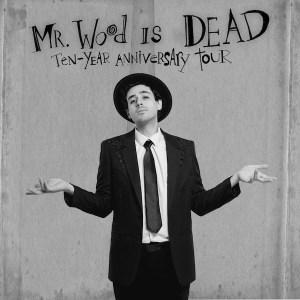
Will Wood is an eclectic popular indie folk(esque) artist who captures the hearts of his fans with his open authenticity and occasionally unbridled and experimental presentation style, while his songwriting invariably taps into an emotional legitimacy within his driving forms of expression. He’s about to embark on a tour with his full band, named “Will Wood is Dead,” commemorating his ten year anniversary. We had a chance to speak with Will Wood about his thoughts on creativity and human experience as the start of the tour draws closer.
Americana Highways: Based on the title of your upcoming tour “Will Wood is Dead,” will this mark a shift in your style of creative output and if so, where will you go from here?
Will Wood: The point is that I’m not sure. There’s some corny part of me that, as much as I don’t want to get all Marvel cinematic universe on you here, there’s a part of me that’s ready for “phase 2.” It’s not so much that I have a grand plan about exactly how I want to do things from here on out, it’s more so that I’m feeling kind of “done” with whatever the first ten years of my career is. And I don’t even really know what it is, to be honest. I have such a confusing relationship with it and a lot of mixed feelings about a lot of it. But if it means anything at all, it means, okay we’re done with “whatever that was.” And we’ll see what happens next. I don’t know what happens next. But also, at the same time I thought it was a fun, goofy thing to call the tour that I feel like plays along with some of the story that is the public perception of me, as far as I understand it, while also acknowledging that it’s just a story.
Maybe I’m overthinking it, because also the answer might be “it sounds funny.”
AH: Your most recent studio albums in case I make it and in case I die you stated that these were attempts to release albums that were more true to you. How does this play into your desire for an honest portrayal and your vision for “phase 2” of Will Wood?
WW: I think I said a lot of things during that period that in retrospect I kind of wish I hadn’t. I use the word “authenticity” a lot, and I kind of cringe when I think about that. Because it wasn’t about “authenticity,” it was about “directness,” it was about “transparency.” Because what is authentic? Sometimes the most authentic thing I can do is just scream and babble and headbutt a keyboard and that’s really what I’m feeling and that’s what really comes naturally to me. Sometimes it’s a matter of trusting my instincts an doing what comes naturally to me. Is it more authentic to let something flow and say “damn the torpedoes” in terms of how it’s perceived? Or is it more authentic to express myself as I perceive myself? By going on and on about how I wanted to create something that’s more true to how I really I am, I think I got in the way of my own music there. Because I’ve always been true to myself as an artist.
I feel like some of the stuff that might be taken as less honest because I said that, is actually more honest, although it’s not as plainspoken or direct, and it’s not coming from a desire to explain myself or be understood. Really what was going on there was I wanted to be understood, and I wanted to express myself as I understood myself. I was sick of being interpreted as this cartoon character. But I then found that you can’t go off what people say online. And you shouldn’t worry about what people say online but I ended up seeing what people were saying online and I was like “oh my goodness this is maddening” because there was still a cartoon character. It’s still not me. It’s still a story.
Maybe you can say maybe now I’m leaning into the story a little bit. I’m trying to find a way to be at peace with the fictional character that I portray whether I intend to or not, while also speaking something that feels true and meaningful. Ultimately the desire to be understood is never going to go away entirely, for me.
AH: As your creative outlets evolve, do you have specific writing process, and if so how has that evolved?
WW: I don’t have a specific process, but I do have a few different angles that I tend to approach things from, but the process varies. I often say “The only thing I know for sure about the process is that I don’t know what it is.” As I go along I learn more about what works for me, and about what gets the ball rolling, and the different ways I can guide the trajectory of the ball once it’s rolling, but if you ask me why the ball rolls, my answer is “gravity,” man. I don’t know how it works. Who knows? I just hope it keeps happening.
AH: Have any songs come to you out of the blue unexpectedly?
WW: Definitely. Some of the songs that are the favorite I’ve ever done came out very quickly and as a result of me saying “I’m just going to write something and I don’t care if it sucks.” Some of my worst songs have come out from me trying my hardest. Some of them do come out of nowhere. I sit down and I realize three hours later that I’m looking at something that is going to define a period of my life. Whereas other times it’s a very slow, intellectualized process too.
AH: This is the first tour where you’ve been able to take your whole band the Tapeworms with you. What will that look like for you logistically and how will it be different than a solo tour?
WW: Oh man it’s going to be totally different, it’s a completely different animal. I did some little weekend runs with the band back in 2018, but other than that we’ve never toured as a group. Even back almost ten years ago all of my touring was done by myself with a station wagon and a tool crate with some t-shirts in it. And I would self-book and drive from town to town to play, and see if I could sell enough t-shirts to get a hotel room that night. That was a part of my lifestyle that I was very committed to, and it wasn’t until around 2021 and 2022 when it became something else, where it was like “there’s a team now, I need a few people with me.” Every tour is different, but solo touring is not as big, of course. It’s myself and a couple of crew members in a van or maybe there’s an RV.
But with a band, I think the team is going to be ten people all together between the band and management, merch crew, audio; we’re going to take a f-ing bus! I never thought I would be taking a bus on tour. That is so ridiculous to me. I fought everyone on the concept of taking a bus because it feels ludicrous and ostentatious and over the top, it’s the thing that maybe Motley Crue did in the ’80s. What is anybody doing driving a bus around in this day and age? It’s so goddamn expensive and I go to other artists’ shows and I see the big “Prevost” bus out front and I think “you fool, I’m sure it’s comfortable but you could do this with 3 Sprinters and a U-Haul.” And now I’ve learned this is absolutely necessary, I see. And the logistics are a whole new thing. I’m going to have to sleep in a moving vehicle overnight which is not something I’m good at, and there are a lot of mouths to feed, a lot of accounting, and it’s all so new. You see a lot of artists doing this and you think “that’s what he does, he gets in that bus a few times and does this every year, that’s his job.” It seems static from the outside. But for me the past five years every tour has been a massive learning experience over the last, it’s totally different project every time.
AH: Last year you had your Slouching Towards Bethlehem tour, and this year you have this big tour as you’re describing. What are some things you’ve done to decompress in between?
WW: Probably not enough! (laughs) I went on vacation, I started exercising again, quit smoking again, and I’ve been writing music for a commission project I’m working on, which I’ll share more about soon.
That’s not really decompressing though, that’s work isn’t it? It’s a shame, all of my hobbies are also my job. I’ve been spending time with my girlfriend and trying to read a little bit more. I’m working on learning to have weekends. Sometimes it’ll be a Sunday and I’ll be thinking I have to do all this stuff, and my girlfriend will say “You said you’d take weekends off, it’s okay, it’s Sunday.” And I’m thinking “there is no office, there are no hours, I pick my hours, and so I pick all of them.” So there hasn’t been enough decompressing. I guess I’m a workaholic just taking on more jobs and more responsibilities.
As an example of not decompressing, I have seven stray cats in a room in my house right now. My girlfriend and I went down to North Carolina to rescue as many as we could of a colony of stray cats that were living in an abandoned construction site that was going to be bulldozed. But now we’ve got so many cats, and we’re trying so hard to find places for these cats to go. So that’s as close to decompressing as I’ve come – taking a big road trip to grab a dozen cats and try and find homes for them. It’s ridiculous.
AH: We’ve heard that the Slouching Toward Bethlehem tour is going to be edited into a digital release. Can you tell us a bit about that process and what it might look like?
WW: The plan is to put it together and get it distributed through streaming platforms. It’s sort of a concert film and sort of a stand up special. It’s our best effort at communicating the show that people experienced live through a digital format or through a video format. It’s an editing of various shows from that tour, done in such a way to help serve the story to the best of our ability. I don’t have a release date yet for that but we’re in production and hoping to have it out before the second run of the “Mr Wood Is Dead” tour which is when I’ll be doing my more quasi-standup think that I do. I guess it’s stand-up. I always feel weird calling it that because sometimes it’s very sad. But I want to get “Slouching Towards Branson” which is the name of the show, I want to get that out, because I want people to come to the show not expecting anything different from what I’ve always done. It will be great to be able to prove to people what I actually do.
AH: Just last month Blue Mayfield, now under the stage name Blue Woolf, announced that he will start the podcast “Camp Here And There” back up. You wrote the original soundtrack for the podcast, do you plan to work with Blue in any capacity for the forthcoming seasons?
WW: Probably not with my schedule right now. If I had to take on another scoring project right now I would die. We haven’t spoken about it, but I’m cool with it if they use the original.
AH: If someone had never heard your music before which three songs would you direct them to listen to first, and why?
WW: I’m so biased and I’m always so close to it, it’s hard. Sometimes as artists we don’t know what we’re good at. We don’t know what makes us good. Sometimes I feel that way anyway, although other times I feel like “you people don’t know what’s good,” so there’s always that kind of conflict going on internally. But it it’s to try to get people to start streaming my stuff more regularly, it’s probably going to be the more popular tracks. But if it’s self-serving in a personal, artistic way, I would probably choose “Cicada Days,” “White Noise,” and then probably end it with “Suburbia Overture,” which is the first track from my Normal album.
I guess it’s because those first two are ones I am personally attached to, and that third one goes a little wacky. I know that I’m probably best known for my wacky stuff, and not so much for my ukulele ballads, so I figure I’ll be a little self indulgent but I also get weird sometimes, so here, here’s me screaming.
AH: Wonderful! “White Noise” is definitely a very powerful commentary. What originally inspired the lyrics for that song? Did it come from personal experience?
WW: Thank you! It definitely comes from inside my brain. I remember years ago I was having a rough night. Not for any particular reason, something just felt off. There was this dull, aching, hollow sort of feeling in my head that I was familiar with. It was a feeling that I’d had before, and a feeling that I’ll have again, and I don’t always know where it comes from or why I’m feeling it when I’m feeling it. I was feeling that, and I thought “it’s strange how I’ve never tried to address this feeling in a song before.” So I sat down and I was new to the ukulele at the time, and I just started strumming what I could strum, and most of that song came out in the subsequent 45 minutes. That’s one of those songs that came out of nowhere, although what you end up hearing on the record is years later retooling and experimenting and including bits from other writing sessions. But ultimately the body of that song came to me pretty quickly.
It’s one of those songs where I hope that something about it can resonate universally, but the origin is very personal.
I don’t know if I can very easily explain what that song is about, but hopefully whenever it moves people it’s meaningful.
AH: You mentioned taking on the ukulele in recent years. But you started your career off with the keyboard. If you were to learn another instrument, what would it be?
WW: Probably guitar. I play a little. I can strum some open chords but I don’t really know what I’m doing. I’ve very much at “open mic night” level with the guitar. I would love to be able to really rock that thing, but if not that, then I get a real kick out of string instruments. Maybe violin. But practically speaking drums, because I could use that as a songwriter. But my first reaction is guitar.
AH: Guitar makes a lot of sense, because ukulele is already the top four strings of an open tuning guitar.
WW: You’d think that as much as I do, I’d get better at playing guitar, but I still have progressed maybe 5 percent since I was 16. I mean 6 strings? I’ve got four fingers to use, what are you doing giving me six strings?
AH: [laughs] Four is the perfect number for you then.
WW: Exactly! Ukulele is the right instrument. And frankly, the guitar is just an excessive ukulele.
AH: Love it! There’s a quote by Cesar Cruz that gets through around a lot, that “Art should comfort the disturbed and disturb the comfortable.” To what extent does this concept align with your songwriting?
WW: I remember years ago when I was a teenager I was going some local show with a band that I was playing in when I was a kid and I got really drunk before going on stage. The crowd was just a bunch of local teenagers, it was like 8 people plus the other bands that were playing that night. I was just obnoxious onstage, and I remember making obscene gestures to the audience that had kids in it, and I had thrown a microphone as well. And after the show one of the people who works there comes up to me when I’m sitting backstage, and I’m drunk, I’m smoking a cigarette, and he says “What the f_ck was that, Will?” I remember looking at him and saying “Art should comfort the disturbed and disturb the comfortable.”
And that’s how I feel about that quote at this point in my life. That sounds like something I would have said when I was drunk at 18 years old. There’s truth to it of course and it’s something that resonates with me to a certain extent, but it’s one of those things that sounds nice and therefore is assumed to be true. Like “it rhymes therefore it must be good,” or “there’s a turn of phrase therefore it must be true.” But I think it’s more complicated than that. Art can serve a lot of different purposes. And who do we decide is disturbed, and who do we decide is comfortable?
I think there’s an implication in that verbiage, at least when I hear it, that what we mean by the disturbed and the comfortable is a matter of social class or strata or assumptions about privilege, and I don’t think that’s actually the case.
I do think that comforting people who are disturbed is good. I think that disturbing people who are comfortable is unnecessary in order for it to be effective art. I think that making something that is comforting to people, regardless of where they’re at in life is what’s important. Because to a certain extent we are all disturbed.
And there are plenty of people who are comfortable. There’s some lady going for a walk in the part with a baby in a carriage – am I going to go up to her and kick her just because she’s comfortable because I’m disturbing the comfortable? No. Rebelliousness is good, social commentary and transgressiveness are all fun and I get a kick out of that but only because in a roundabout way I sometimes feel like the “disturbed” that that adage is speaking to.
But, ask me again in a few weeks when I’m in a different mood, though, and I may give you a totally different answer.
AH: Before we finish, are there any parting thoughts you’d like to convey?
WW: I have this instinct every time I do an interview where there’s this little voice inside my head that tries to convince me that this is the interview where I finally made my point. I have often felt like each interview is me trying to correct the mistakes from the last one, because an interview is a static presentation of a person from a distance at a specific moment in their life. Media is presented in such a way that suggests that what we are looking at is timeless, and not a fleeting moment that in reality truly did pass and no longer exists.
What I mean is that you can quote me but that thing that I said could have stopped being true moments after the interview. People change, life changes, perspectives change. So, you’ve got for example Wikipedia saying I do “x, y, z thing,” but that thing hasn’t been true since I was practically a child.
So I guess that’s what I’d like to say. “Nothing about me is true or real, as far as the person consuming the information is concerned.”
“Don’t believe anything. Disconnect from the internet. Go roll around in the dirt and eat grubs, it’s what we’re built for.”
Thanks very much for chatting with us, Will Wood! Tour dates and more info about Will Wood are available here on his website: https://www.willwood.net/
Will Wood summer 2025 tour dates:
May 16 New York (NYC), NY, US Gramercy Theatre
May 17 Brooklyn, NY, US Warsaw
Jun 13 Rochester, NY, US Anthology
Jun 14 Lakewood, OH, US The Roxy
Jun 16 Minneapolis, MN, US First Avenue
Jun 17 Chicago, IL, US Concord Music Hall
Jun 18 Lansing, MI, US Grewal Hall at 224
Jun 20 Millvale, PA, US Mr. Smalls Theatre
Jun 21 Allentown, PA, US Archer Music Hall
Jun 22 Boston, MA, US Royale Boston
Jul 13 Atlanta, GA, US The Masquerade – Heaven
Jul 15 Orlando, FL, US Plaza Live Orlando
Jul 17 New Orleans, LA, US House of Blues – New Orleans
Jul 18 Houston, TX, US House of Blues – Houston
Jul 19 Dallas, TX, US House of Blues – Dallas
Aug 20 Denver, CO, US Paramount Theatre
Aug 23 Portland, OR, US The Newmark Theatre
Aug 24 Seattle, WA, US Neptune Theatre