




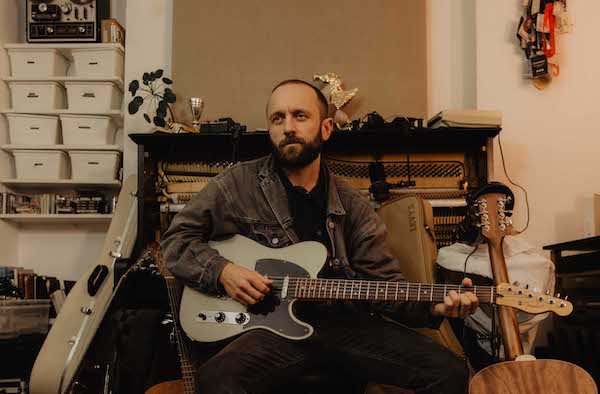
Ian Fisher photo by Talitha Lahme
Ian Fisher Delicately Explores Grief With Go Gentle
Ian Fisher is a singer/songwriter originally from Missouri who has spent a number of years living in Europe and Canada, and refining his craft through recording and performances. He recently completed a tour of Canada and the US behind his February-released new album, Go Gentle. In some ways, it’s useful to think of Go Gentle as a concept album on the subject of grief, while in other ways, it’s more truly a meditation on the experience of losing someone very close and moving through phases of that experience.
Fisher has previously been known for his soundscape-like approach to his music, but for this album, he chose a more spare focus on the core of energy in each song, but still avoided minimalism in favor of key moods that he wanted to evoke. Working with producer and instrumentalist Jonas David again, who had been part of Fisher’s 2022 album, Burnt Tongue, the two took on a very different brief: to bring across mood and emotion while trying to preserve an immediacy that rangers from a garage rock feeling to an intimate experience around an acoustic guitar. The texture of the album therefore became almost as important as the lyrics in delivering the human element behind Go Gentle.
I spoke with Ian Fisher about the weighty task of creating such a personal and, in some ways, taboo album surrounding the experience of loss, and we also had a surprise visit from Jonas David to complete the conversation.
Americana Highways: I see that you were recently in North America touring. Did you play from this new album?
Ian Fisher: Yes, and what we were doing is very close to the record, which is special. Musically, I think some of these songs are band-oriented, and a lot closer to what the songs should be, in my head.
AH: That makes me think of a couple of songs on this album that, to me, are really rocking.
IF: Oh, yes, there are some songs that do not work very well solo! Before that, playing in Europe, I had been performing in very small, intimate rooms. I played two shows in 2023, right after I finished writing the songs, right around the time that I started recording them. One was a very small room in Vienna, with about 100 or so people, and one was a studio in Berlin, with about a hundred or so people. It was completely acoustic, with no PA or anything. It was intense!
AH: Were these new songs mixed in with previous album material?
IF: I only played the new songs. With this tour, we played the entire new album, and only put in three or four others, so it’s a real concept!
AH: It really is. I was wondering, listening to the album, about this kind of thing. If someone knew nothing about this album, and listened to it, would you be okay with that? I think they’d probably figure it out.
IF: Maybe they would. After playing these shows, and seeing the response, both online and in person, a lot of people don’t necessarily affiliate this album with just my loss, and that’s great, because that’s not what I wanted. I didn’t want this album to be just about my mom, and my experience. I wanted to find this balance between my personal experience, and the details of my experience, and a slightly more universal and accessible thing. I think it’s a really important thing that we need to address and talk about, because we all experience loss. Do people need to know the backstory? I don’t think they do. I think the grief of it all comes through.
I’ve heard multiple people talk, after concerts, not about the death of a family member or friend, but just grieving in general, and the loss of a way of life, or the end of a relationship, or the death of a pet. Even though some of these songs point to a specific story, it’s a vehicle to transport a certain type of emotion about a certain theme. It doesn’t have to be drowned in specificity. I hope that people are able to enjoy it and have it trigger emotions, feelings, and thoughts in them.
AH: I think the mood of each song is very strong, which is different for each song.
IF: Oh, yes, because there are different phases in the process.
AH: I think people can recognize those moods as things that they’ve experienced.
IF: That’s all I’ve listened to in songs. The details don’t really matter in the end. It’s just about how it makes you feel.
AH: When we talk about grieving and mourning, we’re really talking about the story of our own lives as we go forward, as much as we are reflecting on the past. It really is our story that we’re telling. I think that comes across really strongly in the songs, because they are anchored in details that point to a place and time. They don’t feel abstract, which could otherwise be a little philosophical. I don’t think it’s a philosophical album in that way, but rather it’s about experience.
IF: Right. I could very easily have written a philosophical album in that it’s just me telling you about how I feel. But I don’t find that type of art interesting at all. What I want is for people to be able to feel, themselves, and to do that, you need to build them a room of a song for them to walk into. If I was just singing about how I feel, it would just be like reading someone’s diary, and you’d wonder, “Okay, cool, but why are you telling me?”
AH: How did you conceptualize what you were doing? It’s kind of a minefield to avoid slipping into a philosophical approach, or into a kind of preachy perspective. How did you stay away from those pitfalls?
IF: Firstly, I’m happy that you think I stayed away from those pitfalls! I’ve tried to stay very conscious of them. I really don’t want to be perceived as someone who is capitalizing off my mom’s death. That would be fucking crazy. I would be a psychopath if that’s what I was trying to do.
AH: Well, celebrity culture, particularly, on social media capitalizes on grief and loss all the time. It’s almost a commodification of trauma sometimes. It’s a theater of melodrama. Unfortunately, we see it around a lot.
IF: Oh, totally. Or just narcissism at its best. But anyway, I actually had no intention of writing an album about this. I didn’t want to. It’s not that I wanted to write those songs. I just felt like I had to. Some of these things were just so heavy on me, and songwriting is the way that I’ve always let these things out. I wrote them, then I showed them to a couple of friends to ask them, “Is this shit? Am I crazy? Should I do anything with these?” I remember talking to a friend who’s an English, Irish songwriter, named Ryan O’Reilly, and I showed him the songs. He said something along the lines of, “These are songs that you don’t just write for fun, but you write them because you have to write them, and these are songs that people have to hear.” So I said, “Well, okay, I guess I’ll make another album.”
I didn’t necessarily want to. I was at a place, especially after this pandemic, where I was just tired. I was tired of hitting my head against the wall, with the industry, and the whole process. It’s not enjoyable or fun to me, and it doesn’t make any sense, either, on a financial level. It’s a nightmare. I just felt like I had to do it. I felt like it would be almost disrespectful to my mom and the whole experience if I didn’t put these out there in the world. It would be like keeping it a secret otherwise, or like I was ashamed of it. I had to do it, but I’m glad that I did. I do think that it helped me, in the grieving process, to continually talk about this, and focus on this, and not be at liberty to forget about it, and repress it.
AH: I thought about that. That having to continually work on this album daily, and then play the songs live, must bring it up for you over and over.
IF: I don’t know what I would have done if I hadn’t had that. Probably just run away from it, just like I went to Europe when she first had cancer. I tend to run away from things. That’s what I do. But I can’t run away from this shit when I’m singing about it every night! I think that has been important for me.
AH: Very occasionally, people say to me that they can’t enter into the emotion of difficult songs when they play them. How do you handle that?
IF: There have occasionally been songs that were hard for me to re-enter in that way. But those were songs where I was singing about a person that I was in a relationship with, and wasn’t in a relationship anymore, and then a decade had passed. Those felt distant and foreign, but this experience of losing your mom, that’s never going to go away. I could sing these songs when I’m 90 years old, and it would still feel fresh.
AH: Do you do any talking on the stage about the album, or do you just play?
IF: Probably too much! I feel like these songs could be so heavy, and a lot of times the audience doesn’t know what they are getting into. They think the concert is going to be a certain way, then I turn up and play these songs that are really intense, and emotionally heavy. Sometimes I feel almost guilty for doing that to them. It could make some people feel awkward. Not only is that rare in a concert context, but it’s rare in our society, not just in the US, but throughout the Western world. It’s rare to actually talk about death, and to talk about loss, openly. Usually, it’s just this candy-coated fucking Disney movie that we all live in. It’s total avoidant meaninglessness. To pull out a topic like this for an hour and a half is a lot to ask from the audience.
So I try to talk a bit between songs, and I find that to be the most difficult part of these experiences. It helps to have the band, since we’re all friends, and we’re able to bounce things off each other, but there’s always a really delicate line between holding this really holy space, to respect the topic, to respect my mom, to respect whoever in the audience might be grieving, and opening this pandora’s box where people now have to think about it and feel. We have to be very respectful, but at the same time, I think it’s healthy to laugh a bit in between, because it’s not all darkness, death, and endings. Like you said, we’re still here, and it’s about us trying to live. It’s really delicate.
AH: Does this album have any significant sonic developments or differences than your previous album, Burnt Tongue?
IF: I didn’t feel the need to reinvent the wheel, sonically, for this album, but I did want it to be a little more intimate, and not have so much of the 1970s synths and keyboards making a giant sound-scape. I wanted it to be more guitar-based and more focused on the lyrics, creating a close feeling. I felt like, sonically, it would make a lot of sense to work with the same Producer again, Jonas David, because we had a really good time before, and we’re good friends.
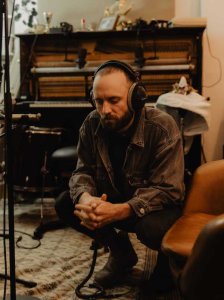
In late 2023, I came up here to Germany, and we started recording vocals and guitar. It was right before I lived in Toronto for a year, so I knew that I needed to record the skeleton to build the rest around. I came here for a week or two, and we recorded the core of it, then over the next year, Jonas did a lot of work building it. We’d get different musicians involved in Europe and the US to record different elements, then he kind of sewed it all together.
AH: It’s amazing that those original vocals and guitars remained as the core, without the other elements for you to respond to at the time. It really does fit together beautifully.
IF: We talked a lot about what the songs could become, so we’d approach the songs as if the vocals and the guitar were part of this bigger thing that didn’t exist yet. We just had the core, and let the rest coalesce around it. We had some ideas, but it was a lot of trial and error!
AH: Since you’re friends, Jonas must have been aware before you came up to see him what the album was about and what you might be going for.
IF: Oh, yes, and Jonas is right here, by the way!
Jonas David: Hi!
IF: Jonas, were you aware of this topic before I came up to see you?
JD: Yes!
AH: You weren’t afraid to handle such a heavy topic?
JD: Scared? No. But it was a very different approach. Because you can’t put flourishes on songs like this, or handle Production the way that you usually do it. You don’t take things out of a drawer, start messing around with things, and start decorating these songs. This was way more intense. There were different things in the spotlight, and you don’t want to color that too much, with tricks and taste.
AH: There’s the danger of being overly glossy in a way that takes away from things.
JD: Yes. It’s also a different process of Production, in general, because sometimes you try to have fun with things. But this was more of a different process of saying, “What is too much? What should be there? What is necessary?”
IF: It was delicate.
AH: There is a core of energy to each of these songs, and that must have been there from the beginning, where you set the tone. It must have been a process of matching things.
IF: Yes, and I think that Jonas did a great job of matching the production to the core feeling on each of the songs.
Thanks very much for chatting with us, Ian Fisher (and Jonas David)! You can find more details and up to date tour information here on his website: https://ianfishersongs.com/
Enjoy our previous coverage here: REVIEW: Ian Fisher “American Standards” Glides Past Grudges