



Robert Hilburn photo by Chris Morris
Robert Hilburn Delves Into His Randy Newman Bio A Few Words In Defense of Our Country
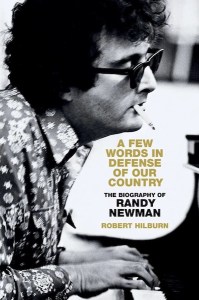
In Fall of 2024, author and former LA Times music critic and editor Robert Hilburn released his biography of the prominent LA-based singer/songwriter Randy Newman titled A Few Words in Defense of Our Country. A beloved and influential figure such as Newman inspired willing contributions to the book from the likes of Bob Dylan, Paul Simon, John Williams, Linda Ronstadt, Don Henley, Bonnie Raitt, and many more. While several of Newman’s early-career hit songs are still covered frequently or found on rotation, his choice to move into more socially conscious lyrics, usually subtly critiquing American life, did not endear him to commercial radio. Undeterred, he continued to produce work that now feels quite immediate and relevant, pulling back the curtain on America’s underlying racism and inequalities.
Hilburn, who has previously written biographies of Johnny Cash and Paul Simon, is particularly attracted to the subject of the songwriter who has a message to share with the world, but he has also long admired Newman, and has kept up a relationship with him for decades since first seeing him perform in the early 1970s in LA. I spoke with him about Randy Newman’s motivations and approach to songwriting in his early career, and how that developed into a highly observant body of work that remains all too relevant today.
Americana Highways: I know this is a big question, but what do you think your core purpose was in writing this book? What motivated you to do so much research and labor to get it out to the world?
Robert “Bob” Hilburn: My purpose was that I love songwriters. I was at the LA Times for 35 years, doing reviews, and I loved all kinds of bands, but the songwriters stuck with me the most. When I started writing biographies, I wanted to do Dylan first. I interviewed Bob a dozen times, but he’s not the kind of person who’s going to want to sit down with you a bunch of times to write a book. So that’s off the table. So, I did Johnny Cash as an interesting figure, because he’s not the greatest country songwriter, he’s not the greatest country singer, but he stood for something. He had a purpose to his music. So I kind of combined those two things: songwriting and purpose. I think it’s really interesting if a person has a point of view that’s socially beneficial in music. Cash had that, and people believed him. He could be at a prison, he could be at the White House, but people felt he was speaking to them. There was a kind of universal optimism and a sense that you can be redeemed.
Then, with Paul Simon, I thought, “If I had my list of great songwriters, I’d have Dylan, Simon, and Newman in there as one, two, and three, in no particular order.” Those are my first three. Simon was great because he goes from “Sound of Silence” to “Graceland,” and that’s an incredible journey. He’s always improving himself, and commenting on things, and open to stuff. After that, I thought that Randy Newman was perfect for these times. For all those years, from 1968 to today, all his albums were, in essence, about shortcomings in the American character, from sexism, to racism, to greed, to the failure of government to protect citizens, and all that stuff. That’s at the heart of what we’re debating today.
When I was just starting the book, and trying to define that position, I watched the storming of the Capitol, and I thought, “My God, millions of Americans are thinking, ‘How did our country ever get to this point?’” And I realized that all of these Newman songs were fifty years old that were leading up to this. So my goals were to present his uniqueness as a songwriter, but most of all, to present his relevance, his importance, and the message. One of my disappointments, somehow, is that a lot of critics or observers have liked the book, but they haven’t really picked up on that view. He’s the person who has commented, even more than Dylan, more constantly and purposefully on the problems of America. That’s not by writing protest songs, but by using the device of the unreliable narrator, like speaking from the perspective of a racist. You can see why radio avoided almost all of his songs for all these years. People know him as the “Short People” guy, or the “You’ve Got a Friend In Me” guy, but 99% of his songs were social consciousness songs that the radio wouldn’t play. They were too controversial.
AH: I think you’ll agree when I say this: They didn’t just want him to be simple in his songwriting, they wanted him to be simplistic, and he wasn’t going to do that.
RH: Well, yeah. Early on, he and Paul Simon both wanted to be songwriters, and when songwriters went to publishers, they’d tell them, “Copy what’s on the radio.” This was the Brill Building. One of the great revolutions in rock ‘n roll was not just youth and rebellion, but it broke the old Tin Pan Alley thing of songwriters writing, and singers singing. Dylan changed all that. Now it’s about: How do you think about things? Randy and Paul grew up with the old school thing of writing for the radio, and probably a love song is best. Then, both of them, gradually realized that this wasn’t what they wanted to do. They wanted to speak about what they cared about. But it took Randy four or five years to become Randy Newman. He didn’t just walk into the studio the first day and sing “Sail Away.”
AH: It seems like the inertia he faced as a young man would have been even harder because of his family and background. They were really well-respected Hollywood composers, right? Did they want him to do into the family business?
RH: Yes, that’s true. He was stereotyped, in a way. And mostly, he was intimidated by it. His grandfather, Alfred Newman was one of the greatest film scorers of the 1930s and 40s. He was a giant in Hollywood. And two other uncles were film composers. His father wanted to become a film composer, but Alfred thought it was all a fluke and said, “No, don’t become a film composer. Go and be a doctor.”
When Randy was eight years old, he was in a room with Alfred, who was writing a composition, and Alfred was complaining about how hard it was. He turned to Randy, who was eight years old, and said, “Do you think this is any good?” He was just looking for some affirmation. Before conducting, sometimes he would throw up. It made Randy wonder, “How can I be as good as these guys?” Randy was great on the piano, since his father, wanting him to be a composer, rolled a piano into his room when he was five years old, and said “Get started.” And Randy went on that path. He went to UCLA and studied film composing, because that’s what was expected of him. But his friend, Lenny Warnecker, who’s father was the head of a record company, knew how good he was, and said, “Why don’t you come over here and write Pop songs.”
Lenny’s father’s label had Julie London, Eddie Cochran, Willie Nelson. He said, “You ought to write like that.” One day, when Randy is about fifteen, he realizes that Lenny is right. He realizes, “If I go to Pop music, all the intimidation is gone. I don’t have to worry about living up to all that expectation.” But he told me that it wasn’t that Pop music was easier, it was that Lenny was there to back him up. Randy said, “He was my spine, he was my everything.” From his uncles, Randy got the drive to be good, but all this insecurity. So Randy was a driven person, but he had this gripping insecurity. It was part of an unbending perfectionism. It was like going into a room to write a song, and thinking you weren’t any good, but also insisting that the song be the best you could do. Songwriting was a torture for him for many years. Not until the last twenty years or so has he begun to realize about his work, “It wasn’t bad.”
AH: That is such a war to have going on in one’s brain. I’m used to songwriters talking about their insecurity, and that’s just a seemingly unavoidable thing, but when perfectionism comes in, it’s that TKO. How did he manage to get things to completion with that perfectionism? Did Lenny help with that?
RH: Well, every time he wrote a song, he’d call Lenny the next morning at seven or eight o’clock. In a mysterious way, you can have perfectionism, but underneath it all, you can have a faith that you can be good, so you keep at it. He wanted his peers to admire what he did.
AH: To get up and perform, you have to have some of that, or you wouldn’t be able to get yourself do it.
RH: He loves to perform. He hopes to perform again. He’s had a whole bunch of physical ailments, so he hasn’t been able to perform, but he loves the applause. You sit there and work in your studio for hours at a time, day after day, grinding away, and all of the sudden, you get that applause. It feels nice. He misses making an album these days, but he really misses that audience, too.
AH: Could you tell me about that first time that you saw him perform, in the 1970s? Was there anything particular about him that struck you? I know you’ve had a long relationship with him since then, but what were your first impressions?
RH: That was the first formal engagement that he ever did, at The Troubadour in early 1970. I was just beginning my tenure at the Los Angeles Times reviewing people. I think I saw him in January or February of that year. When he walked out, my first impression was, “Where’ the guitar? Where’s the band?” Even singer/songwriters had bands that they came out with, so that was unusual. And his voice was unusual. It wasn’t the James Taylor kind of voice. He sounded like Fats Domino. But then those songs came out! And the humor of it, the uniqueness of it!
As a critic, when you see a new artist, you think, “Hmm, who is this person trying to be?” In the 1960s and 1970s, for years, is was Bob Dylan, or Paul Simon, or Jimi Hendrix. But with Randy, it was unique. There was nobody where I could say, “He’s trying to be this person.” But I wondered how he was going to do, because the humor in his performance was probably the most commercial aspect. But the songwriters in LA just started adoring him, because The Troubadour was the spot where they all would hang out. Overnight, people were asking, “What’s Randy doing? When’s his album coming out?”
AH: So other musicians were really taking note at that point?
RH: After he released his first album following The Troubadour shows, he got a phone call from Paul McCartney, a letter from Brian Wilson, Don Henley. People around town are reacting to him. Lenny Warnecker, who was now at Warner Bros. Records, was being asked, “What’s he like?” There’s a great story where all the guys from The Eagles were in a room working on songs, and they said, “You think this is any good? Let’s go see what Randy’s doing.” They looked up to Randy as a great writer.
Linda Ronstadt talks about recording his early songs, since they were more pop-oriented. When he gets to his third album, Sail Away, that’s when he started doing social consciousness songs, and a lot of the radio stations stayed away from them. A lot of people recorded some of his early social consciousness songs, like “Sail Away,” but the social consciousness was so unorthodox that they didn’t quite realize it was a protest song. For a long time, those songs were just considered beautiful songs.
AH: It’s tempting to say that he was too subtle, but I don’t think that’s true. I think if we look back at his songs now, we can definitely see that social aspect more clearly. People just weren’t used to that kind of storytelling yet, perhaps.
RH: It was all new. People were asking, “What is this? Is it this? Or that? What’s going on?” He realized, after “Political Science,” when people were laughing in the club, that they didn’t get it. He also didn’t want to be stereotyped as only comedic, so he toned that down. He wanted people to get the serious emotions.
AH: It’s interesting that he had escaped into pop so as not to be pigeon-holed, and now he had to be careful not to be pigeon-holed, even within the singer/songwriter camp. He was a aware of the limitations that could arise.
RH: In many ways, he was walking a tight-rope a lot of the time. He didn’t want to become a rock ‘n roll act. He said, “I’m going to pretend as if The Rolling Stones never existed.” He admired The Beatles because they used orchestration and all of that stuff. He wanted to write these unusual songs, with orchestra and piano. Elton John did that, in a way, in the 1970s. But Randy loved Cole Porter, and Gershwin, and he wanted to be able to draw on all of that, not just on the contemporary consensus. That was all kind of a tight-rope act. He never became a big seller.
His biggest selling album was six or seven hundred thousand. At the same time, on the same label, James Taylor was selling four million, The Eagles were going to sell 20 million, and Fleetwood Mac would go on to sell 25 million. He was never a big, big seller because radio didn’t play him. And that was the decision that he made. He knew, “If I keep writing these songs, I’m never going to be a big star.” He could have gone back and written more songs like “You’ve got a Friend in Me” and “I Love L.A.,” and become a wealthy songwriter, but that’s not what he wanted to do.
Thank you very much, Robert Hilburn, for chatting with us. Find more information here on his website: http://www.roberthilburnonline.com/about-bob.html
Check out Randy Newman here: https://www.randynewman.com