


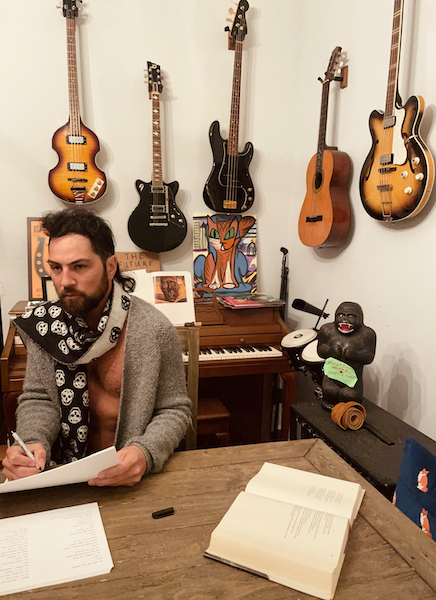
Jesse Daniel Edwards Sees Songs In a New Light For Clap Trap Venus
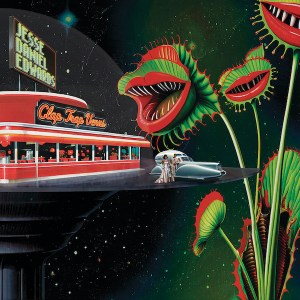
Jesse Daniel Edwards released the album Clap Trap Venus in October via Cavity Search Records, a collection which had some significant differences from previous album Violensia. It’s a more eclectic and experimental album, and steps slightly to one side of the operatic rock elements that were so imbued in Violensia, and a staple of his band’s live shows. Part of the reason for that was a major real-life shake-up when their drummer became seriously ill and life as usual, focused around live shows, became untenable.
But this dramatic change in Edwards’ life led to some useful and hopeful discoveries as he found different ways to approach songs that he wanted to take into a more intimate live setting, or songs that he’d previously cast aside because they were too sonically different to fit his previous trajectory. With a renewed sense of appreciation for songwriting and a determination to explore new territory, he put together Clap Trap Venus. Now, working on an album that spans whose songs span an earlier period and this current time of productivity, Edwards finds himself asking new questions, and finding new answers, about his music. I spoke with Jesse Daniel Edwards about this era of change, how he engaged in songwriting during uncertain times, and the discoveries he made with Clap Trap Venus.
Americana Highways: It’s high time to talk about your album, which arrived in October. Has a little distance given you a different perspective on it?
Jesse Daniel Edwards: I think, if anything, it’s kind of nice, since a little time has gone by, so I’ve been able to percolate about it. Sometimes the impressions that you get when you’re making an album, or when you’re thinking about an album, or when it’s done, but you’re waiting, you have different impressions at each stage. I might be getting special impressions due to the time that’s passed, that weird ingredient of time.
AH: That’s a big one. It’s one that people don’t often know about as much in the public sphere. I don’t know if you’ve performed these songs yet, but that’s another aspect of how time will affect songs.
JDE: Songs have such long lives, don’t they? I was reading about the Nick Cave that came out in the past couple years, and he was saying that the way that people often record, sometimes they don’t even know what the words mean yet. The words become non-literal, or they can. Sometimes it’s you talking to yourself about your own life. We don’t even know what it is until, sometimes, years go by. I think that for most people, who aren’t musicians, the closest comparison is that you might have a song that means a lot to you, more than it being popular, or than you liking it in the moment, but it’s something that goes so deep that it’s just with you for life.
“Do You Realize,” by The Flaming Lips, is an example for me. That’s a song that’s always going to be in my sphere of being. I don’t listen to it that often, but when I do, as a musician, I get different things out of it. There’s something that I’ll hear in there, like something that that the bassline will be doing, that for whatever reason, I hear. Because of that shifting landscape of relevancy in any aspect of art, it’s constantly changing for me. For that, I’m really grateful that I’ve put the time in to listen to it and appreciate music in that way, though on the flipside, that means I don’t get to just gloss over it and listen to it as casually.
As I’ve gotten older, I’ve tried to still make room to be open to new music and new musicians. There was a time in my life where I was surrounded by so many musicians that I was losing my reference point to music itself. Often they just wanted to talk about how much they hate music! Or about technology and how competitive it is. I needed to get away from that and just hear music again. I didn’t want to go that way.
AH: I’m really amazed when I hear a song that I’ve known for a long time and suddenly, a totally different emotion hits me than I’ve experienced with that song before. I’m thinking, “Wow! Where did that come from? Am I such a different person now?”
JDE: That’s so right. I was listening to only sad music for so long because I think it was stoking that aspect of what I was going through in my life. But music is like chocolate, or wine, if you’re into wine, that you need to creep further out and experience the range of emotions that music can teach you about. There are these subtle and inflected emotions, that are complex, and I think that when we clear time for that, or are just open-minded and grateful for the process, we are able to learn more about ourselves. I think that gives us emotional language that really helps us navigate the crazy, complex, emotional things that we encounter, or encounter in others. It has the power to bond people together through difficult times, whatever they may be.
AH: Did you have specific ideas about this group of songs and what you wanted to accomplish? I heard that this record, particularly, is one that you did on your own and kind of took the opportunity to flesh out songs that you rediscovered.
JDE: I kind of went into this knowing that I wasn’t going to necessarily have an idea of what I wanted to do, but trust the process that, in time, it might make sense. There’s a little bit of faith in that. With the internet, in this day and age, things are out there for a long time. Things can get used in so many ways in this digital domain. Songs can go so many places. I was looking at my Spotify the other day, and apparently there’s quite a few handfuls of listeners in Finland who support my work. I had no idea about that! It’s magical to me.
But at the same time, I want to make sure that what I’m putting out there is true, good, and the best that I can craft. These are nebulous targets. These things are kind of a snapshot, but at the same times, songs are kind of like our children, and we don’t know what they are going to be. The songs are going to go out there, and people are going to have opinions. It’s one of those things that people have opinions about: religion, politics, and music. [Laughs] It’s funny to me because it’s so subjective, but people get so fired up about it, attacking or defending music. In the background, I’m thinking, “This is just music! This is stuff I made in my bedroom on a laptop and uploaded to Spotify.”
At the same time, it can be very powerful. A lot of what I do is very anti-gun violence, anti-Fentanyl. The next record that I’ve got coming out takes on a lot of these things. I tackled school shootings after there was a major one in my town [of Nashville]. But the next album is actually one that I did before Clap Trap Venus. It was just one I wanted to wait until it grew a little, and I grew a little, to see what my range might be.
AH: It seems like events that happen in your life during these periods can also affect how you decide to record and present songs that you may have already written. This album, I read, was impacted by thoughts on mortality and change.
JDE: We saw my drummer struggle with suddenly suffering from rheumatoid arthritis. He’s doing okay now, but it’s been almost two years. It was up close and personal, because we’re so close, but he didn’t have health care, none of us do. We’re all broke musicians living the last dregs of the dream. Seeing that up-close was rough. We saw him have to quit his job, have to move back home with his folks, and it was really tragic. It was kind of the first wake up all for all of us, “Hey, you’re not kids anymore.” It’s one thing when you’re 19 or 20, and everyone can jump into the back of a van and sleep on peoples’ floors, but it can get pretty serious pretty quick when you get to a certain age and start thinking about your health.
This was our first brush with that. The fallout was that we all had to do other things, since it was our livelihood. We had to ask, “What are we going to do now?” It was a curve ball that required time to deal with. There were feelings to process that weren’t easy. All of us in our tribe were figuring out, “What do we do now?”
As a musician, it’s tenuous. For a brief moment, I was thinking, “Gosh, is this it? I’ve spent every moment practicing the guitar, and the piano, and crafting songs. Is this the end?” You’re on the stage, or you’re in the studio, and you feel that what you’re doing has beauty, and is necessary, and has value, and means something, and the next moment, it’s just dashed at your feet. You realize, “I don’t have a backup plan.” We learned, we adapted, and our drummer friend is doing okay. He’s gotten to the point where he can, more or less function normally, but in the two years intervening I had to decide what to do with the shows that had been booked, what to do with all this momentum that had been generated with our album Violensia, and all the post-pandemic push.
AH: How did you get to the point where you were able to work on new songs with so much else going on?
JDE: I had a bunch of songs that I forged as I was trying to transform some of these shows into solo shows, which was definitely a shifting of the gears that was not without its rocky moments. Then there were songs that we did as a duo, which I had written for that. Then there were some songs that hadn’t made it onto Violensia because of the tempo, or other things. That album had been recorded all in one weekend, so there were songs that had been cut. I had all these orphan songs. I was thinking, “I wonder if, instead of trying to have it [the album] be cohesive, I were to just embrace that they are going to be different? It’s going to be a roller-coaster ride for me, and for the listener.” For a bit, I was thinking about that, “Wow, that’s a bold move. I don’t know if it’s a smart move.”
I have been challenged by my mentor, Denny, at my label, who’s always been in my corner. He has said, “Explore art. Never worry about the industry. Just explore what comes to you in your head, and play and sing. That’s it! That’s all you have to do.” Gosh, that really set me free for what the record might be. In the moment, it becomes crystal clear in the studio what to do. When you open yourself up to being creative. I just try not to stand in my own way. I just play to the best of my ability, though oftentimes it gets pretty challenging. Some of the stuff on this record was pretty challenging, not that it’s so difficult, but I’d never played certain things that way, or sung in certain keys. At the outset it felt disjointed, but then it became clear.
AH: Do your views of songwriting change because of these experiences? Did that become more valuable to you after seeing what your drummer went through?
JDE: One hundred percent, though I don’t know that I’d even become aware of that until you said it. That’s exactly what happened. The direction of the band was so clear before that, where we were doing the operatic rock thing, like with Violensia. The sound worked, but when it went away so quickly, it made me take another look at songs that I considered throwaway songs. I didn’t even realize how meaningful they were to me until I needed them, like we’ve been talking about.
As songwriters, sometimes we form opinions about our songs even before we demo them. But I’ve learned to temper that now, knowing that songs have the potential to go a lot of different ways. I’m right in the middle of demoing now, and I’ve never done it this way before. I have 18 songs, and I’m demoing them on the acoustic guitar, on the nylon guitar, on the electric guitar, and on the piano. This is way more OCD than I am, but for whatever reason, I felt the need to hear them this way. I think it was this lesson I learned making this last record, seeing how different they can really be.
Thanks very much for chatting with us, Jesse. Find more details and information here on his website: https://www.jessedanieledwards.net/
Enjoy our previous review in our review column here: Grooves & Cuts August 2023