



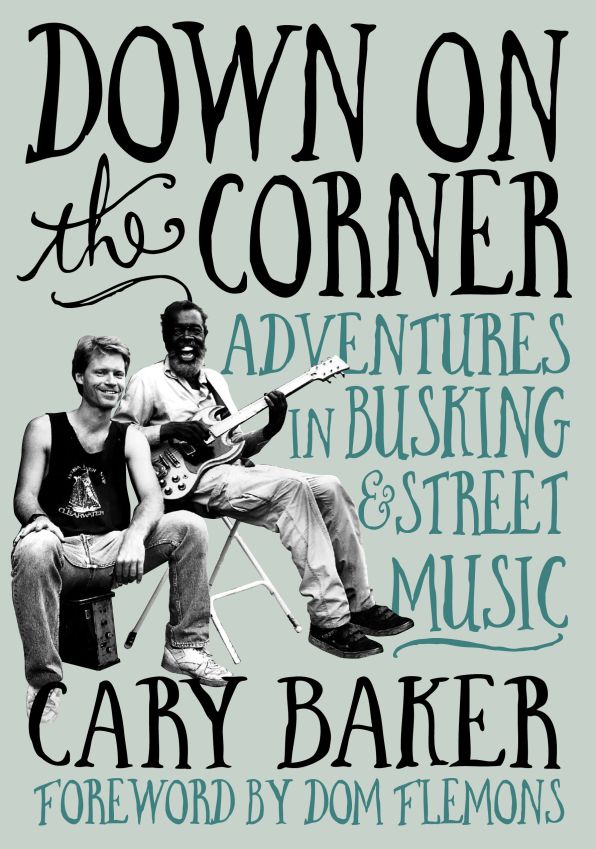
“Down On The Corner (Adventures In Busking & Street Music)”
In the digital age, the ancient art of street singing or busking might seem like an anomaly. But in his new book Down On The Corner – Adventures In Busking & Street Music (Jawbone Press) author Cary Baker makes the case for its continuing vitality–while taking readers through a historical journey and series of delightful vignettes with artists that have braved the elements and navigated city ordinances and public spaces as they have taken their music to the streets.
Weaving together a historical framework of busking, Baker has culled a collection of portraits with artists like Billy Bragg, Glen Hansard, Lucinda Williams, Elvis Costello, Tymon Dogg, Peter Case and others to discuss the subject of what Dom Flemons of Carolina Chocolate Drops characterizes in his foreword as “feeding the street.” As Old Medicine Show co-founder Ketch Secor says, “I just felt like it all began with trying to prove yourself on the curb, be the best performer that you could be, without any whistles or bells–just with a cardboard sign or open case and whatever you can bring. I just figured if you can do it there, you can do it anywhere.”
Baker breaks out the book into four geographic sections that trace busking on the East Coast, through the South and Midwest, California and Europe. Readers will revel in the anecdotes, stories of struggle and artistic affirmation, all set against the imagined sound of a tin cup and an open guitar case that accompanies many of the tales told.
To give you a taste of what’s to come In Down On the Corner, Baker captures the story of Ramblin’ Jack Elliott and Woody Guthrie traveling across the country to California on $11 they earned from busking in New York’s Washington Square Park. Baker doesn’t interject himself into the narrative much but steps in to remind readers that nowadays, this wouldn’t even buy two cups of coffee.
Before we get to the artists themselves, the author traces busking back to ancient Rome, through the Middle Ages and here in the United States to the 18th century noting that even Ben Franklin disclosed he was a street performer. Baker cites the Merriam-Webster definition of a busker as “a person who entertains in a public place for donations.” Throughout the book he deals with locales and evolving laws that try and contain street performances in public places.
The author also shares his own personal history. Baker’s pedigree of writing about music and later promoting artists through record labels and his media relations firm Conqueroo, served the transitioning rock and burgeoning Americana genre well throughout the years. Down on the Corner reaches back in time to when Baker was young and his father took him to shop on Maxwell Street in Chicago. The presence of music struck a chord in Baker who became a passionate fan and advocate. The nearly all Black musicians turned to Maxwell Street as a place to earn rent money after the blues taverns closed at 4am. Baker surprised his father when he told him he wanted to come every Sunday thereafter. As one musician later said, “I play Maxwell because I know I’m going to make some money. If you have people in a club paying a tab, you never know.”
As Baker got older and lived near Northwestern University, the sixteen year-old pitched his first story to an alternative weekly newspaper about the singer Blind Arvella Gray. revealing, “I titled the article ‘Blues Over a Tin Cup’, even though his cup for spare change was actually a paper Dixie cup safety-pinned to the lapel of his jacket.” Baker’s advocacy led him to pitch what would become the singer’s only album recorded through the night with him present as the sun rose the next morning. While Gray received attention over the years, Baker observed: “Unfortunately, most singers in Maxwell Street never received anything close to that degree of attention. Most played for spare change year- around, including during Chicago’s legendarily cold winters. When one would cease to find them at their self-assigned spot on the Maxwell grid for weeks on end, it was safe to assume they’d become ill or passed away.”
The exemplary research and scholarly approach to documenting busking as an art form underpins the book. But it’s the vignettes told through the own artists’ eyes that bring busking to life. For Peter Case, the experience of playing on the streets of San Francisco provided a lifetime education for the high-school dropout who will one day be able to tell his grandchildren about the time that poet Allen Ginsberg “sat in” with him
In Tim Easton’s segment, we experience the sense of what it’s like to be a street musician and how it shaped him as an artist. “You get used to singing right through the distractions out there when the world is in your face.” When Billy Bragg plays sets with short changeovers at festivals in front of thousands, he still relies on the lessons of years of busking to connect with the audience and his ability to read the mood of the crowd.
What might you ask, do the Violent Femmes have to do with busking? Baker tells the tale of how the Milwaukee band was literally discovered playing on the street in front of a venue. When Pretenders guitarist James Honeyman Scott walked outside and was followed by Chrissie Hynde, the band was invited to open for the Pretenders and went from the street to the stage and then back again to the street after their set.
A similar fate befell the Old Crow Medicine Show which was discovered by Doc Watson at MerleFest. Co-founder Ketch Secor regales how he busked on the streets of the Northeast in January and lived through frigid winters to tell about it. Secor learned that while tipping with dollar bills is certainly appreciated, he learned that people liked to hear the noise of their change hitting a plank when they tip. Like his busker brethren, he leaves us with an admonition that music belongs in public spaces.
Perhaps the digital world we inhabit makes the stories of Down on the Corner that much more heartfelt. As Baker notes, “Nowadays, promoting a song to Spotify playlist compilers is a more efficient way to achieve success without leaving one’s bedroom. But this is a book about those who have braved the elements, stood within spitting distance of their audience, put their own lives in danger, risked ridicule and theft, endured days of fewer and fewer dollar bills—and bet on their talent.”
As I read the book, I thought about the bluesman Furry Lewis playing on Beale Street and his encounter with Joni Mitchell documented in “Furry Sings The Blues” playing through my mind. I also thought about the night Sturgill Simpson played on the street outside the Country Music Awards in a quiet protest a few years back.
The book made me think about my own exposure to street musicians. Spending several decades in and around New York, the sounds of a makeshift rhythm ensemble of young men playing furiously atop of oversized paint cans as street drums, comes back over me. There was that thirtieth surprise birthday when I wandered into a Chelsea restaurant and street musicians Adam, and Satan (who grace the cover of Down On The Corner) were playing and I spotted Joe Jackson in the audience. There was also the tale of the man called the Opera Singer who performed outside the old Gulf & Western building in New York and relocated to San Francisco to be discovered by the same coffee shop customer who recognized the sound of his voice. But the one memory that stands out the most is walking into the sweaty urine soaked, smelly 7 train terminal in New York’s Grand Central Station, and hearing a guitarist playing an out of tune “Terrapin Station” by the Grateful Dead (not that the Grateful Dead ever played out of tune mind you.)
When I approached him in my enthusiastic recognition of said piece, I asked him how he was doing. He said he did all right but he looked away when he said he was only making $75 a day and was thinking about moving to another subway station. “I just don’t feel I’m getting paid for what I’m worth,” he said before striking up his next song.
(For more about Down On The Corner: http://jawbonepress.com/down-on-the-corner/)