




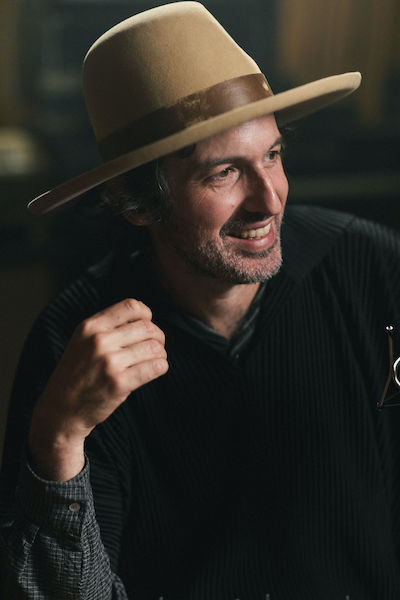
Joachim Cooder photo by Abby Ross
Joachim Cooder Dreamer’s Motel Has a Story In Every Room

Joachim Cooder will be releasing an album of original songs titled Dreamer’s Motel on November 1st, 2024, and embarking on a UK tour. It follows his album, Over That Road I’m Bound, a reimagining of songs by Uncle Dave Macon, which arrived in 2020. His work with Macon’s music brought him fully into experimenting with the Mbira as an instrument, building on its melodious and percussive possibilities. Now, with Dreamer’s Motel, Cooder takes this new era of composition into even more distinctive directions.
Many of the songs on Dreamer’s Motel hail from elements that came to light during the creation of the Macon album, leaving behind hints of future compositions, and some take inspiration from elements that have been in mind for quite some time, only now finding their proper place. Each of the songs tell stories in their own unique way, building on places and imagery that suggests the domain of memory, semi-solid, but enduring in their own time and space. I spoke with Joachim Cooder about building the songs that make up the varied rooms in his Dreamer’s Motel.
Americana Highways: What will the setup be like for your UK tour coming up? What sort of venues do you prefer?
Joachim Cooder: I like the smaller rooms where people are seated, so it’s performing arts centers and little hubs. We did a tour of Ireland, and the smaller the venues, the better. Everyone is right up near the musicians, and everything just goes better when you’re right in there, and you aren’t removed from the audience.
AH: Is it good to have a lack of distinction between the audience and the performers?
JC: Yes, and my show is just a duo, so it has a more intimate feel to it. When I feel far away or up high, it loses something.
AH: For this collection, it’s been a bit longer since you released original songs. I say that, but that’s not quite true, because the Uncle Dave Macon album is really your work reinterpreting his work. Does it feel like a while, though, since you’ve put together original pieces?
JC: It feels like a while, in general. I know I’m not alone in this, but because of the pandemic, and being a dad of small children, time has become so abstract that I realize, “Oh wow! Over that Road was in 2020, and I probably finished it a year before it came out. And I think it was 2018 or something when I put out my first record of my own stuff.” So it does feel like a while. I’ve been working on the Dreamer’s Motel record for a long time, too. So it’s nice to finally have it listened to!
AH: I feel like everyone gets a three-year pass on getting confused about what year it is. Are you someone who holds onto bits and pieces of songs that you’re working on, and works with them over time?
JC: A couple of the songs started during the Uncle Dave period, and when I would make some Uncle Dave songs my own, to a certain point where I took them so far past what he was doing, it would sort of then need to be peeled off that project and set aside. [Laughs] It was too radical of a transformation. I also take bits and pieces from songs. It’s kind of like how some people have a secondary car just for parts.
If they have an old car, they have two of them, and they strip the secondary one for parts to keep the main one going. That’s kind of what I do with songs. I say, “You know what? This chorus is good, the verse isn’t.” So I’ll take the chorus off and have it be the verse of the other song. Some of that stuff had been floating around for a few years, and certain things fell by the wayside, and certain things stayed.
AH: That’s an interesting process of trying to match things that might have a similar vibe as well.
JC: It could even just be a line. I take the best line of a song and make it another song, and the original song just disintegrates.
AH: I can see how that contributes to a feeling of interrelationship between these songs. They all come from the same swapping around environment. I think there’s a feeling of specific memories and places that runs through them. Though the sound is quite varied.
JC: Nice, thank you! It’s always interesting to hear what people respond to. You’ve had a chance to hear them all together, and to hear you think that you have a through-line means that it actually comes across the way that one hopes that it will.
AH: The sequencing is also really fun, too. To me, it does feel like an arc, because the song “Dreamer’s Motel” does feel like an introduction, a crossing into that world. That’s almost cinematic, right? Like everything takes place in that space.
JC: Yeah! Like maybe the other songs are rooms within that motel that you can walk through. You can say, “What’s in this door?”
AH: The song “Down to the Blood” is a very different song. I saw something that you posted on Instagram that was pretty freaky! [Laughs]
JC: It’s a freaky thing! You mean the dolls? These dolls are my wife’s family’s dolls that are all from the 50s onwards. There are many generations of dolls. As a new child or grandchild is born, they kind of take them, and the dolls get more and more mangled looking, and more clumps of hair are missing. They have sort of this scary look in their eyes. There’s many of them! And there are new ones and old ones. We moved during the pandemic, and at one point I looked into our little guest bedroom, and they all were there, on the shelf.
I didn’t remember getting them! We would have had to have gone to my wife’s parents’ house and collected all the dolls, which was kind of far away. I said to my wife, “Babe, when did you bring all those dolls here?” She said, “I didn’t.” And I didn’t! Then I thought, “Best to not rock the boat, because they are here now! Best to not upset them!” Then I started watching them watch us. I thought, “Oh, they are watching us. What do we seem like through their eyes?” It became this strange blues song of us through their eyes. [Laughs]
AH: It does feel like a blues song, absolutely. I love this crazy story. It seems like current generations really understand that dolls are creepy, and they want them in their lives, but they know that they are creepy. Yours are worse, though!
JC: These definitely won’t be thrown away because at this point, there’s too much mojo in them, or something. Now especially, since I’ve immortalized them in “Down to the Blood.”
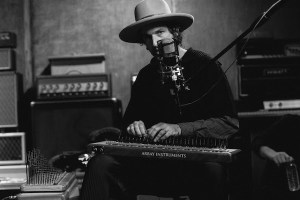
AH: When you think you’ve got a song that’s fitting together, do you build the songs around a certain instrument first? I know that the Mbira has been a big part of your past two albums. Is that a big part of how you wrote these songs?
JC: Definitely. Each song on this record came about in a little bit of a different way. “Dreamer’s Motel” started with that guitar loop in the beginning. I was on tour with my dad and Roseanne Cash, and we were doing all Johnny Cash songs. There was this moment when I had my iPad with me, and my dad was playing before a show in Chicago. He always gets to places early and just starts playing. It was in a big hall, and I placed my iPad down and pressed “record,” and walked away. Back at the hotel, I found this little, pretty thing. It had such ambience around it because it was in this big concert hall. So I just looped it, and let it play for a long time, and just sort of sat there with it. I just started singing “Dreamer’s Motel” over it.
Other ones, like “Sea Level Man,” really started with the Mbira, playing those chords. Each song starts with something that puts me in a headspace where I can go and be receiving of ideas.
AH: Is that usually a strong enough element to be the backbone of a song, or could it just be a tiny element?
JC: I think sometimes it will either be a backbone element, or it could be that by the time the song is done, the initial element might be reduced to just an outro. With “Let Me See My Brother Walk,” that was something where I had another song, and then I asked Raina and Kieran Kane, who were playing fiddle and banjo, to overdub that other song. Then I just took the entire song away, and just kept their overdubs, then rebuilt a new song over that. That’s an example of what you were just saying, in the extreme!
AH: Were they surprised by the switcheroo?
JC: They didn’t even realize that it was them! Because I had taken them out of context, and I’d slowed Raina’s fiddle way down.
AH: I was wondering what form these songs are in when other people hear them in order to collaborate. You do have some duet vocals in places and backing vocals. It sounds like you’re not too concerned to put it in a final form before that point. It sounds like the pieces are mobile.
JC: Yes. By the time my wife, Juliette, sings harmony on it, it’s pretty done, though. There’s finally a shape. But since we have small kids, I’m never there! I record, then come back, then Juliette goes back to sing, and I come back. I’m not there for it, so it’s nice to come in and hear it. It’s fun to be surprised.
AH: It sounds like you were doing remote collaboration before everyone else was!
JC: Yeah! It’s fun that way, though. I don’t always need to give opinions. Too many cooks!
AH: Let me ask you about “Sea Level Man” for a minute. I think a lot of these songs have a pretty upbeat feel, but “Sea Level Man” is very much like that. It’s quite positive and suggests contentment. It’s brave in that way because it suggests that contentment is actually possible.
JC: You’re right! There’s nothing wrong with that.
AH: It feels a little tropical and surfy to me.
JC: That’s the first time I’ve ever consciously said, “I’m going to do this one beat.” I remember when I first got CDs in fourth or fifth grade, there were only like four CDs that everybody had. One of them was Faith, by George Michael. Like so many people, probably I was obsessed with that record and the song “Faith”. I said, “One day, I want to rip off that beat.” Which he probably ripped off from Bo Diddley. It’s the most toe-tapping beat ever.
I was working with somebody else at the time, and said, “Will you do this song like ‘Faith’?”, and he said, “No.” So I kept this beat I had made, and when “Sea Level Man” came around, at first, I did it really slowly, and it was like a dirge. I asked, “Why is something where the lyrics are hinting at something so upbeat so slow and strange, and melancholy?” I thought, “I will resurrect this beat that I’ve had in the back of my mind for 30 years!” That was a very conscious decision to have it go that way, which I don’t usually do.
AH: That must be pretty satisfying, finally finding a home for it! It’s like when you move around and carry the same items in a box but never find a use for them until, finally, one day….
JC: Right! Exactly. Which is what we do. There’s a suitcase of CDs that we have, but can’t listen to, because we don’t even have a CD player. But we can never throw these CDs away, because they are from our teen years. We lug this big, busted suitcase around from house to house. It’s the same thing!
AH: I kind of associate “Sea Level Man” with “Sight and the Sound.” Was the phrase “Do you have sight and the sound?” the most important building block of the song?
JC: I always love this thing that the great songwriter, and all-around man, Nick Lowe once said about his songwriting. He said that when he writes a song that truly comes from somewhere else, and he’s just a conduit of it, he refers to it as “The Bloke” which has visited him. Any other time, it’s just him trying to imitate “The Bloke,” and it’s not real. And he knows that. But when “The Bloke” comes, it’s real.
That’s how “Sight and the Sound” came. It felt pre-written, like I just kind of happened upon it. I didn’t labor on it. Not that there’s anything wrong with laboring, because I know there’s a bunch of songwriters who go to work every day, and they write, and I think that’s incredible, but this one just sort of appeared. Then, I looked into it, and figured out where the story could go, but when it first arrived, it was just right there.
Thanks very much for chatting with us Joachim Cooder! Find more details and information here on his website: https://www.joachimcooder.com/
Enjoy our previous coverage here: Show Review: Joachim Cooder Plays Uncanny Set at Birchmere