



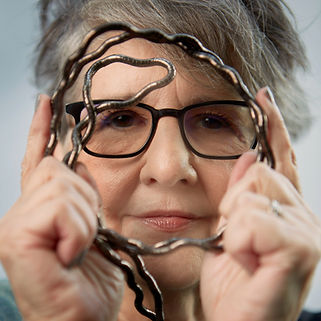
Binnie Klein photo by Mistina Hanscom
Binnie Klein on Building Community for In These Trees/Tartie Collaboration The Quiver
It’s becoming more and more common for creative projects to come together via remote collaboration, furthered by the growth of home studios and the innovation that many artists devised during pandemic lockdowns. However, the story behind the collaboration of a new songwriter, Binnie Klein, aka In These Trees, and vocalist and songwriter Tartie, is particularly surprising and fortuitous.
Klein, who has been a radio DJ and host, as well as a psychotherapist, for many years has introduced many smaller and indie bands to the world via championing them on her radio show on WPKN.org. After striking up a correspondence with Australian artist Tartie about her music, Klein took a creative plunge and sent her some lyrics for feedback. The long-term result of their long-distance, multi-year collaboration is the ten-song album, Quiver, which arrived this summer.
Add to that the fact that the album was produced by David Baron (Lenny Kravitz, Noah Kahan, The Lumineers), and features guitarists Jeff Pevar (David Crosby, Graham Nash), John Andrews (Nena, Kim Wilde) and drummer Jerry Marotta, and there’s no doubt that the album is an unusually stellar debut.
Extending collaboration still further, Native American artist Jennifer Kreisberg of Ulali contributed to several songs, making this a true communal effort. The songs on the album explore myriad themes, but many of them strike at the heart of intense relationships and life-changes that we encounter, drilling down into emotional states and offering catharsis. I spoke with Binnie Klein about the development of Quiver and working with her many collaborators.
Americana Highways: Did this period of work involve a lot of pre-writing and preparation once you knew that you wanted to do some more songs?
Binnie Klein: There’s a space that’s the preconscious where there are things kind of starting to rumble along. When we were kids, we’d sharpen our pencils, get our notebooks lined up, and say that we were going to do our homework. As adults, now, and post-pandemic, there’s a lot more time spent building up to creative activity, but it’s just as important as the actual expression. It’s like things being on a simmer on the stove.
AH: I talk a lot with people about creating the space and time for creative activity to happen, because we can become so distracted that there’s never any stillness. That pre-creative state is a receptive one, I think, and it’s something that we often have to be intentional about these days.
BK: That’s dead-on. We’re in a culture that’s about doing, doing, doing, so keep doing it, but don’t settle down and be quiet. And God forbid you should rest. In my clinical work, I’ve had a number of aspiring professionals who would say, “I don’t know how to relax.” One of my favorite things is looking at a magazine I like. I’m really good at doing very little! [Laughs] That’s my achievement!
HMS: That’s a great achievement. Since this is your first album, does it feel unusual to be talking with other people about it and sharing it with the world? I’m keeping in mind that you’re a music radio host!
BK: Part of why our wonderful producer, David Baron, suggested doing an album was that there’s actually more chance of getting reviews and attention than with singles. I’m completely unknown, I’ve never written songs before, and Tartie is a singer in Australia who had been in the States for a while. He said, “You’re in a prolific phase together, so can you do a 10 song album?”
But I got the most wonderful, attuned review recently, and it made my day. It does feel incredible when someone else writes about this effort. I’m a great appreciator of music and can put together a music show, but I don’t think I could write about music all that well. I so admire the people who can. From my side of things, I am so grateful that people are writing things. It’s what I’ve hoped for and dreamed about. It’s about knowing that if you made something that you consider beautiful, that someone is appreciative of it, and takes the time to really listen.
AH: How does it feel, as a lyricist, to seek out collaborators? I know that your collaboration with Tartie came up somewhat fortuitously, but is that something you think you’ll do more of?
BK: Right now, I’m reading a memoir by Chris Frantz of The Talking Heads because he does a show at our station and lives in Connecticut. Reading the book is incredible, with the scene of the Lower East Side in the 70s, and the punk scene, and then them touring Europe. It’s all about community and extroversion. This is a different way to work, now, and it’s got its ups and downs. I often feel lonely.
AH: Naturally, just by being involved, you learned a ton of stuff making this album, and that gives you a tool box for future projects.
BK: Yes, it’s like walking into the party alone, and hoping to connect. I think lyricists desperately need a singer. There have been some great lyricists who wrote things for singers, or their producers helped them find singers.
AH: There’s also overlap for people who sometimes perform, but not often, but are primarily songwriters. I think there’s a greater acceptance these days of people whose vocals are distinctive, and even for almost spoken-word styles.
BK: I’m really glad to hear that! I just had an interview with Mike Watt, the bassist, and he requested some more work of mine. I’ve always been a poet, and I published a memoir, so I went back to my creative output, but I did play around with some colleagues on spoken word stuff, including synthesizers and looping. Some of it we improvised live on the radio. I thought he’d be open to it, and he was. Then, I found some demos of songs I’m working on now that some other artists have worked on with me, like a song about Simone de Beauvoir. One of the demos that it took some guts for me to send has me singing and doing a little bit of keyboards. My husband did a little bit of guitar.
AH: How did you come to work with Jeff Pevar on this album? Was it through your show that you already knew him?
BK: I’m so proud of that “get.” Years ago, I was taken to a concert at a small town in Connecticut where I think he lived at the time, though now he’s in Oregon. I went to this little café, and I was blown away. You may know him from Crosby, Stills, and Nash. He seemed like a golden god. He was seven feet tall and very handsome in a compelling way. But the playing was so much what I like on my shows, like Jeff Beck, David Gilmore. It’s a clean, pure, emotional sound. He played a version of “Little Wing” by Jimi Hendrix. I was an immediate fan.
When I was working with David Baron, and we were doing the songs “Sky, Ocean,” “Meet Me on the Mountaintop,” and “Hailstorm.” I was at the studio in Woodstock, New York, one day, and we had John Andrews doing a great job on lead acoustic guitar, but I said, “You know who I need? I need Jeff Pevar.” And David Baron said, “Let’s ask him. Just write to him!” Jeff Pevar heard the demos and he said, “Yes.” That kept happening with this album. When musicians heard the demos, they said, “Yes.” I was so very grateful. Then Jeff became part of this collaborative, geographically non-centralized project. He was sent the files with Tartie and so-forth to his studio in Oregon, and he was incredible, because he was also a Producer. He’d send back mixes, and he really liked the music. I was startled by that, because I really think the world of him. At the end of the song “Meet Me on the Mountaintop” is an extended Pevar solo, at my request.
AH: I heard that solo, that was amazing.
BK: Something Tartie and I have discussed is how country to go in terms of sound, and that makes it a little more country. We even have an unreleased country mix!

AH: That song felt like the most Americana track on the album to me.
BK: Yes, exactly. There’s a version that Jeff Pevar sent me where he took out the keys, and it’s even more country. There’s mandolin and slide-guitar. I love it.
AH: While we’re talking about the collaborative side of this, how did you end up working with the Native American vocalist, Jennifer Kreisberg?
BK: I’m thrilled that you have mentioned her. “Ablaze” is a song which Tartie had written in response to the Australian wildfires. Wildfires, of course, have been popping up almost everywhere. It’s a true reflection of climate change. Tartie and I both share a concern for climate, environment, animals, et cetera. One day on Zoom with Tartie about it, she said that the Melbourne community were writing “fire songs” and putting them on local stations and that she had done one. I asked to hear it, and when I did, I was blown away. I wanted another female vocalist, and I wanted those vocals to sound like a wail, the wail of the Earth.
As I often did in putting this album together, and when giving ideas to David, I would look up a lot of songs that I’d played on my show over the years, or that had stuck with me. I remembered the group Ulali, a Native American trio, who I used to play on my show. They had played with Robbie Robertson. I mentioned them to David, not thinking he’d know them, but he immediately said, “Oh, Jennifer Kreisberg lives in Connecticut!” With Jennifer, who is very involved in Native American culture, heard the song, she said to me, “I like this song. I find it very moving, and not much moves me.” She said, “I don’t record much in ‘engrish’.” She has a bias against pop music, but this song made it over that hump. She asked if we could meet up at another studio in Connecticut where she goes to work, and mostly does sound tracks to nature documentary. It was an unusual recording session because she had a process that was very emotional and very moving.
We got this incredible stuff from her on “Ablaze,” but I also asked her to also do something for the end of “Hailstorm.” The song “Hailstorm” is up tempo, light, and a discussion of the stickiness of love. She said, “I don’t do pop songs.” But I said, “Just give it a try.” And it came out fantastically! In the end, I was so utterly grateful, and I think she adds so much to those two songs. I would love to work with her again somehow. There was one moment where she did an extended wail, and tears came to our eyes. We were just incredibly moved. She gets to the depth and the core of things.
AH: It makes a lot of sense that she was interested in doing “Ablaze,” with its environmental themes.
BK: Yes, exactly. The song actually became popular through a syndicated radio show called “First Voices.” I sent the song to them and it got picked as one of their top songs. I went on the show and we talked about climate and wildfires. I made that the second song on the album because of its themes.
AH: I noticed that song, particularly, because of the piano, and also the rising tone of the strings, as well. Tartie also gets to show off a real vocal range on that song. She does all kinds of vocals on this collection, but this song is a great example.
BK: Yes. I think she also reaches quite a crescendo on “Ghost in Our Room,” which is kind of a piano ballad where she wrote both the words and the music. So she’s quite a songwriter, too.
AH: She wrote the words on “Meet Me on The Mountaintop,” too, right?
BK: Yes. That is also a Tartie special and has that charming backstory of how she drove up a mountain to meet with her husband and tell him that she was pregnant with her first child. That also makes it a great Country story.
AH: It’s got that landscape and very universal feeling to it.
BK: Yes, it’s so universal. Jeff [Pevar] had heard an early mix of keys, drums, vocals, and acoustic guitar on that song. The basic structure was there. When he would write back to me, he would send very detailed notes. Then he added to the band sound for that song.
Thanks very much for chatting with us, Binnie Klein! Find more information here on her website: https://www.inthesetrees.com/
Enjoy our review of the album here: Grooves & Cuts – August 2024