




Zoe FitzGerald Carter photo by Irene Young
Zoe FitzGerald Carter’s Deep Dives Into Creativity Inspired Before The Machine
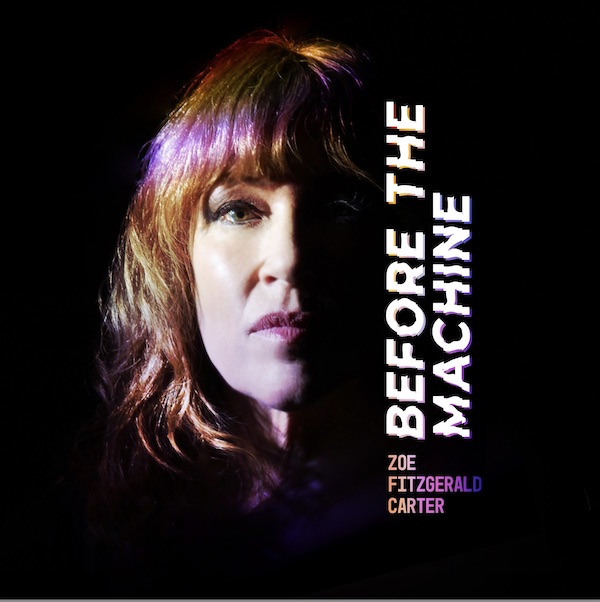
Singer/songwriter, author, and journalist Zoe FitzGerald Carter released her second solo album, Before the Machine, in June, bringing the first cache of songs to the surface that emerged during a particularly deep dive into creativity. Despite the difficulty of the pandemic period, she also found that it led to a period of productive songwriting, leaving her with a wealth of material to choose from. Some of those songs were memoir-like, carefully exploring moments of her past and deriving new reflections from them, while some reflected more on the circumstances of modern, like the title track, in which the “machine” referred to is the smart phone.
Carter also continued down a path that she began with debut solo album Waterlines of exploring more musical genre elements in her songwriting, including jazz, the blues, and even rock. Her live performance experiences only enhanced that desire to spread her wings further, encouraged by playing alongside a rock-leaning band. I spoke with Zoe FitzGerald Carter about the useful reflections and personal development that we might be able to carry forward following difficult times and why boredom and time without screens might be a valuable commodity.
Americana Highways: I had spoken with you about your previous album, Waterlines, and I can’t believe how fast time passes! But this time, for Before the Machine, I’m happy to see that you got a chance to play these songs before recording them, which wasn’t the case with Waterlines due to the pandemic.
Zoe FitzGerald Carter: Yes, exactly. By the time I was able to go out and start playing the songs on Waterlines, I had written a lot of the songs that are on Before the Machine. Then, I had to go back and learn how to play the songs on Waterlines! That was so weird. I remember that I had this really thrilling show at the Freight & Salvage to celebrate Waterlines and I had to re-learn my own album. Most of the songs on Before the Machine were written during the pandemic. I had more songs than I wanted to put on one album, and so I’ll be releasing a second album of them in 2025. I had so much!
AH: I got the sense that this was a very reflective time for you, where you gather lessons from certain experiences in the past, though the title and title track have another take on the past, a specifically positive one.
ZFC: This album is not really a concept album, though I feel like the title track is a concept song. It’s about something that I had something to say about. I could weave a story that would make it something of a concept album, but I think the songs come from having a time during the pandemic when I was isolated with my partner, in a little house on a hill in Berkeley, and I really had time to write music.
I am a memoirist and journalist by trade, and it was a time to be thinking about experiences that I’d had and be writing about them. A couple of songs on the album are ones that I consider memoir, almost. “One by Land” is about living in Boston, kind of in this tenement building, but looking out on the North Church steeple, which is where Paul Revere began his midnight ride. This lit up steeple flooded my apartment at night, and was a kind of presence as I made all my mistakes and had all the bad romances that I had. “Let’s Stay Friends” is, weirdly, about a similar time of life, of being single, and in my twenties, when I was living in New York City, where I lived for about ten years. I joke that it was the “pre-Tinder” world, but it had a quality of Tinder to it since there were so many seemingly available people, but also so many disappointments. [Laughs] The possibilities are seemingly endless, but so many of them don’t pan out!
AH: You’re making me think of the experience of watching Netflx, where there’s seemingly so much to watch, but you spend all your time scrolling and that’s it.
ZFC: Oh my God, yes! Exactly. That’s so true. I am not on dating apps, but for people who are on them, I hear similar things. When you really come down to it, nobody’s really who you want. But that was the inspiration for “Let’s Just Be Friends.” But I loved living in New York and it was a very atmospheric time to write about. I imagined myself as a kind of Tom Waitsian character floating through downtown New York. That was super fun.
AH: I did get the sense of time-travel for a few of these songs. With your previous album, there was some of that, too, but this time around, you really go in for the detail, setting the scenes. This really is not just nostalgia, but re-entering those moments and exploring a perspective on them.
ZFC: I take that as a huge compliment, because I think that’s really what good writing is. When I teach writing, or have given talks about journalism vs. songwriting, I think that good writing is good writing, whether it’s a song, poem, piece of journalism, or novel. Because it is about precise language and specifics, and vivid verbs and descriptions. There are also great characters and a story. I think there does need to be a story in songs. I’m always aspiring to tell a story that is vivid and impactful. I really come to music as a writer, even though I’ve always played music.
AH: How do you see the sound directions for these songs in comparison to Waterlines?
ZFC: Musically, even though I’m really steeped in Americana, folk, and bluegrass, and I ended up playing that kind of music in various bands, I’m also really interested in other types of music and I’m trying to push myself in new directions. I have a jazz-influenced song on this album, and my first real rocker, “Magic Pill” is on this album. It’s kind of a rock song, which was so fun! I’ve been playing with a band now who go in that direction, and we really rock out. It’s a bigger sound and I’m able to explore that more.
There’s also blues on this album, like “Staying Home Tonight” and “Lockdown.” Those are the two that are really about the pandemic. “Staying Home Tonight” is a little tongue-in-cheek because that’s all we could do during the pandemic! I hope that my pandemic-inspired songs age well and that people will still want to listen to them, though I understand if some people don’t want to be reminded of it.
AH: I think we’re still living with some of the lessons that we gleaned during that time, and hopefully putting them to use.
ZFC: For me, as an artist, I learned that I don’t need to be as busy as I think I need to be. And that I really need to create the times that, in a way, the pandemic created for me of just being able to go deep, and do the work, and write the songs. I really missed playing music with other people, but there was a way in which I was able to go really deep into my own musical instruments. I have to remember that when I’m getting so busy again. And to also create the time, even taking a couple of days and dedicating them to working on new songs. It’s about mining that vein. It can kind of get lost in the busyness of life. That was a good lesson for me from the pandemic, and I was lucky to be able to access that, rather than just suffering through that time.
AH: Your title track, “Before the Machine,” referring to smartphones is something that just about everyone can relate to, whether they have strong feelings about phones or not. Was there a particular thing that pushed you to write it at that time?
ZFC: During the pandemic, our relationship with screens really intensified. The song really did come from waking up one morning, turning on my phone, and starting to look at things like news, checking my e-mails, and Instagram or Facebook. I was feeling like, “My head is full of all this stuff and I haven’t even gotten out of bed yet!” That didn’t used to exist for most of my life. I used to get up, go about my day, and interact with people. I would be in my own mental space and I wouldn’t have this influx, this firehose, of information and dopamine hits. Other peoples’ problems, and the world’s problem wouldn’t have then been crashing in on me the moment that I became conscious. And then, intermittently, it would also happen again all day.
The irony is that is connects us, and also isolates us. I think we’ve all had the experience of sitting across the table from someone who’s looking at their phone. It’s such a sinking feel and you feel very isolated. You see that each of us has this intense relationship with our own private internet landscape. It’s not as if we’re even looking at the same screen. We’re so separated. I’m not a luddite. I’m not anti-technology. I feel like GPS is the best things that’s been invented. We have access to so much information, entertainment, and music, but I feel like we all have a sense of unease and melancholy about this way of living that we’ve lost. It’s a life less busy and less overwhelming. We also had more room to dream and think, and seek other people out. There is a sadness in that song, and a kind of unknowing, asking, “What have we lost? And when did we agree to that? Did we agree, or did it just kind of happen?”
As with most innovations, there have been real changes in how people live because of it, like discovering fire. Innovations change how we live in profound ways, and there’s been a mix of good and bad, always. I think there’s a movement to really question what it’s doing to us, and provide a space for children and young people to not be impacted by this all the time. Hopefully, someday there will be a scaling back of how much space and time it’s sucking up. Like the fact that we don’t all smoke a pack of cigarettes a day anymore!
AH: Ironically, I saw this on social media, but I saw a meme about how we’ve taken away boredom from our children, and that’s very dangerous, because boredom is often what prompts creativity. It was asking questions such as: “What if you never picked up a guitar? What if you never wrote a story or drew a picture?” I certainly remember being very bored as a kid, but it absolutely drove me to do things like that.
ZFC: I think that is so true. I think there are still kids picking up the guitar. I just met one recently and it made me so happy. He came to a class of mine with his mother, and I could see that he was completely obsessed. But I think you have to have a stronger drive now to overcome all these distractions that can just go nowhere, from my point of view. I do think that out of boredom comes a lot of good things, like cleverness, resilience, and digging into yourself and finding things that are interesting.
AH: There’s getting to know yourself and other people, too.
ZFC: One thing which I’ve thought about a lot is that playing music is the biggest antidote to screens. You can’t do it while you’re on your screens. It’s creative, intellectual, social, interactive, and intimate. It’s a compelling stew of things that really counter the state you’re in when you’re on your phone or computer, and to me, it preempts those things. To me, it’s a really fabulous way to create space in my own life away from my machine.
AH: One thing about screens is that there’s a lot of reaction and actions taken without even really paying attention to what you’re doing, whereas with music, you really have to pay attention to what you’re doing. It’s an important mental state.
ZFC: You have to be engaged, and you have to be present. Particularly with performing, you can’t space out! If I garble a lyric, I feel mortified and have to get over the mortification. [Laughs] Even reading a book versus scrolling involves more internal work, since you have to imagine what you’re reading, instead of being fed images. It feels like a huge shift in our way of life.
AH: What makes your song haunting is that it’s an open-ended situation. You’re looking at the past, and you’re looking at that moment of change, but the haunting thing is that we don’t know how big that door is that we have opened yet. It’s not a dark song, predicting bad things, but there is a sense that we don’t yet know the end of this road.
ZFC: Yes. Ideally, it makes you think and feel about what it means for you, but I’m not laying out arguments. I think I’m just evoking something that a lot of people are feeling at the moment. I think we all feel pretty addicted to devices, and that they take up too much space, and at some points, they are getting in the way of socializing.
Thank you very much for chatting with us, Zoe FitzGerald Carter! Find more details and tour dates here on her website: https://www.zoefitzgeraldcarter.com/
Enjoy our previous coverage here: REVIEW: Zoe FitzGerald Carter “Before the Machine”