


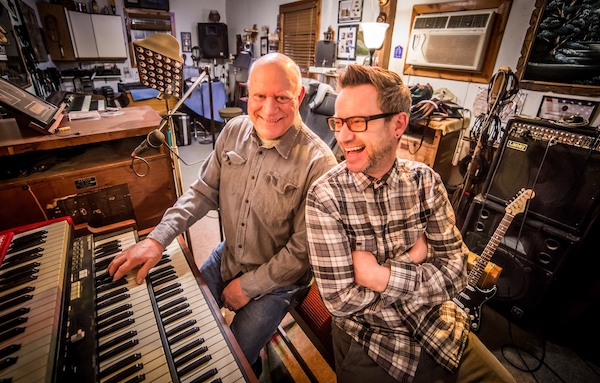
Brandon and Paul Draper photo from their Facebook page
Brandon Draper Shares The Musical Life Behind The Draper Family Band’s Debut Album
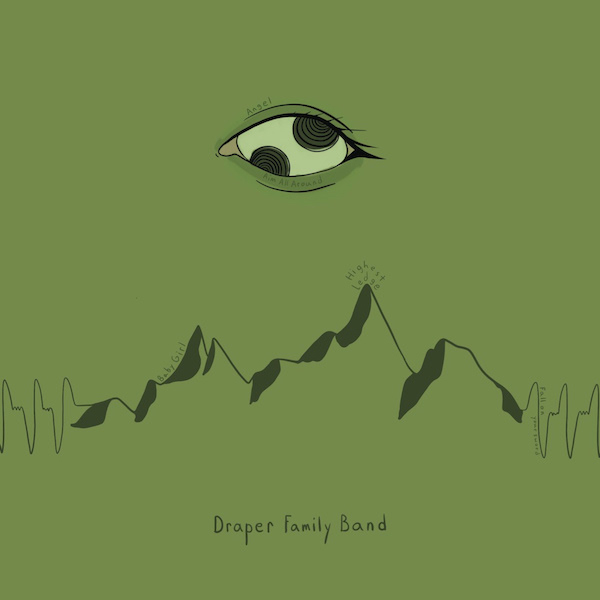
The Draper Family Band comprises decades of familial experience in music as well as a wealth of professional experience that has served them well as a live band and has now resulted in a debut self-titled album. At the center of the band are Hammond B3 and keyboardist Paul Draper (an inductee of the KS Music Hall of Fame) and his son, Brandon Draper, who is a multi-instrumentalist, producer, educator, and songwriter. Both are known for working across genres and cultural traditions, which brings an even wider scope of possibilities to the work they play and record together.
Their debut self-titled album has both the energy and excitement of original compositions and the satisfaction of completing unfinished business, since a number of songs had been building up over a period of years without a clear outlet for release until now. Inventive, and often combining instruments that don’t commonly mesh, the album draws on jazz, blues, and rock traditions, as well as many others. I spoke with Brandon Draper about his multi-faceted life and work, and the ways in which this album has come together at the right time for the band.
Americana Highways: I’m wondering about you, your dad, and genre. When you were a young person, what were you most into? Is your taste eclectic because of your family?
Brandon Draper: Very eclectic. The short story of the influences that were around is that my dad was a professional musician. He turned down an invitation from Keith Richards in 1981 to come and play with the Stones. They were auditioning keyboards and my dad had played at the studio in North Brookfield, Massachusetts. He had moved back to Kansas to have children, and I was two years old when he got the call. He had pretty much reorganized his life to be a dad. I didn’t hear that story until a couple of years ago, actually. The details of that story were actually too painful for him to talk about. He didn’t want me growing up thinking, “I chose you instead of the Stones! You better be good!”
AH: Yes, that could be quite a heavy thing. I can understand keeping it a secret.
BD: But I grew up in a house where half the home was a recording studio and he played keyboards at this very high level. I knew that my dad sounded like the everybody on the records. There was Dad’s record collection, and his bands, and his friends coming around. One of his friends, who was a drummer, and professor, started me on [drum] lessons with him when I was five. That guy, who is kind of like my second dad, introduced me to blues, rock, jazz, so the eclecticism was there. Then, when I started getting older, I realized that all these genres were a well-spring that’s never stopped.
AH: Do you change and move within those areas with an intentional rotation, or are there eras of your life when you’re more into one area than another?
BD: There have been definite seasons for me. I went to college, then I went to grad school, and then I started playing in symphony orchestras as a classical percussionist. At the same time, I played in a reggae band in Albuquerque, the polar opposite of a symphony. I sort of put the guitar down for about ten years, then I moved to Kansas City and songwriting and producing took more of a front seat.
I get depressed if I do the same thing for a long time. I’ve actually resigned from a few bands and left some long-running gigs after a certain period of time when it felt bad for my soul to keep doing the same thing. Maybe that’s the improvisational history of how my dad plays and my jazz influence. Last week, I played with a classical Arabic ensemble for an ethnic enrichment diplomatic ball. I was playing with some friends from Iraq. I went from that straight to a jazz gig and the next morning I was playing guitar for a contemporary church service. Jumping around like that was really fun. I guess it’s about having a lot of different cars to drive. I feel that creatively.
AH: Do you think it’s important to do various different kinds of things and keep trying new things in life?
BD: My grandma wanted to be a painter her whole life, and finally did. I skateboard every day if it’s not raining, and I ride motorcycles. I love to cook. So those are the non-music things that complete me.
AH: I was reading in a psychology book about the idea that people who come into later age, like your grandma, but have left something undone that was key to them, if they think it’s too late and don’t try it, they’ll be very unhappy.
BD: We released one of the songs as a single that my dad wrote thirty years ago, and he’s heard it a bunch, but it makes him really emotional. It’s so powerful to see that. I think you’re right. I think so many things are left undone because society, outside of the arts, doesn’t feel comfortable with those things. They think people need to fit in a box.
AH: We can also be told from a young age that we need to pick only one field and eliminate all the others, to specialize if we want to “amount to anything.” That was my experience, and it was quite a harsh one.
BD: Right. I told a story to a music entrepreneurship class in Chicago a couple of days ago that once I was home for Thanksgiving, having been at a music festival that involved camping in California. We played right after The Flaming Lips. I had just done that and had been all over the country that year. I was teaching at two schools. My life was being involved in a lot of things. We were at the dinner table, and my grandma was excited and asking me about everything. Then my grumpy uncle says, “Well, are you taking care of your parents yet?” I said, “No, they are both still working.” And he said, “I wouldn’t say that you made it, then.”
AH: Whoa. That is ridiculous.
BD: I told the students that story because I said to them, “As soon as you walk outside this door, you’re going to be bombarded by people who have to tear you down because of their own insecurity.” It’s in these groups of people who we can get to know that we need to fervently believe in each other. That’s where we get our promise from. Also, I tell them, don’t say, “I’m taking drum lessons now.” Say, “I’m a drummer!” It takes those people who believe in you.
AH: How did the family band set up morph towards recording? Is that also a live entity?
BD: Yes, and my dad is a really unique musician to play live with. He brings an energy that is so rare. Anything that knows him, when they hear the story about the Stones, their first thought is “He would have got the gig.” He’s 75 now.
But the songs on the album go back. There’s a song that I wrote on there that I wrote in 1996, that I wrote in high school and played with a band that I had in high school, called “That Cat.” One night I saw a cat that didn’t have a home, and brought it home, and wrote a song about it. One of the songs was one I wrote in New Mexico in 2006 called “Angel.” I had these different writing spurts. The song “Stars” was written stream-of-consciousness, playing and singing it in three minutes in 2011. It sat for a long time. A lot of the songs were ones that I didn’t know how to have a relationship with if I released them. That one is about standing in front of my grandma’s house in front of a tree that I would climb, dreaming about being a musician. The songs on this first record span a good 20 year frame, but are mostly from the past ten years.
AH: Wow, this is unfinished business for you, also.
BD: The song list is 60 songs deep. This 12-song album was originally 30 before we started chopping it down. I honestly want to just put out as much of this music as I can and get dad playing on as much of it as I possibly can because we only have a certain amount of time, a minute, to be alive and do these things. Some of the songs that friends and other artists think are the best ones that we play live aren’t even on this record. They’ll be on the next record.
AH: Are all these songs what make up the live shows? Or do you do covers and jams?
BD: It’s all original with a couple of covers sometimes. It depends on the audience. Some of the places that we play are more of a dance-groove approach. With my dad’s physical abilities, I’ll sometimes only have him play the second set. We’ll do a first set of instrumental covers that are coming from 60s funk, soul, horn-band music, so they are not something that’s on the radio. We do blues and funk stuff, which is great because the older generation gets it right away, even though the younger folks are starting to get people into funk music. But we focus a lot on original music, as well as the jam. We have a set this summer that’s 60 minutes and I was joking to the band that we might do two songs. Everyone in the band is legit world-class and go forever.
AH: When you all were making these recordings, was it in-person?
BD: Dad has a studio. I have a couple of studios. I booked time at studios here in Kansas Studio. There was only one song that was tracked in one studio in one day, “Aim All Around,” the opening track. We miced up the drums and what you hear on the album is my first take as I was thinking through the song. It ended up being just right. Granted, I grew up recording all the parts on a four track, so it’s normal for me to jump in. But that song was recorded in one day where I laid down the drums, laid down the guitar, and we had a bass player there, and the horn section. The accordion player was a buddy who was in the neighborhood and stopped by to see how the project was going. I said, “Do you have your accordion in the car?”
When I tell people about that first track, I say, “It’s got Hammond, Rhodes, accordion…” Then they say, “How’d you get all that to work together?” I say, “We just listened to each other and stayed out of each other’s way.” When things like that happen regularly and naturally, it’s a project I want to pursue. [Laughs] Everybody is respecting musical space and ideas. Everything was recorded over a number of years in different studios.
AH: It sounds like you all have really figured out how to work together and the band is an ongoing venture for you.
BD: Oh yes. The only challenges that Dad and I had had was rooted in other things, like stuff coming out in a session where we’re writing and arguing about things. It was never about the music. We’ve gone through so many of those patches that it doesn’t bother us. It’s saying, “We’re going to work through this.”
There was one situation where I wasn’t at the board mixing but I was standing there, and the guy asked, “Who’s soloing here, your dad or you? Do we want to cut the organ?” I said, “Oh, no, we’re both soloing and that’s what we do.” There literally is a magic in how that stuff comes together that I can’t describe. My dad is the most supportive musician in a band of anybody. The only challenges for him playing in other bands is that he can be a little intimidating because he’s so natural. His work is really raw and beautiful. The honest truth is that we just want to get the song started because we want to play. It doesn’t matter who’s leading.
Thanks very much for chatting with us Brandon Draper! Folks can discover the music here: https://symphony.to/draper-family-band/dfb and find more information about the Draper Family band here: https://www.facebook.com/DraperFamilyBand/