







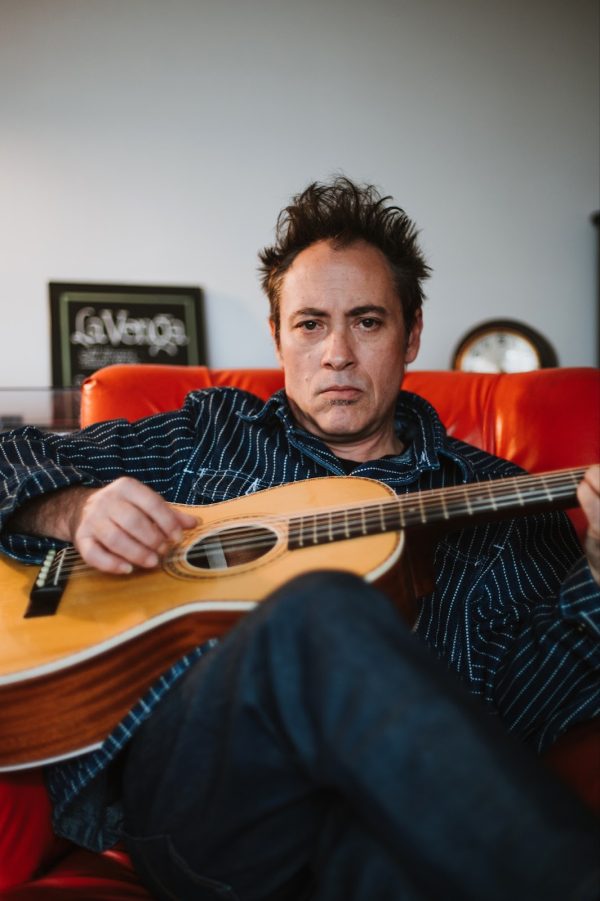
Todd Albright photo by Agnes Fischer
Todd Albright on Recording Blues for Dexter Linwood and Launching Misfortune Records
On April 17th, 2026, country blues artist Todd Albright, known for his 12-string guitar work, will be releasing the album Blues for Dexter Linwood via his own newly launched label, Misfortune Records. The album was produced by Albright’s friend and colleague, folk artist Charlie Parr, and recorded in mono with very little studio production, geared toward a live sound. The songs were selected based on audience responses during a long history of live performance, but for Albright, each song has something special that made him include them, and often it’s a sense of personal connection to the songs and the people who first played them.
Launching his own record label is something that Todd Albright intends to expand upon, and even though he took plenty of lessons gleaned from observing record releasing over the years, it’s not something that he found daunting. Rather, he sees it as “office work,” and something that, taken on, can be accomplished with some directness and organization. That’s an approach that seems to fit well with the music that most interests Albright, music that found its home on the street corners, in small venues, and more rarely, in brief recording sessions in the 1920s and 1930s. The real star, for Albright, is the 12-stringed guitar, which he feels gets to shine under his mono approach to recording, Blues For Dexter Linwood, named after the neighborhood in his home city of Detroit. I spoke with Todd Albright about the practicalities of launching his label, his stripped down recording methods for the albums, and about some of the stories and people behind these evocative songs.
Americana Highways: When I look at your work alongside other blues music that I’m aware of, it really is quite different. Do you get that reaction from people often?
Todd Albright: The country blues, historically, has never been popular. It was out of fashion by the time that it was recorded in, say, 1926. That’s when Blind Lemon Jefferson started recording. That’s when they decided that they no longer needed a large band if they could just get a guitarist and vocalist, and they could get away with a solo guitar player doing his own vocals. It’s much cheaper to do that then hire a band, and have rehearsals.
AH: That sounds exactly like the climate right now, and it’s shaping the music industry. Alongside you spreading the word about this lesser known music, you’ve started your own label, Misfortune Records. Is that for your own work, mainly, or will it support other music, too?
TA: I had never realized how “not hard” it is to do. You have four or five components, and then you have your record. You have to take care of the recording, you have to take care of your artwork, you have to get your record pressed, you have to have a publicist, and then you have to go on the road. That’s all the components. A big production is unnecessary. It doesn’t have to be that way. Figuring that out was kind of a watershed moment for me, thinking, “I know what the record labels are doing, and it’s not that hard. It just takes a couple of bucks and some imagination, and you can do it.”
It’s not just about my own records, it will be putting out records by other folks. It’s not in any way a “vanity label.” It’s an actual record label. The next record will be by my mentor, who just recently passed away, Paul Geremia. It was a live album from 1984 that he was trying to put out before he had his stroke, and he was actually writing liner notes. The record ended up being shelved, and I was able to get it back from his former record label. Now, Misfortune’s going to put it out. It was a race against time. I was trying to get it out while he was still among us, but since he has pulled into the great Waffle House in the sky, [Laughs] we’re going to have to do it without Paul’s input. But, he left enough, and he left everything as he wanted it. It was ready to go. So, we’re doing a bunch of stuff.
AH: My condolences. It would be great to have a party for him, and that record.
TA: There will be something. I’m looking for maybe an early fall release. Maybe these things will line up.
AH: I’ll ask one boring question. Something that’s daunting for people who think of launching labels in the physical labor and cost of packing and shipping. Do you have any good strategies for that? Postage costs have been going up, too.
TA: There’s a lot that goes into it, but the technology that we have today allows it to be much more streamlined. I’m sending things out via Media Mail, and I can anything anywhere in the United States for five bucks. And the tracking is easy to do. It’s really not that bad.
AH: You’re right that there’s a mystique that has to be dispelled. This is just hammer and nails. You’re making something anti-fragile by making it your own business, too.
TA: It’s office work. It’s not as hard as record labels make it out to be. There’s a lot of gatekeeping-type stuff. You just have to be smart about it, and you figure out what your mistakes are. It’s a learning process.
AH: When it came to choosing the songs for this record, was it purely a mental exercise, or do the songs have a relationship to the ones that you’ve been playing the most?
TA: When you introduce a song that you’ve never had in the repertoire, you kind of test it out on the road, and you gage how people react to it. Are they enjoying this? Because I’m not making the record for me, I’m making it for them. These songs are mine, and I can play them sitting on my sofa all day long if I want to. I got the test-pressing for this record, and it sounded good, but I haven’t listened to it again! I’m not who the record’s for.
Traditionally, recording was just guys going into a studio, knock out four or five songs, and a couple of those would hopefully end up on a 78, and that was it.
AH: There’s a freshness to that, to keeping that energy. I think that live performance must be so much of what this whole work is for you. I think the track order and the songs have a variety in the way that a live set might.
TA: As far as tracklisting or setlists go, you don’t want to play the same key twice in a row, and you want to change up the tempos as you go through. You don’t want to bore people to tears, or run them over. I find it terribly irritating to make those decisions. I have no interest in those decisions! It’s true. Charlie Parr, my pal, produced this record, and we went into three different studios, with a few different situations. In one situation, I had an upright bass player, someone playing fiddle, and someone playing mandolin. We tried to do this a few different ways. None of the results were satisfactory.
What we were going for was to try to capture what I do on stage, but in a studio type situation. What we decided was that we would record in mono, with just one mic in the room, and it went directly to two-inch tape. How we mixed this was that Charlie sat behind me, about seven feet behind, and a harmonica player sat across from me, because it was a double-sided microphone. That’s how we mixed it.
That’s the thing about multi-track recording, is that you have to mix all this and make it sound like it was not recorded at separate times on separate days. In this case, I didn’t have to mix anything. It was done. There was no going back. That’s what Charlie and I had wanted to do, but it had never occurred to us to actually do it! Sometimes you have to really complicate shit before you can get it how you want it, which was as stripped down as possible. I think I recorded this thing in an hour and forty-five minutes. It was usually done on the first try, but if not, on the second try.
AH: I’ve done a lot of interviews in my time, though not as many as some people. And I can say, that is the shortest studio recording time that I’ve ever heard of. You win!
TA: Well, 11 songs at five minutes a piece. It’s just like playing live. That’s how I approach it. You don’t get to “do it again” on stage.
AH: That’s true, but even people who make live albums usually do multiple takes.
TA: I know. But we need to capture what happened. The less time you spend on Production, the better. I spent a lot of money on the guitar. The guitars cost money, and they sound great. I want the recording to sound exactly like the guitar, not the studio.
AH: I love the idea of giving the guitar its space, because there are plenty of deserving instruments out there who don’t get treated with dignity.
TA: Especially with a 12-string guitar. They are so finicky, and they never stay in tune. I spend most of my time on stage tuning the guitar, and that’s just how it is. I haven’t owned a six-string guitar in at least ten years, because it’s tough to serve two masters. They are pretty much two different things.
AH: The storytelling in these songs really jumped out at me, and I loved that aspect. They are gritty, too, with a lot of interesting female characters.
TA: If you listen to Blind Willie McTell’s version of “Delia,” he recorded it a couple of times from different perspectives. One is from the perspective of a lover who is sad that she is dead, but she kind of had it coming, because she was a gambler. There are all sorts of different stories, some ripped from the headlines.
AH: Do you think that subsequent interpreters of songs enjoyed changing things up, making them their own?
TA: Things were changed. I think once the stories entered the public, through the people who were playing on the streets, or recording the songs, they changed things. In a Folk way, they might have also misheard things.
AH: I was thinking that, too, that they might have just misremembered things that they heard, and that led to changes over time. In some ways, a classic song from this album is “Drive Away Blues.” It’s downbeat, it has place-names. That’s exactly what I thought I’d hear on this album. But then, you have things that are, in some ways, a bit more upbeat, like “If That Woman’s Love Was Whiskey.” It’s sprightly!
TA: Sure, yes. “Drive Away Blues” was a Blind Willie McTell song, and a lot of songs got mistitled. There’s nothing in the song that says “drive away.” Willie was big on place names. He was a very visual lyricist, and a lot of descriptions are prominent in his songs. That makes it interesting for me, that he was going to “go up to Lookout Mountain” and “look down on Niagara Falls.” How the hell are you going to do that? Lookout Mountain is in Georgia! But, he was blind, so maybe he was seeing things that we couldn’t. Little things like that make me giggle.
AH: It’s almost a poetic, visionary experience.
TA: He had vision only as a little baby, maybe until age two or three. So he knew what things looked like, but that was about it. “If That Woman’s Love Was Whiskey” was something that Paul Geremia wrote. I think that he wrote it sometime in the 90s. It didn’t get recorded until much later, since he went some years without recording. The original tongue-in-cheek title for that song was, “If That Woman’s Love Was Whiskey, That’d Be All The Proof I Need.” [Laughs] But it was a little long to be put on a record.
AH: Wow! I love that.
TA: That’s a song that I heard Paul play many times when we’d tour together. I find this is true with a lot of stuff: I don’t have to sit down and learn a song. If I saw it enough, saw Paul play it a few night’s in a row, you absorb it, rather than learn it. Maybe I’m not playing it like he did exactly, but it’s a “misremembrance,” which is fun also. I play this little game at home, too, where I think of a song that I don’t really know, but I want to learn. And I’ll try to guess, without listening to it, what’s going on. Then, I’ll listen to it, and see how wrong I was. Sometimes I nail it!
On the album is the song “Titanic,” which Lead Belly did. I don’t think it’s one of his stronger songs, actually, but what I love about it is that in an interview he did, he said that’s the first song that he learned to play on the 12-string guitar. You’ve got to figure that was 1912. That’s a long damn time ago! He was at that time playing with Blind Lemon Jefferson on the streets of Fort Worth, Dallas, and all around that area. So, I’m playing that song just because it was the first song that he learned to play on the 12-string. It’s important to me, even though no one else is going to know that. I care about that. That’s what’s important to me. That was another song where I remembered the song in my head, and I played that version of it, and when I listened to Lead Belly’s version of it, I got pretty damn close!
Thanks very much for chatting with us, Todd Albright! Find more details here on his website: https://www.toddalbright.com/