





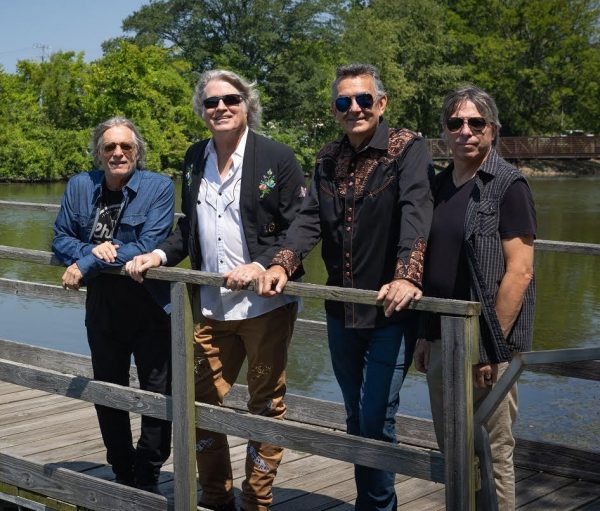
Chris P. James of The Burrito Brothers on Stretching Their Sound For The Magic Time Machine of Love
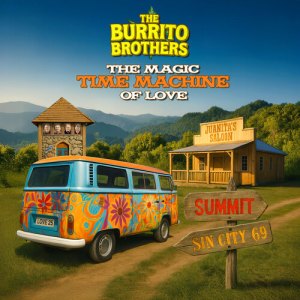
In the last part of 2025, The Burrito Brothers released new album The Magic Time Machine of Love via Think Like a Key Records. The title plays an interesting role in presenting the album, since the songs on the record span origin points in time, players, and even genre-elements. And yet, you’d find it hard not to identify any track that didn’t have the stamp of the band’s ethos all over it. Careful thought and planning have a lot to do with the cohesion of the album, as well as certain mindset that embraces The Burrito Brothers’ storied roots and also looks towards the future, stretching their sound as much as feels right to them.
The album opens with an extract from a Gram Parsons interview in 1972, and features tracks where original Flying Burritos members Jon Corneal and Ian Dunlop appear, as well as archival tracks never released, energetic cover tracks, and original tracks written by Chris P. James. Two tracks even feature Gram Parsons vocals that were originally recorded for other tracks, here given new Burrito Brothers instrumentation. I spoke with Chris P. James about the identity of the band right now, the ways in which he’s starting to look towards the future of the multi-generational group, and how the sound of the band continues to find new and affirming avenues.
Americana Highways: I really appreciate that on this album, each song has its own intricate story and background. It’s like each song is its own story and energy.
Chris P. James: I feel the same way. The title refers to the fact that it covers a lot of ground. It’s recorded through many years, with different personnel and different sessions, but it’s not an anthology. It’s all previously unreleased stuff. It just felt that the nature of this group invited something like this.
AH: I haven’t had the pleasure of hearing you all play live, but when you do play, are your shows very wide-ranging as well?
CPJ: I would say so. We play kind of seldomly these days. Everybody’s older, and living here in Nashville, everybody stays really busy playing with other people. It’s basically a group of studio musicians that I tend to head up. I’m less so someone who plays with other people because my role in the group is to be the anchor, and the face of the current lineup.
Towards the end of every year, there’s usually some kind of Gram Parsons tribute in Nashville, and we love playing those. We tend to play one every year, and for the past few times, we’ve had a revolving door of people, kind of like this album has. That’s different alumni of the group that allow people to hear slightly different lineups. This group, more than any I can think of, has had an ever-changing lineup, and that’s part of its dynamic, which is very unusual.
There’s never been two albums in a row with exactly the same personnel, even as far back as when it started with Gram Parsons and Chris Hillman, Sneaky Pete, and Chris Ethridge. By the third album, Gram Parsons himself was gone, and it just went on like that, with each album shifting. I would contend that it’s been something of a blessing in disguise because there’s no real laurels to rest on. Every time there’s a new album, and a personnel shift, the new lineup has to rise to the challenge, and live up to the legacy, and the quality of music that’s been made in the past.
AH: That’s a really cool way of looking at it. I can see how people might want to get in on that, and take part in that. I can see how even inviting people to sit in and be involved in those events would be heart-warming for them. It’s about celebration, fandom, and love for certain ways of playing. I think that’s going to attract people to contribute.
CPJ: It’s interesting because I’ve now been in the group for 17 years. I came in in 2009. That was one of those major shifts in Burrito personnel. The group prior to us had been going by the name of “Burrito Deluxe”. Fans always thought that was a slightly different name for the same group, which was true. There was a thing that I sensed back then, among older, curmudgeonly people, saying, “They’re not the Burrito Brothers!” But my reaction was, “Then who is? Who has been a definitive version of the group?”
And by the way, yes, we are. Each time that it’s been carried on, it’s always been people from the previous lineup who found one or two more new people to enter the picture. It’s always been an offer. It’s been continuous. When I came in, I already knew all those guys, and had worked in other gigs with them. The first time I’d played in a guest member of The Flying Burrito Brothers was back in 1986. When I joined the group, and we had an offer to do an album, I got in touch with Chris Hillman, and he said, “I’d just request that you don’t go by The Flying Burrito Brothers. Can you just go by The Burrito Brothers?”
So we’ve always honored that request. In some odd way, I kind of like it more that way. It’s concise. There was this idea that The Byrds had back when they started that they wanted their name to start with “B” because of The Beatles and The Beach Boys. Then there’s The Band, The Bee Gees, whatever. Something about “The Burrito Brothers” works for me.
AH: This reminds me of more of a “collective” set up, too, where a band is able to have these shifts in personnel and still keep going. That’s something that came out of the late 60s and early 70s, I feel like, and though it’s not that common anymore, it’s still around, even among young people.
CPJ: I think so. There are examples that I’ve loved in history, going way back. The extreme example of that is when the number guy of a band leaves, but they carry on. There are wonderful examples of that working. When Syd Barrett wasn’t able to carry on in Pink Floyd, they rebounded like no one could have dreamed. Peter Green left Fleetwood Mac. I love those examples.
AH: Part of the measure of that is usually, “Can they make an album?” And the answer to that is “Yes,” in those examples and your own.
CPJ: There’s a quote that I locked into and put on our website when I took on this leadership role. Creatively, we’re all equals, but I do the role. In 1972, Gram Parsons was asked in an interview what he thought of the band carrying on without him, and without even any of the original members. He gave this answer along the lines of, “I think it’s great the idea will continue, whether I do it, or anybody else does it. It’s got to keep going.” We’ve put that soundbite on one of our songs, on Still Going Strong from 2018. It’s the song “Between Your Hands and Mine” that was written by Gram, but hadn’t been recorded. We put it in the fade out. I think that, right there is the justification of people like us carrying it on.
The odd thing is right now that I’m on the other side of the picture. I’ve got to now make sure that it continues past me. If I’m going to believe so strongly in what Gram says about how it has to keep going, then I’m a hypocrite if I don’t also think that about me. I don’t want it to end with me.
AH: That’s right! It’s tricky. It needs to be multi-generational.
CPJ: I think it already has been! It hit me that right now, we’re the first ones “after.” Everyone who was around back then is gone, deceased, or no longer active. Even the slight exceptions don’t really play much. Most of them are gone, and yet this thing has carried on. We are the “next” generations. That’s kind of weird. Hopefully we are not the last!
AH: I think this album, and different approaches you take, kind of illustrations options for the future. You have covers where you’ve been very much like music scholars. Like with “Whiter Shade of Pale,” you know an awful lot about this song that’s influenced how you’ve presented it.
CPJ: Thank you. That’s absolutely true. I love when people catch that. In the first place, to do that song, one of the greatest songs ever written or recorded, just to do it would not satisfy me.
The challenge is, “How in the world can we bring something else to it?” If I was given the impossible task of picking my favorite song, I’d lean towards that one. I think it’s near-perfection. One of the greatest recordings. It’s just magnificent. Since I regard it as my favorite song, I thought I’d like to do it some time in my career, but then there’s the challenge of what you bring to it.
I have that album by a group called The Paramounts, who was basically the R&B cover band in the mid-60s that the guys in Procol Harum were in. They never made it in America. The last thing that they recorded was “Freedom” by Charles Mingus, and it hadn’t been released. I remembered that, and digging the cool Jazz vibe of it all, I thought, “How about that as the intro?” Those who follow the group will pick up on that.
Then there’s the fact that there are four stanzas in Keith Reid’s original lyric, of which only two verses made it into the classic “Whiter Shade of Pale” recording. So, to use the other two verses is completely legit. It’s not like I made those words up! Every bit of the original poem is there. So that’s how we came up with our own version. Plus, in general, I love the idea regarding The Burrito Brothers of the pedal steel guitar player being featured as a signature instrument. It always has been, and always should be, in the group. It’s part of the identity of The Burrito Brothers. So, for Tony to play the Bach-based signature stuff that was on the organ in the original gives it another flavor. I think we brought enough to it to make it our own version.
AH: It sounds very different to me in a really interesting way. It’s very approachable and warm. By the way, it makes total sense to me that “Whiter Shade of Pale” is your favorite song, when I then listen to the song “Time Machine” on this album, which you wrote. I think that the way that “Whiter Shade of Pale” allows for there to be different movements within the song is similar to your approach with “Time Machine.” It’s open to possibilities in that way.
CPJ: For “Time Machine,” and even more so with “Tales of Desire,” we went out on a limb more than we had done before. When I first entered The Burrito Brothers, there was definitely the question, “What do we think the group is supposed to sound like?” But we did that with some pride. We tried not to stray from what we felt that was supposed to sound like, since it was supposed to be a hippie-hybrid. We wanted it to be reminiscent of Gram Parsons and Chris Hillman. Now, all these years later, and having been The Burrito Brothers for this long, I thought, “Well, back then when they started, it was a crazy hybrid. That certainly wasn’t traditional country music, and it was strange for rock.”
So my thought was, “I can go off into almost prog rock.” Which I do like. I like King Crimson and The Moody Blues. There’s just lots of good music. I thought, “It’s this personnel, it’s these voices, and it’s this wonderful pedal steel. We’re still this hybrid. But we can stretch all the way out to there.” The spectrum is incredibly broad on this album, because we also come back to some of that incredibly old-school stuff like “What Goes On” and “Used To Do.”
Thanks very much for chatting with us Chris. More information about the Burrito Brothers is available here on their website: https://www.theburritobrothers.net/