


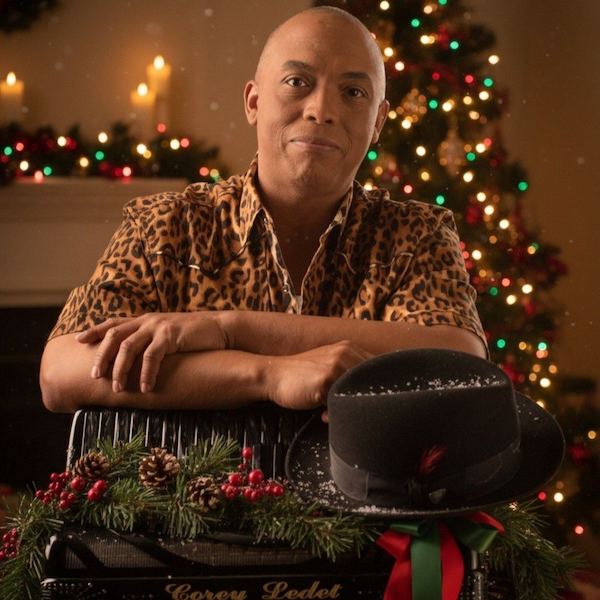
Corey Ledet Zydeco on The Black Magic Band and Capturing Live In Alaska
Corey Ledet Zydeco recently rolled out a new logo, updated name for the band, and new instrument, as Corey Ledet Zydeco & Black Magic. With it comes an energetic, refreshed shine that well suits the release of his first ever live album, Corey Ledet Zydeco & Black Magic’s Live In Alaska. Arriving as his 16th album on the 23rd of December 2025, it features original songs from across his catalog in both English and Creole, as well as the impromptu jam, “Alaska Funk,” showing off the chops of the Louisiana musicians in Black Magic.
Having travelled all over the world, Corey Ledet is frequently an ambassador for Creole music, and also just for the power of music in general, but keeping up a magical connection with the band, both on and off the stage, was part of what made the Alaska trip behind this live album so special. I spoke with Corey Ledet about his current focus when it comes to developing his Creole language skills passed down through his family, his move to embrace a new look, band name, and instrument, and why this live album is a long-awaited sweet success.
Americana Highways: What made this particular trip to Alaska so special for you?
Corey Ledet Zydeco: It was a very cool trip. I’d been to Alaska a couple of times, but this one was really cool. Normally, when we go out of town, they’ll put us in a hotel and everyone will have their own room, but this time around, they put us in an Airbnb, and I think I liked that better. We had a kitchen, we could cook. We were all in one house, like one big family, so I really enjoyed that.
AH: That’s a more human way to do it. I’ve been experimenting with that more, too, and it’s way less sterile, and it’s less stressful.
Corey: It really feels like you’re still at home. Sometimes, when we’re in hotels, we’re spread out. We really enjoyed the kitchen aspect, and we could cook all our own foods, and have enough for later. We didn’t have to go to McDonald’s or the restaurant.
AH: Had you ever been there in January before? Did you have the right clothes?
Corey: That was our first winter trip to Alaska. They told us ahead of time that we had to come prepared, so we did just that! It was funny, too, because they are used to it up there, but we were getting off the plane with six layers of clothes on. They said, “Yep! You guys are from Louisiana!”
AH: It’s been a few years since I’ve spoken to you, so I’m wondering what your creative goals have been lately. Are there things that have been appealing to you these days more than in the past? Are there areas that you’ve been focusing on?
Corey: In recent years, I’ve been really trying to learn Creole, and learn how to speak it. My dad and everybody on his side of the family speaks it, and the dialect that they speak is spoken around the St. Martin Parish area of Louisiana. My dad is from Parks. I was a part of that generation where the parents didn’t want the kids to learn it because they wanted to talk together, and they didn’t want the kids to know what they were saying.
AH: That’s funny. They wanted their secret adult language.
Corey: Exactly! [Laughs] But by doing that, it played a part in killing the language. So now, I think there are less than 10, 000 people that still speak the dialect that my family speaks. So I’m doing my best to learn it, and my Dad has come around now, saying, “Well, you’re a grown man now, you might as well know what everything is.” We have another cousin who speaks it and he also reads and writes it, so he’s teaching me to read and write. That’s really on my front-burner right now, to get as fluent as possible.
AH: Was there a time when your dialect was written down more? Are there documents you can look at?
Corey: I think at the time that my dad was growing up, it was written down more, but there weren’t documents, it was just what they spoke. My cousin Herbert Wilts, and another couple people, have come up with a way to write it down, and they are teaching me how to do it. It helps me to learn it better, because if I can see it, and if I can say it, I can go faster.
AH: Do you feel that you can express things in Creole that you can’t express in English?
Corey: What I’ve discovered, for me, is that English is actually one of the most complicated languages out there. There are so many different ways to say things to get your point across, and a lot of what we say these days is actually slang and not proper English. Sometimes you can’t translate things word-for-word to get it across, and that’s what I’m seeing studying Creole.
AH: Do you think it’s influenced how you think, and your experience, the more you learn?
Corey: I’ve never met my grandparents on my dad’s side, really, though my dad’s mom had seen me, I was just too young to remember. My dad’s dad died before I was born, so I never got to meet them. Every time I learn a new word, I feel closer to them, and their parents. I feel closer to them, spiritually, since I know that is what they spoke. Every time I learn a new word, I feel them.
AH: You wouldn’t be able to learn those words, now, if they didn’t speak them, since they spoke them to your father and cousins. It’s a direct line of transmission, right?
Corey: Right! There’s the connection there.
AH: I see the introduction of “Black Magic” to your act and presentation. How did that come about? What is the significance of that change to you?
Corey: I was “Corey Ledet & His Zydeco Band” for the longest time, but then I felt that it was time to reinvent something. I came up with that, “Corey Ledet & Black Magic,” but let me call the band Black Magic, because when we get together, it is magical.
AH: It’s a neat name. How do the band feel about it?
Corey: They were all for it! Every time we get together, it’s like there’s an energy there that can’t be denied. We get energy around each other, when we start playing, and the people are enjoying it, and we’re all jamming. It’s a magical feeling. Just like on Live in Alaska, you can feel the energy.
AH: You’re also working with a new instrument. A lot of musicians prefer older stuff, but what’s it like to play a new instrument here?
Corey: My new accordion, “Black Magic,” is one that I wanted all in black, but I also wanted them to tune it in a certain way, a little bit different from the way that my other accordions have been tuned. I also asked them to make it a little bit lighter than normal. Those big piano accordions are not light, they are pretty heavy.
This one is still full-sized, but they made the body frame a little more compact to help out with the weight. For some reason, when I strap that one on, it feel like a part of me. The good thing about that it is that after I play it, and put it down, my back isn’t sore. I feel really connected to this instrument. I’m young, but I’m not that young anymore, so I don’t like to hold a heavy instrument for too long.
AH: That’s smart for the future, too, to avoid repetitive damage. You have to look after your health, as well.
Corey: I love my older accordions, too, but I know that I have about 30 minutes before I start feeling the effects. Once I start feeling the effects, I know that I can’t perform at my best.
AH: I think it’s great that you’ve made these updates and changes to your name, your logo, your instrument, and even your tour van. It’s all so expressive of who you are right now.
Corey: It takes some courage to do it. A lot of people say, “If it ain’t broke, don’t fix it.” But I look at it this way: Picture yourself sitting in a seat too long on an airplane. Those aren’t the most comfortable seats. You have to shift a little bit! That’s what this is.
AH: You’ve done a lot of albums, and there’s been a lot of great music that you’ve captured, but why didn’t you do a live album before now?
Corey: I’ve always wanted to do a live one, but things never lined up properly for it. Every time I wanted to do a live one, something got in the way, like one of my musicians got sick, and couldn’t make it, and I would have had to get a substitute, which would change the sound. Or we tried to record something, and something was wrong with the equipment, and it didn’t capture right. It was always something. I’ve been trying to do it for about ten years.
Now, I play every year for Jazz Fest, and they record live. But that’s their project. They record, but they don’t go in and clean it up. So if we have a set and there’s feedback, you’ll hear it. But I’ve always wanted to do a live recording, and this time everything lined up properly. I said, “Why not try to do something in Alaska.” I talked to the people over there, and they made sure that they had the proper equipment, and the sound guy over there, to make sure it was working properly.
We played three times, and we recorded every set, and then we blended everything together. Everything lined up perfectly. When we came back from Alaska and I listened to it, it really almost sounded like it was ready to put out. It was that clean, and that clear. It still needed to be cleaned up, so we did that. I said, “This is it!”
The guy that played keyboard with me in Alaska, Cecil Green, has his own studio, and he helped me mix everything down, and do a little overdubbing, and make everything pretty. Then I took it to another friend, who did the mastering, and he really brightened it up and put the bottom into it.
AH: When you were playing these sets in Alaska, did knowing that this might be released as a live album affect what you chose to play?
Corey: I kind of had an idea of what I wanted to do. I wanted to play mainly originals of mine, and I kind of wanted to stay away from covers. Because when you start to do covers, you have to get licences, and all that. I didn’t really want to deal with that, especially for my first live album. I wanted it to be all systems go. I said, “Let me just do mostly my originals.” Usually, we do some more blending with covers when we’re live, but for this one, we focused on Corey Ledet Zydeco & Black Magic.
AH: I do appreciate that you allowed the album to have an impromptu piece, also.
Corey: Things happen live, right? We were playing one night, and I just jumped into it. I told the drummer, “Give me a funky drumbeat.” And we all just kind of jumped in. Stuff like that happens all the time, it just happens. We’ve created a lot of original songs like that, too. Then, when you have a band, I focus on having well-seasoned musicians who are capable of doing whatever.
That’s another thing that makes the Black Magic Band magical. I have to have a musician who is extremely versatile on his instrument, “well-seasoned” is what we call it down here. That way, if I want to play a smooth Jazz song, it’s going to be smooth jazz, and if I want to play a gospel song, it’s going to be gospel, or if I want to play a rock ‘n roll, Guns ‘n’ Roses, heavy metal, or thrash song, it’s going to be that. And then, when we jump back to Zydeco, it’s going to be Zydeco.
Thanks very much for chatting with us Corey Ledet. More information is available here on his website: https://coreyledet.com/
Enjoy some of our previous coverage here: Interview: Corey Ledet Zydeco’s “Médikamen” Brings Creole Language To The Party