







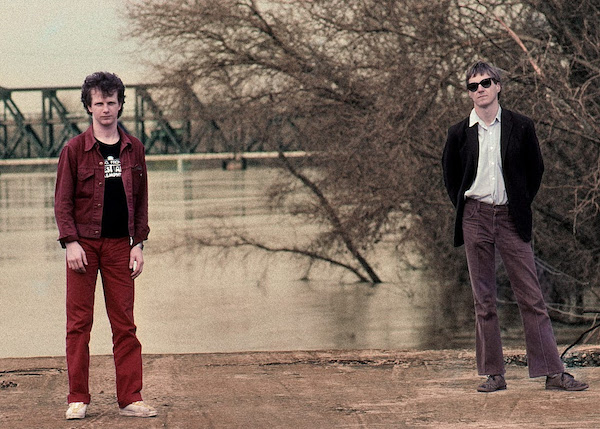
photo of Charlie Peacock with virtuoso bassist Erik Kleven, American River, Sacramento, CA 1981 by Bob Cheevers
Charlie Peacock Reflects on The Lifelong Impact of Working with David Kahne on The Kahne Sessions 1980-81
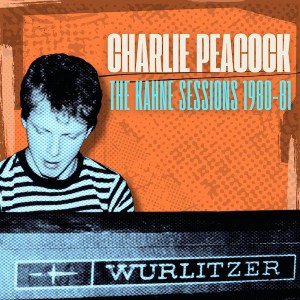
In October of this year, Grammy-winning producer, musician, author, and solo artist Charlie Peacock released The Kahne Sessions 1980-81, a digital-only EP that revealed to the world the results of a very interesting recording session where Peacock, as a young artist worked with Grammy-winning producer David Kahne, who was also just starting out then. Brought to the public view after 45 years, the New Wave-influenced songs on the EP are restored and remixed by Peacock and are an excellent example of what archival work can accomplish these days, and of what a fascinating window previously unreleased tapes can offer on the past.
Charlie Peacock (The Civil Wars, Chris Cornell, Switchfoot) and David Kahne (The Bangles, Lana Del Rey, Paul McCartney) experiment and make discoveries on this EP, bringing in computer-related technology that was groundbreaking at the time, and combine it with energy drawn from a rich array of players from the Bay Area. The atmosphere of the music, and the meeting of minds behind it, captures creativity in motion, and suggests many of the lessons that both Peacock and Kahne would build on in their future work. I spoke with Charlie Peacock about his work as a producer, and about how working with Kahne in these sessions laid the groundwork for the development of his own personality as a producer in ways that are still evident today.
Americana Highways: We’re here to talk about these recordings, but actually I have an interest in interviewing producers about their work, so I get a double dose with you. For a lot of people, becoming a producer seems inaccessible, and yet it happens, so we talk about how that happens, and the things in their life that led to it. And that’s all tied into these recordings for you.
Charlie Peacock: That’s right! My wife and I were at the Paul McCartney photography exhibit in Nashville, and we went through it. I’m old enough to have watched the Ed Sullivan show where The Beatles were playing, and I’ve been fortunate enough to even play on that same stage, when Letterman had it. I played on that stage with Chris Cornell. So, we were talking afterwards about The Beatles story, which is so long and phenomenal, that it’s hard to image that these were young people who came from modest, middle class homes, in their port city of Liverpool.
There’s so much mythology now, and the ubiquity of fame is so extraordinary, that the distance between then and now is so great. But it’s no different than looking back for me, in a way, because my wife and I got together at 14 and 15, and I was just starting to play in bands. Now, here we are 50 plus years later, having had what I consider to be the perfect career for me. I’m super-grateful for it. There’s always a story, everybody has a story.
In the same way with Paul, my story is embedded in having a parent who was a musician or music lover. My dad was a working musician, who sang, and who played trumpet. He did the songs of his era, so when I was a little boy, my dad played Friday or Saturday nights. If he was the leader, he was playing trumpet and singing, but if he was called to play in someone else’s band, he might play bass, or drums. I never knew what I’d wake up to on Saturday morning, and see a drum set or a string bass in the hallway.
AH: Those are very different instruments!
CP: Later, when I was older, I realized that my dad was really gutsy. He was just going for it, and trying to take care of his family. Even though I’m only really accomplished as a pianist and as a composer-arranger, I play everything. I can play anything there is, but not well! I could probably play “Mary Had a Little Lamb” on an oboe. That’s all from growing up with a parent who was a musician. You can’t help but think that sets the stage for the challenges of production.
One of the things that people don’t realize is that in the studio, we don’t use the word “No,” very often. We’re more apt to say, “This is better than that.” The studio life, you don’t survive in it if you’re a creativity killer. That’s true you make people feel their idea isn’t warranted. We talk so much about safe spaces today, but the studio, for me and so many people I know, that was the safest place you could go.
There truly were no dumb ideas, there were just ideas, and we sorted out what were the best among them. That kind of egalitarian, democratic rule over creativity set the stage to learn how to work with people who came from very different backgrounds, and had very different personalities. You realized that you were a steward over this time that you spent in the studio, and steward over these people. But you weren’t lording over them, you were just there to make sure that you weren’t herding cats. You were inviting their contributions and affirming them.
The other thing that maybe some folks don’t necessarily know about production is that you’re not in the production seat unless you have thirteen alternate ideas that you’re not speaking.
AH: A few times lately when I’ve talked to people about their albums, and they’ve spoken positively about their producers, they’ve said that things are calm or positive because they are offered multiple options each time to choose from. Like you said, there’s no “No.” There’s no “dead air.” There’s no blank page.
CP: Exactly. It’s not the way with all producers, but some who are like me are also like a Swiss army knife, very eclectic. I would say that I can create any form of American music, including classical and neo classical. That includes all forms of American folk music, from Appalachian to jazz. You have to have a vocabulary. You have a vocabulary of music, and then you have a studio vocabulary, including understanding the tools and the engineering behind them. And then the people management, that’s a huge part of it.
There have also been some great producers that were just been the ultimate fan. I would say that they had incredible musical taste. If you look at producers like John Hammond, who was also an A&R person, that type of producer is someone who would be in the studio with an iconic artist, and would be there to be encouragement. If they saw things going off track, they were the person who pulled it back. But they wouldn’t necessarily be the type of producer I’ve mentioned who watches an artist trying to make a decision, and has like five ideas that might help. You have to have the brain mechanics for that and the memory to be able to sort through thousands of recordings! You’re that unique character that holds that information and then can offer it when it’s needed.
AH: This is a good segue because when you made these recordings with David Kahne, that must have been one of your earliest experiences in a studio and watching production happen.
CP: Yes, absolutely. I don’t think that I would have the framework for being a record producer without working with David Kahne so early in my career. I had produced a few things, and I had worked as a session musician, so I knew my way around the studio just a little bit. But, for me to be able to have access to one of the best studios in the world at that time, The Automat, in San Francisco, was something. This was where Bay Area musicians like Herbie Hancock and Santana were recording.
David had an office there for 415 Records, which was an indie label. They had groups like Pear Harbor and the Explosions, Wire Train. Those were early Bay Area bands that were signed to 415. David had worked on my very first development deal with A&M Records. He was the producer on that. We didn’t end up going to a full-length record at that time, but he was convinced that if we kept working on it, we’d find the formula for success for me as an artist. He was really the archetype of the kind of producer that I would become, which was someone who, if you needed a guitar part, they’d play it. Just having the ability to conceptualize on an instrument, even if you weren’t the greatest player on it.
He was the person who showed me at the time how to create a non-band-like arrangement that sounded contemporary, but still used the basics like keyboards, guitars, bass, and drums, but were far more interactive in terms of parts. This was something that was really coming over from the UK, that you could heard in groups at the time like The Eurythmics. He really opened the door and gave me the key to how to do that.
From that point onwards, and particularly when I was doing more pop records in the 80s and 90s, learning that from David was the key to so much of the music that I made then, because it was such a hybrid. We were playing instruments, but we were using the programmed drum-machine as the basis. If you had keyboards, a drum machine, and samplers, you’d be getting them all to talk together through midi. This was the earliest use of computers to design arrangements, but it wasn’t solely based on that.
Most of the parts were played by musicians.
AH: I feel like that is very evident on these songs. They feel very contemporary to the New Wave interests at the time.
CP: I was very fortunate. On one of the songs, “Rhythm Girls,” I have Mark Isham on trumpet. Then Mark goes on to become one of the biggest film composers in the world. The level of musicianship in the Bay Area at that time, that David could draw on, was pretty extraordinary. And he was a fantastic musician as well.

AH: I thought I heard horn on a couple of these songs, and that felt unusual to me for this kind of music. That seemed idiosyncratic.
CP: Yes, exactly. That was the sort of thing that David introduced to me. And in 1984, when I finally made my first solo record, sure enough, I made sure that the biggest song on the record had a trumpet solo. [Laughs] I really was convinced that you make something that sounds like the time that you live in. You’re a person of your time, and you’re making what you hear, but what makes things special is that you introduce an element that wouldn’t otherwise be there. I remember that, years later, I did that. We had a song on a film soundtrack, The Elektra, with Switchfoot, and I put a bass clarinet on the song. It was a Rock band with a bass clarinet. It was one little touch just to set it apart just a little bit, and that’s something that I learned from David.
AH: Something else that felt very contemporary about these songs is how dance-oriented they feel. I can definitely imagine these songs in a club.
CP: For sure. We played these songs. Probably of those six songs, three of them were tested out in a club. We played them with a band. Before David and I started working on these recordings, we were probably using a band recording as the basis of it.
AH: Is there any chance of other recordings surfacing or is this it?
CP: I’m looking at a white board right now that is filled with songs, multi-tracks that weren’t released, things that were remixed, lots of live recordings, so we’ll see. Each one is something I’ll have to decide if I can live with! It’s really more for those folks who delight in getting a peek at it, and I’m happy to let them see it.
AH: Well, conveniently, it’s in the right hands, as well, because you’re the person who can handle the tapes and make sure they are in shape for proper release. You’re an all-in-one package.
CP: And we have some great technology here, with stemming. With the EP that David and I have just put out, we had the ability to raise the vocal level, and things like that. Sometimes you have something and look back and wonder, “Why did we mix it like that?” Now, with stemming technology, we can just separate the vocal from the track and raise it.
AH: That does make it sound like now is the time to be doing this kind of work.
CP: This is definitely the time to be doing it. Some of the tools, for this kind of archival work, are amazing.
Thanks very much for chatting with us, Charlie Peacock, and for reminiscing. Find more details here on his website: https://www.charliepeacock.com/
Enjoy some of our previous coverage here: Song Premiere: Charlie Peacock “Turtle in a Chinese Food Box”