


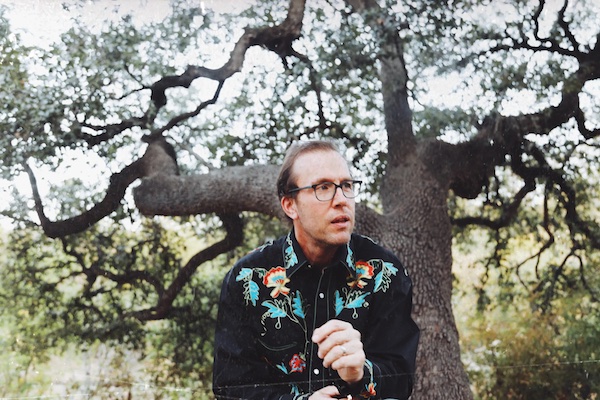
Terry Klein photo by Eryn Brooke
Terry Klein on The Subtle Changes and Completeness Behind Hill Country Folk Music

In November, Austin-based singer/songwriter Terry Klein released his album Hill Country Folk Music, working again with Thomm Jutz as producer. The title is something of an ode to Klein’s adopted home of Austin, and the album gathers together new songwriting, as well as songs that have been a part of Klein’s live presence but have never been canonized in the studio. While Klein loves the method that he and Jutz have established in recent years, and this album followed suit, including working with the same band of Jutz on guitar, Tim Marks on bass, and Lynn Williams on drums, there were a few differences that resulted in the fascinating texture of this new collection.
One of them was Klein’s gradual immersion into using a new guitar, and another was working without a click track, both areas where nominal discomfort produced outstanding results. Thematically, Klein also ranges from the heavy to the light on this album, and sequenced the songs to form a complete listening experience for audiences. I spoke with Terry Klein about what certainly seems like his most confident and seasoned album yet, even as it takes its place in his already impressive catalog.
Americana Highways: You’ve taken some new steps on this record, particularly in terms of sound. But you’re working with Thomm Jutz as you have for several years now. Did things change at all in terms of how you wrote, what you discussed, or how you recorded?
Terry Klein: He has changed, since I started working with him four years ago, a little bit. He probably wouldn’t admit that. On the first record, he told me that there were two rules. The first rule was, “You can’t tell the players what to play.” That’s still the rule. Then, the second rule was, “You’re not allowed to conceptualize.” The example that I give to explain that is, you can’t walk in saying, “I want to make a record that sounds like Dark Side of the Moon.” Or in my context, one that sounds like Car Wheels on a Gravel Road. That aspect of him has changed a little bit, where he was interested in what my concept was for this record, or if I had a concept.
I’m very stuck in my ways, so I said, “Well, no, the way that we’ve done this is the way that we’ve done everything in the past. Which is that we’re going to get a really good band together, and we’re going to play, and what’s going to happen is what’s going to happen.” I think his process has changed a little bit. It’s hard to say that my writing has changed, and he’s adjusted to that, since half of these songs are from before I knew him, actually.
AH: I did hear that several of these songs are older songs that had been favorites in your live playing, but had never been recorded. Nevertheless, this album does feel a bit different. Isn’t that the goal, though? Don’t you want things to sound a little different each time?
TK: Absolutely, with growth, and different textures, and that kind of thing. There is one really critical technical difference on Hill Country Folk Music in the recording process, and one less critical one. With the exception of one song, we did not record with a click track. Lynn Williams would set the rhythm and we would all just kind of float along, the way that records used to be made. When I first started making records, it was jarring and intimidated to have a click track. Now, it’s jarring and intimidating not to, because I feel like I have to be really good and on it.
The other really dorky technical difference, though, is that I made this record with a different guitar. It sounds different, it sits differently in the mix, in a way that we really, really liked. Those are two technical differences in how this one happened.
AH: I can see how those could both make a substantial impact. I’ve had people tell me that every new instrument has a song in it, and will tell them what it wants to play.
TK: That’s one of the parts about all of this that has fascinated me. This is a Collings, OM 1 model with an Adirondack spruce top, and a mahogany back, and mahogany sides. I got it when I turned 50 because I’d wanted one for ten years. I’d played one at a guitar store in Dripping Springs, Texas, called Hill Country Guitars, which is now long gone. And I fell in love with the guitar. All Collings are good. Once you find the thing that moves you, you get it. So I ordered one online, and it showed up. And there were songs in there, but it took like 18 months for me to literally throw away the box and the packing materials, because I thought, “I might have to send this thing back. I don’t know if there are songs in here. I don’t know if I want to get this out and play it live.”
And a bunch of these songs were written over that push-pull period. I think it took the song, “Hopelessness Is Going Around” for me to realize, “Okay, there are songs in here. There are songs that I like in here. I’m going to keep this. I’m going to take this out and I’m going to start playing with it.” With my older guitar, that I’d written on for many years, songs just tumbled out of that forever, but this one had a feeling out period, somehow, between me and this inanimate object.
AH: Absolutely, there has to be a breaking of the ice. Is it a brand-new guitar? That seems relevant.
TK: It was new, from 2023.
AH: Antiques seem pre-broken-in. I can see how, psychologically, too, this is a huge change for you, since you’d been building songwriting with that other guitar.
TK: Yes! And the other aspect is that it’s a fancy guitar. There were months where I said, “Do I deserve to play this instrument?” This is what Julian Lage plays and other virtuosic players.
AH: It reminds me a little bit of adopting a pet, and you don’t know each other yet. Or if you suddenly inherit a family member’s dog. And then you have your breakthroughs where you suddenly connect and start your relationship from that point.
TK: Yes, as the parent of an adopted dog who we’ve now had for nine years, that feels very similar.
AH: I can see why it might be intimidating, thinking, “This is the guitar my heroes play. Am I that guy?” What’s funny, is I hear that with this album. I hear you stepping into that role, and almost sitting down in a community of older songwriting, and broader sounds. To me, that album feels comfortable in that way. So I’m glad that you felt comfortable doing that. But now I know there was some discomfort for you, getting to that place.
TK: I think there was some discomfort, and I think that you can hear it. There are five songs, I think, that I started after the last record, and those are the first five songs on the album. So the second side are songs that I’d played, but hadn’t recorded, like “Yellow Butterfly” and “The Job Interview Song.” Or they were songs that were older, but there was always something that bothered me about them, and I fixed them. With the five new songs, I think you’re right, that they are about being a little older. You’re onto something, though I don’t know how to say it.
AH: I don’t know how to articulate it either, except that it feels like you’re more in conversation with the songwriting community of different eras. For the older songs, did you have to adapt them to the new guitar?
TK: Not really, but there were a couple of songs that I had written on different instruments, so I had to adapt them to the guitar in general. Like the song “The Dirty Third,” I had written on the piano, and I’m not a good piano player. Getting that on the guitar was a bit of a process. “Try” was a song that I wrote on the mandolin and you can really hear that, just in the melodic structure of it. For the other songs, the guitar is so good that everything just sounds good on it.
AH: I really like how “Try” becomes kind of a thematic song for the album, with that opening and closing version. That does kind of set the stage. Maybe that’s why I was thinking of older music regarding this album, too, because “Try” could have been a song from the last century, except that it’s also modern in what it refers to. It’s almost dream-like in feeling.
TK: I don’t know if you’ve seen Renaissance-era paintings of St. Francis up in the mountains, but that was kind of what I was picturing in my head. It turned into a song that, for me, is kind of unusually hopeful. The person who produced my first two records, Walt Wilkins, is still a very dear friend of mine. He writes very hopeful, positive songs, and I talked with him about that.
Writing songs from a place of hope is very hard. It’s much easier to write a sad song, to pour your guts out, at least for me. That was a change for me, with “Try” and, yes, there are elements of it that indicate struggle, but the fundamental aspects of it are way more about agency, and that sort of thing, in a way that’s kind of unusual for me. It was also just a really important song in the recording process.
I pulled up to the studio on the third day, and the song that was playing on my radio was “The Swimming Song” by Loudon Wainwright III. I have always loved that track so, so much. It’s a lovely, exuberant, piece of music. When I walked into the studio, Thomm was putting the finishing mix on the first track of “Try,” the starting version. It reminded me a little of that Loudon Wainwright track. In that moment, the song felt so optimistic and defiantly so, because these are not days of optimism. They really aren’t!
AH: Yes, I think I know what you mean. You don’t want to push your optimism on others or offer false hope.
TK: Well, when I heard that song, I said, “This is going to be the starting track. This is it.”
AH: Something that I think adds to the optimism of the first track is that rolling beat, that movement. By allowing that optimism, I think it forms a nice balance on the album with heavier material. For me, the heaviest song was “A Quiet Place To Sit.” I think I related it to my fears right now about what’s happening to the country right now, the economic downward slide. Do you think that you have heavier and lighter elements on the album?
TK: Yes, I do think that. It’s one of the things that, as we were nearing the end of the recording and mixing and process, made me feel really excited. It was the sequence of the eleven songs on this album. Some albums are easy to sequence, some are really hard, but with this album, the sequence revealed itself to me in about three minutes. It was so clear. There is a trajectory to it, where the first five songs are heavy, and there’s a devastation trajectory, and a mortality trajectory towards them, then in the second half of the album, up until you get to “Try Again,” for me it’s a little bit of a funnier and lighter.
“Musconetcong River” is a very wistful song, but there’s a sweetness to it. So the album moves from track to track. And I think the people who listen to the kind of music that I make really do listen to albums, still. From track to track, it just clicked into place in a way that was surprising to me, and was really gratifying.
AH: I hear what you’re saying about the heavier songs, because “If You Go” is a very serious song. Though I might have said that it was the heaviest song on the album, it wasn’t to me because it had that repetition, “You’re loved.” That really fills the song and offsets the extreme heaviness.
TK: I think in the pantheon of dark topics, suicide is in that pantheon. It was a very hard song to write. It took a really long time for me to figure out how to write about it. I knew that I wanted to, and I kept going back, and trying. I tried to write something on the piano, and that felt general and not specific enough.
Then, I was at the Moccasin Creek Festival, spending time with Bill Passalaqua who runs that festival, and he’s a dear friend of mine. I told him the story about how Dana Anderson, the last time I saw him, a week before he took his own life, he’d given me this really crappy self-help book that he hadn’t wanted to finish. But he’d given it to me because he thought I might like it. I don’t remember the exact words that Bill said, and I hadn’t been telling him the story because I wanted to write a song, but me telling him that led him to say something to the effect of, “I think that might be the song.”
So I played the festival, and I woke up before dawn the next morning to catch a flight out. The festival is in Illinois, and you fly out of St. Louis, so you cross over the Mississippi River. And I looked down at the eddies and currents, and at that moment, the song really took shape in my head.
AH: That image of the river becomes so important in the song. It’s perfect for the idea of things on the surface versus things beneath the surface, and the trouble beneath the surface.
TK: Yes. I’m still kind of left speechless by Dana in a lot of ways. He listened in a way that’s unusual for people to listen. When you’d talk to him, he’d listen in a way that was intense and was a real, generous gift. I think this is true everywhere, but there’s a surprisingly large songwriting community in Central Illinois, and the extent to which he inspired them to write, and to write well, is amazing. Dana has a legacy. That community lives on, and there are people who he’s inspired who are going to continue to write songs.
Thanks very much for chatting with us, Terry Klein. More details are available here on his website: https://www.terrykleinmusic.com/
Enjoy our previous coverage here: REVIEW: Terry Klein “Hill Country Folk Music”