



Mike Hollon photo by Corey Rourke Photography
Mike Hollon Finds Creative Connection and The Courage To Go Solo with Irving Park
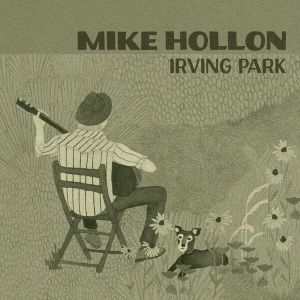
Mike Hollon recently released his debut album as a solo artist, titled Irving Park, and it represents songwriting and work that spans his time in various geographical locations, including his more recently adopted home of Asheville, North Carolina. It also gathers his musical knowledge and experience from writing and performing with bands, and represents the breadth of his live shows, which are a big part of his current life in Western North Carolina and beyond.
A hiking enthusiast who loves spending time in the local mountains, Hollon was interrupted in his recording of Irving Park by the impact of Hurricane Helene on the Asheville area, and spent time without water or power. The album actually ended up being recorded, finally, in his home state of Nebraska, helped along by contributing musical friends. That was appropriate because many of the songs on the album had been written there at Irving Park when, during the pandemic period, he discovered a renewed connection to songwriting through working outdoors. I spoke with Mike Hollon about his musical past, his perspective on the links between music and the natural world, and how music can help fill the silence, even when you may not yet have words to convey your feelings.
Americana Highways: I’m really familiar with Western North Carolina, and hearing about the context of making this record, disrupted by Hurricane Helene, sounds really difficult. I get the impression that you have played in bands in the past, but in recent years, have been delving into solo work. Is that true?
Mike Hollon: Pretty accurate, yes. In school, I played the saxophone, which I gave up, and I wished I hadn’t. I was doing pretty good last year, trying to read music with it. At the time, the guitar was more important to me, so that’s why I gave it up. I’ve been in a band, and I was a songwriter in that. I brought a lot of different influences to that power trio, called Stone Belly. We did our best to get out there.
I did that for several years, then almost out of necessity, and wanting to challenge myself a little bit, I got into solo work. I didn’t want to turn down the opportunities for shows. There would be so many times where we’d have an opportunity, but other band members couldn’t make it. I really wanted to go further with it. Everybody has to do their own thing, and we all learned a lot from each other, but it was a challenge to me. And it really was a challenge at first. A lot of places want you to play three hours, or two or three sets, if you’re by yourself, and I had to work up to that.
Everything I did, I’d see the risk and the reward were about equal. If I put the time in, I would get a booking, and it started snowballing.
AH: I can definitely understand the logistics issue, and there’s something to be said for being streamlined and mobile as a solo artist.
Mike Hollon: I was rereading the book Zen Guitar, which is really for any type of musicians. It’s written in a neat way. There was a line in it that said something to the effect of, “You don’t always get to play the music that you want to play. Many times, you have to play the music that you need to play, or have to play.” What I took for it was, “Maybe you want to be in the biggest Rock band, with a three-piece horn section, and you’re just jamming it out every night. Well, maybe you don’t a get chance to do that, but you have to get out there and play the best music you can.” I really took that to heart.
With a band, there were electric guitars, and amps, and I bring a lot of that to my shows, still. I bring guitars, and amps, and I’ve become a pretty good looper. But I also really enjoy bringing it right back down to just an acoustic song. What made you say that you had the impression that I’d been in bands?
AH: I said that just because your original music on this album is so multi-genre in approach. I often find that people who can write across genres have been in bands of different genres, and kind of collected that knowledge. I also know from your website that it was really the Covid situation which took you back to songwriting in a big way. I thought that was a really interesting journey for you, which sounded like it was about your life as well as about your music.
Mike Hollon: That’s very true. Honestly, before Covid, I felt like I was in a rut. The stuff wasn’t happening as quickly as I wanted. Covid made the band fizzle out for a while. Then, I got laid off from my job. I was thinking, “Jeez!” What I realized was that it wasn’t that I was in a rut, it was that I didn’t have any time for music. I was working a couple of jobs just to get by, and it seemed like the music got pushed to the side a little bit. It seemed like I was not really as prolific, and I wasn’t finishing stuff. I wasn’t finishing songs.
I realized, then, from going to Irving Park a lot during Covid that it was not about being less prolific, it was just about not having the time. I went to that park more that summer than I think I’ve been to a park in the totality of my life. There was something chill about it. I just started writing, and I started making sure that could continue to happen. I made that park part of my week, every day or every other day, if the weather was nice. It was in a cute little neighborhood with homes from the 1920s, an older neighborhood, and I really enjoyed it. I guess that’s where I started coming up with the idea that I wanted to do a solo album, and see how it would turn out.
AH: I got the impression that being in the natural world, outside in the park, during those writing sessions was helpful for you. I think if we don’t spend any time in nature at all, we start to forget to do it, and we forget the effect that it has. I think it’s an encouraging environment for creativity.
Mike Hollon: You’re absolutely right. Forgetting to do it is the key, too. I had forgotten to do it a lot! It wasn’t important enough to me, or something. I would take walks, but I wasn’t really in nature. When you’re in the forest, it’s good for the human body, and good for healing. It makes so much sense.
AH: It’s definitely an atmosphere that lightens everything up a bit, and you feel better afterwards.
Mike Hollon: If you’re moving and walking, it does help you process that. I have always found it funny, when out on trails, every once in a while, I’ve seen someone with a big Bluetooth speaker blasting Metal music. I’ve thought, “What is the point of that?” [Laughs] There’s already music all around you. You just need to hear it. I think they missed the point.
AH: I like how sound operates in forests. It’s so muffled and different. The ground and leaves absorb and react to sound so differently.
Mike Hollon: It can be so quiet at some points, that silence is almost deafening. It’s spooky and creepy, but in a cool way, wondering, “What is going on here?” There are a lot of black bears around here, and even though I’ve hiked hundreds and hundreds of miles in the mountains, I’ve never seen a black bear on the trail. I’ve seen them on the way to the trailhead, but not actually in the forest. That doesn’t mean that they haven’t seen me! As big as they are, they are super-quiet. When they walk on the ground, you can’t even hear them.
AH: My family sends me photos and videos of them sitting and enjoying the morning sunshine in their neighborhood. Just sitting up, like a person, being quiet.
Mike Hollon: I’ve recently seen a couple articles that they believe that bears kind of know that they live in a pretty environment. They sit and watch lakes, and sunsets. It’s like they are thinking, “Hmm, I live in a pretty cool place, don’t I?”
HMS: That’s wild! When you go out walking and stuff, does that give you ideas for music?
Mike Hollon: It always does seem good for me, even when I seem like I didn’t want to go. As far as music, I always hum little things into my voice memos if I get an idea. I can’t think of anything that’s really happened in the mountains, except one song that I’m still working on. It was because we went on a hike that never seemed to want to end, where we got sort of stuck when the sun was going down, and the rain rolled in, and then there was lightning. Looking back, it became one of my favorite hikes, because there was so much drama to it. I often get ideas while driving, though, which kind of sucks because you have to record it somehow, and if you’re on the interstate, it’s not easy to pull over.
AH: Do all of your songs on this album come from the sessions from the park, or are some of them from a later period?
Mike Hollon: Some of them are from the park. Some of them are from later, from Asheville, like “Blue Mountain Spring” and “Casablanca.” Some of them are from ideas that got developed more once I got to Asheville. A couple of them are older songs that I had written, that I felt never really got “realized.” I just kind of changed them enough that finally I felt that they were saying what I wanted to say. They often had better chords, better rhythm, afterwards.
The whole album was a little bit like that, finally feeling like I was saying what I wanted to say. “Casablanca” and “Blue Mountain Spring” were two instrumentals that I wrote here. “Blue Mountain Spring” is how the album closes, and it’s sort of a piece for after Hurricane Helene. It’s just a little instrumental about brighter days ahead. It came to be after Helene. I didn’t really have words for that. Sometimes I can write when I’m in the thick of something, but sometimes I need a little perspective, like the song “1000 Days.” A little perspective and removal from it gave me the ability to process and write that song.
At the time, I didn’t know what words to say about Helene. Then, that instrumental came along, and I think it kind of says what it needs to say. It has a Spring feeling to it, but it has some pushback, too, but then it comes back, and it lightens up again. It’s supposed to symbolize what happened, a little bit. Part of this album, too, was that I really just wanted to get these songs out there. I have a lot of other songs, and I’ve been playing all these songs live. I don’t want to leave songs sitting. It was super-important for me to get the album out this year. It was a personal goal.
AH: It makes sense, since these songs go back in time for you, back to the pandemic period and beyond. It’s an era of your life that you want to document.
Mike Hollon: Yes, it frees up mental space, too. It’s a lot of work to record an album, and you need to get it out there.
AH: I meant to say, by the way, how much I loved “Blue Mountain Spring,” and I’m glad you included it on the album. I love your explanation, that you weren’t ready to have words yet about Helene. But it really shows off your composition and playing. It has three phases where it winds up and down, and isn’t all building to a peak. It’s like trying again, starting over. Do you play that one?
MH: Thank you. Oh, yes, if it feels right, I’ll play that song. I don’t do that one every show, but if I feel that people will get it, I play it. Especially around here, if I think I can share the story about it, I will. I play “Casablanca,” a lot, opening a set.
Thanks very much for chatting with us, Mike Hollon. You can find more details and information here on his website: https://www.mikehollon.com/
Enjoy our previous coverage here: REVIEW: Mike Hollon “Irving Park”