




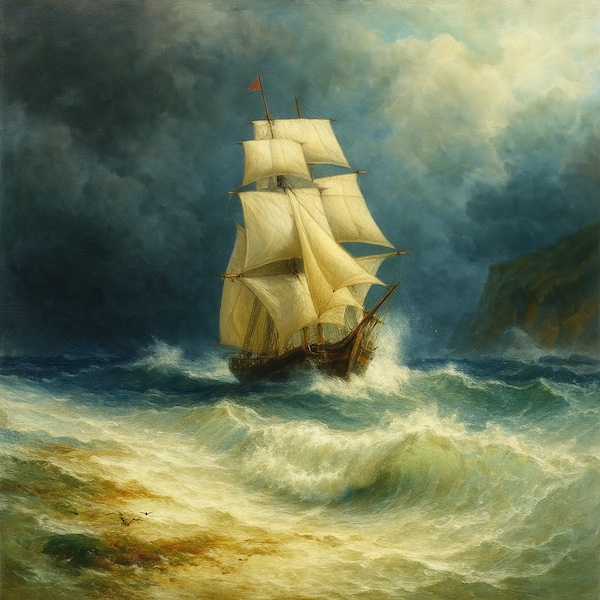
The Heavenly States “My Sloop”
Americana Highways is hosting this video premiere of The Heavenly States’ song “My Sloop” from their forthcoming EP. The EP was engineered, mastered and produced by Ted Nesseth and mixed by John Agnello.
“My Sloop” is core band members Genevieve Gagon on keys, violin, and voice; and Ted (Theodore) Nesseth on guitar, and vocals, with John Olrech and Erik Grostic on bass, and Danny Piccuirro and Jason Toll on drums.
We had a brief chat with Genevieve Gagon about the song and it’s a formidable tale of the ultimate fate humans have wrought on the earth, and the Olympian judgement of the gods. The premiere appears just beneath the interview.
Americana Highways: How did the concept and narrative behind “My Sloop” — supernatural beings judging humanity — come together, and what do you hope listeners take away from it?
Genevieve Gagon: This is one of those things that came together like a puzzle assembling itself. The fuel for the assembly was fury and fevered searching. The voices in the song are witnesses, taking stock of what “man” is and has done. They aren’t so much sitting in judgement than they are in a process of trying to find a way away from man’s acts and afflictions. It’s a pacing rumination that picks up steam, finds its legs and starts to run. This chorus of witnesses is more connected to the natural world, more protective of it than man has been, taking stock of earth’s situation. If survival should prove impossible, they fantasize about how to memorialize what has been wrecked by an imbalance of power.
AH: What would we want people to take from the song?
GG: We hope they connect with the rage, but also see how the experience of entrapment and rumination can progress to transformation. We hope they feel reminded of things greater than the human sphere. What the band did with the production of the song was to color in these feelings, find their direction and boost their energy – make them destabilizing, rumbling and physical. It’s a good example of how a poem differs from a song in that this tale needs to carry you off like a flood. It’s also an example of how an acoustic version of a song can differ from a fuller sonic experience. “My Sloop” needed to be cinematic yet seen with eyes closed. It needed to be orchestral in order to carry out its work.
AH: Your songs often wrestle with the chaos and contradictions of American life. How has your relationship to America — as a place, an idea, or even a character — evolved over time, and how has that shaped your songwriting?
GG: We have always tried to embed our insignificance in our work. We can be loud and we take things a bit far sometimes but it’s because we’re always trying to reset the terms of this “being a band” thing, or “adding to the culture” job. I think that’s one of the internal drivers of a lot of so-called avant-garde or punk “artists.” Creatives as such depend on a problematic cultural and economic relationship. At the micro level, we have turned down our share of record and management deals because they put us into a servitude and professionality which would have tied our hands. Yet, we needed to be close enough to our own business so that we knew it and could speak about it. We didn’t want to be myth-y special people. We needed to be working people, not just working musicians, because — for what we wanted to do anyway – it was not going to be enough to write about being on the road, processing snapshots of “American culture” from the artist bubble on the bus. We actively sought to stay awake through the endless night of oppression, not pretend to be special people with the power to float above it. We wanted to document how people crumble, how corporations get their hands around people’s throats, how evil and idiocy rise, how people fight. Being critical, searching, and un-branded are not a great fit for the music industry. From our place though, we were in a pretty good position to witness the homogenization and theft of all desire in our culture, each person being made to want the tools required to claim their piece of the sameness. People once used tools to attain other things, food, shelter, love, companionship, peace, privacy, community, the experience of being alive in bodies with life being it’s own end. The pressure on people now is to be TV-heads, web-heads, talking heads each our own brand, a nightmare of brands on a shelf stretching from here to Mars. We imagine that our thoughts and expressions must be broadcast, 8 billion voices screaming through the matrix of a handful of channels owned by a handful of moguls. There is no longer any object of this flattened desire. Life for itself has ended, which is perhaps why it is easier now for humans to hold any living thing in disregard. “My Sloop” is a song for the last of the living, now fantastical beings of conscience.
Speaking of being “special,” maybe “America” was a “special” character floating above the gritty lived reality of different populations united by their each holding a string to that lovely blue balloon. And then over time, fat bad actors became powerful enough through technology and the unevenness of knowledge to pop that balloon and position themselves there in their barges, like hideous Hindenburgs.
Another answer to your question would be this: I don’t think about Americans or America as such anymore. I think about people. I made this internal shift because the term “Americans” has been weaponized against its final enemy – Americans themselves, to divide and conquer us. It has been further deformed into a brand by a charter I didn’t choose. To this division and hopelessness, we the band say, hogwash – is that Americana enough? People are people and people can change. They can turn on a dime. Many of these People Formerly Known as Americans are lost, anxious, afraid, overpowered and estranged. They can change that once they are willing to set the Hindenburgs aflame, internally in their hearts, and see what actions follow.
AH: What inspired the theatrical, almost classical direction of “My Sloop” — and what was the process like in shaping its six-minute arc?
GG: “My Sloop” grew from being a song composed on piano into this 3-D monster of a sonic experience because we all felt driven to try to flesh out its feelings. It told us what to do, it was clear. If you go hear a live performance of Stravinsky’s Rite of Spring for example, you feel your bones shake. Maybe you read the liner notes about the sacrificial rites, maybe you don’t, it doesn’t matter. You are moved by some heavy sound that pushes you around inside. We had a clear vision of how the song would progress through rumination, loss, disgust and vengeance-lust to flashes of hope and empowerment, the weighing of options, the remembrance of who we are and also who we don’t want to be. We dramatized the sound of that momentum, the momentum of regaining one’s footing. Then we brought it to a stop on the head of a pin and turned toward uncharted seas. It was all to witness this internal struggle. We just painted it in.
This song is a majestic powerful apocalyptic creation that’s dark, moving, and ultimately offers a glimmer of hope. It’s a truly unique composition: “Justice and remorse, innocents be warned, thunder hunts for him, a hissing hunts his kin and all who follow him.”
Find more details here on their website: https://www.theheavenlystates.com/