






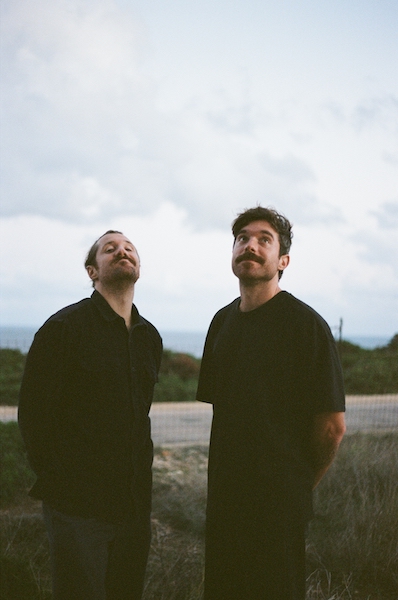
Amistat photo by Glynn Parkinson
Amistat on Finding Joy In The Stripped-Down Direction of Their What We Are EP

Amistat is an indie folk duo made up of German-born, globe-trotting twin brothers, Jan and Josef Prasil, who released their new EP, What We Are, in late March. The EP represents a development for their sound as they brought in banjo and mandolin, and continued their inclination towards created a more stripped-down sound both in the studio and through their “live from home” release videos. Amistat’s new songs have also kicked off a large European tour that they hope will bring them back to the United States this autumn, since they have a following here awaiting their arrival, too.
Jan and Josef have been outspoken about their views on music, and its role in society, in the past, and essentially don’t feel that art should be created for the increased popularity of the artist. Instead, they feel that it should serve the needs of audiences and fans, and help them form a connection with each other. The songs on What We Are speak to personal states of struggle, but are also reflective, and encouraging, like “Stranger” which insists on bridging the gap between parties who aren’t connecting anymore, and “Sweetheart,” which is as much about caring for yourself as for others, seeing that as a continuum. I spoke with Josef Prasil about the ways in which Amistat records music, what led to the use of banjo and mandolin this time around, and their experiences with fans during live performances.
Americana Highways: Is the EP a usual format for you to release in? Your singles seem really important to you also.
Josef Prasil: There’s no real map, or right or wrong way to do it. What you could do with EPs is record the second half of an EP, and then release it as an album. There’s a million ways of doing it.
AH: I saw mention of the fact that you record only a couple of songs at a time, which plays into this. It sounds like it’s your natural way of working with recording. Have you ever recorded a whole album in a short period before this?
Josef: Yes, we have done that, probably in 2015. We did a full-length, 12-track album, and back then we had a lot more time, because we weren’t nearly as busy touring. We weren’t as far along in our career, and had so much time to write songs, that we had plenty lying around, so we went in and did three weeks in a row in the studio. I don’t think that was healthy. We only had two or three days off within that time. That was not good, and I wouldn’t do it again that way.
Obviously, when you go into the studio for that long, you have more time to get into the flow of things, which can be good and bad. After a while, I think you tend to overthink and not be as objective anymore. If you’ve been in there for 12 days, you begin to hit this ceiling where you may lose the vibe that the song may need. But if you only have four days in there, you may get the mood when the song is fresh, and you don’t overthink things. I find it really refreshing to do things the way we’ve been doing it now, just two or three songs at a time. Traveling as much as we have, we don’t have much time to write, but after this year, we have prioritized that again. Probably we’re going to skip touring so that we’ll have more time to create music. We’ll release a bunch of singles, probably, which will lead to an album.
AH: If you decided to do a full album next time, will it be easier on you in terms of your recording method, and do it in smaller chunks?
Josef: One hundred percent. I think it’s not healthy for us otherwise. Back then, we did it that way to save money, but I’d say anything longer than four or five consecutive days in the studio is not something we can physically do. I don’t think we’d be doing ourselves a favor, or the album. We would approach it differently, for sure.
AH: I have a kind of sense, when I listen to this EP, that since it’s music that moves towards positivity and a meditative feeling, it makes sense that you want to record it in a positive and meditative way. Otherwise, it’s very hard to construct that, if you yourself are feeling crappy.
Josef: Yes, absolutely. I think, over the past few years, its crystallized itself as the way in which we pour the most energy into the songs and not drain ourselves. If you can’t capture the magic in the studio, it won’t translate with the listener. Is it the ideal way? I’m not sure, but it’s worked so far. We may try different approaches in the coming years.
AH: Speaking of experimenting, when did you start thinking about having the banjo and mandolin on this group of songs? Had you been wanting to try that? Was that a conscious decision?
Josef: I would say yes, definitely it was a conscious decision to put a different spin on things, and on the production. The mandolin, and sometimes even the banjo, kind of just happened. We had a mandolin lying around and said, “Why not try it this way?” It felt great! To be honest, in the studio you tend to lay too much on things, putting too many layers. For “Sweetheart,” for instance, this time we said, “Look, we write music on one instrument, so why not try to record like that, and just keep it naked?” That’s when that song came about. We consciously tried to be open to things going anywhere, and it’s been fun, a new adventure in different instruments.
AH: I think it makes sense for these songs, but it also makes sense with your other activities, where you put up videos playing live at home, or do acoustic versions of your songs. It seems like part of your personality, anyway, so it’s a great transitional element to take the songs into another format.
Josef: Our background is very much folk and acoustic, so it came naturally to us to do less. We love that. We love stripping things back and just having guitar and vocals, or guitar and piano.
AH: Your live from home videos make me stop and think, “What is music, really? What am I listening to?” It’s such a contained unit of just two people, but there’s so much sound and it causes so many reactions in me.
Josef: That’s very true. I love listening to a very reduced versions of songs. That’s what I love listening to, live versions. I prefer it over produced versions of songs. You just feel everything with rawness and realness. You peel it back to just the artist and the instrument, and it hits you so hard sometimes. It’s astonishing how much it can move you and touch you. That’s how I love to consume music.
AH: In recent years, there have been a lot more live releases of music, not just from current artists, but looking back through archives and finding live recordings of bands from the past. Fans really seem to want to dig into those tracks. This was big in the 1970s, but it seems like this might be just as big a time for live recording.
Josef: I agree. A lot of artists are recording live. I’m a huge Zac Brown fan, and I love the fact that most of his songs are recorded live in the studio. I think it translates with a lot of people. I think Covid did a lot of weird things to people, and people craved the connection and the realness. I think they are fed up with things that are not genuinely made. When something is straight up and candid, I think people just gravitate towards it. I agree with you. I think it’s a big time right now for honest, heartfelt music, with not a lot to it. They just want to be given the heart, and people want that.
AH: I think we’ve recognized our need for that more fully.
Josef: I think it’s a good time for music like Jan and I do, and also for artists who have always held true to craft, and keeping it real, and not going mainstream or pop. I think it’s flourishing at the moment. It’s a good time to be doing folk, indie, and singer/songwriter stuff. I think Zac Brown and Noah Kahan have really turned things around for that type of music.
AH: I have a philosophical question for you: Do you and your brother feel like you come from a musical tradition that goes back before the 1950s to more traditional roots in homes, or in older concert halls? Or do you see yourself as part of a more recent tradition?
Josef: That’s a hard question to answer because maybe music meant different things to people in different centuries and maybe that’s changed over time. But I think our energy is definitely part of a tradition of music that was designed to bring people together in homes or small spaces, and to just connect. It was meant to be enjoyed together, and connect the people together. That’s evolved in many different ways.
I feel like, especially since streaming came along, that it’s become more about quantity than quality. Everyone’s creating music, okay, and it’s a big business, but why are people creating music? I think that’s gotten lost. I think it’s become more of a business now, and because so much music is being put out, normal people are just overwhelmed by the sheer amount of music that’s out there. There may have been a sense of urgency to music thirty or forty years ago because it was more limited and the purpose of it was different.
I just want to write music about something that’s in here [pointing to chest], and I need to get it out, but it’s also for the people, and not about me. It’s not about me being a star, and being on social media, and making it about me. It should be about music. That’s how I think it should be. I believe that in the 1950s, 1960s, and 1970s, it was more about creating music and giving it to the people, and me and brother are very much in that way of thinking. We write this music, and we channel it from somewhere, and we give it to the people. It’s about them enjoying and consuming music.
AH: Have you been able to share any of these new songs with people live yet?
Josef: We’ve only played one show, in Capetown, where we played some of these songs, and people sang along, which was really nice to see, because they had only been out a few months. It was the first time we’d played a headline show since release. Now, we are starting a tour in a few days, and then it will really start to show. Even when we were in the United States last September, the song “What We Are” was out. We played that song for the first time ever, and people were singing from the start, all the way to end. I thought, “Wow! This is nuts!” It was great.
AH: You have a very sizable online following, so this must be surprising for you to actually encounter those numbers in real life, while performing. Sometimes you don’t realize that until you see it in person, right?
Josef: Online, it’s so intangible, so you really don’t know. You have your stats on Spotify, or whatever, but you really don’t know until you’re in the same room with people. Also, people may know every word, but they still don’t sing. There are certain countries that are more inclined towards singing than others. Having not been to the States before, we didn’t know what we were going to get, so it just blew me away.
Thanks very much for chatting with us, Josef Prasil of Amistat. Find more information about Amistat here on their website: https://www.amistatmusic.com/