





James Cook of Captain’s Audio Project Brings Historic Instruments To Waiting For The Moon
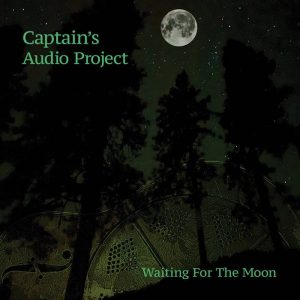
On March 1st, 2025, Portland Oregon-based songwriter and multi-instrumentalist James Cook will be releasing his solo debut under new project name Captain’s Audio Project, titled Waiting for the Moon. Cook is best known as the co-founder of the long-running and beloved band Trashcan Joe, a band where all the players contribute songs, sing, and perform on home-made instruments. After many years spent playing upright bass as a professional musician in the San Francisco area, and also leading a project as singer and songwriter called The Wags, Cook relocated to Portland and it was there he was bitten by the home-made instrument bug.
But the pandemic slowdown as well as his tendency toward prolific songwriting soon got the better of him, and with a pile of songs in hand, Cook heeded the invitation from a friend to begin recording his own solo work. In the end, it became far less solo than intended as Cook’s roots in the music community soon pulled in many excellent contributors, joining his own 1931 National Tenor Resonator Guitar, and 100-year-old upright bass. Mike Danner added piano, Hammond B-3, and Wurlitzer electric piano, Paul Brainard added pedal steel as well as the “Paul Brainard Horn Section,” and Willy Mathis and Scott Van Schlick also added their magic. I spoke with James Cook about his life in music, becoming a home-made instrumentalist, and how Captain’s Audio Project took shape for him.
Americana Highways: I see a connection that you have with the natural world, and since I’ve lived in the Portland area, I can see how there’s just so much inspirational landscape around you to draw from.
James Cook: I can literally hop on the road and in twenty minutes I can be on the [Columbia River] Gorge. It’s just absolutely beautiful. It is one of those things where every day, driving around, you say, “I can’t believe I live in this place.” It’s absolutely stunning all the time. I do get out and hike and I still get out camping a lot. These days, the camping is more associated with music festivals!
AH: Nature still sometimes feels like it gets the upper hand in some places, which is a special feeling.
JC: That is true. In Oregon, there is much of the state that is nearly empty. Most people think about Portland, when they think of Oregon, and most of the population is in the area, but in Eastern Oregon, there’s so much that’s not very populated. I used to love driving in Eastern Oregon, and I’d look on the map and I’d be like, “Welp, there are no roads for a hundred miles east of me right now.” It almost makes you feel like a pioneer when you’re out there. There’s just nothing, and it’s an amazing feeling. It feels like you’re just a visitor.
I actually grew up in San Diego, and it was a nice place to grow up, where the weather was always sunny and 72 degrees. But I used to spend summers up in the Northwest because my sister lived up here, and gradually, through my life, I moved further North until I got to Portland, and then I thought, “Okay, this is home.”
It has the best of everything because, for a big city, Portland has a lot of small town feels. Even though it has music, art, and a symphony, which is attractive for a metropolitan area, but I can be in a wilderness in minutes. There’s not many places that you can do that.
AH: You lived and worked in music in San Francisco for a number of years. Was that formative for you in terms of finding a music scene?
JC: That’s where I decided that I was no longer a dreamer musician, and I actually was a professional musician, because I was making a fairly substantial part of my income from music. I had taught music, but it was never really my thing. The reality of the professional musician scene is that you have to teach, and do a lot of gigs that might not be glamorous or fun, but as a songwriter and a composer, and someone who considers music really sacred, I didn’t want to hate it. I didn’t want it to be a job like that. I was able to do that. I had an original sounding band and I was able to keep busy playing small clubs in San Francisco.
What I did was that I got accepted to what was then called the North by Northwest Music Festival and I came up for that. When I was up here, I explored Portland and it was the beginning of falling in love with the place. The funny thing about getting gigs then, around 2000, was that it was so low-key. One of the first clubs that I called to book a gig, I ended up talking to the owner of the club, and after about ten minutes I said, “Could I send you a demo?” And he said, “No, that’s okay, we’ll just book you.” [Laughs] I thought, “That never happens in the Bay Area.” It was that low-key. It’s changed some since then, and it’s more competitive now.
AH: Getting going in Portland, you were primarily working with bands, right?
JC: One of my longstanding bands, Trashcan Joe, has been around for a long time. We were playing a lot, and it got to the point where I didn’t really have to do much when it came to booking. Booking can be a big pain, and I don’t like the salesman aspect of that, but we didn’t really have to work too hard at that, but then the pandemic came around, and it really pulled the rug out. Now, we don’t play as often, although we do get big shows, and we’ll do big theaters collaborating with circus troupes and things like that. That’s really fun. There’s a local circus troupe, The Rose City Circus, who we have a great collaboration with. We basically give them our music, and they choreograph their acts to our music. We’re half the show, and we play our songs, and then there’ll be acrobats, and jugglers, and dancers coming out, and they’ll choreograph their act to our music. We sold out a big theater for a couple of nights in a row for Valentine’s Day. It’s really fun.
AH: As far as I understand, Trashcan Joe shows an interest in historical musical tradition. With Captain’s Audio Project, I can see some of that as well. Is your solo project something that arose because of less playing for Trashcan Joe?
JC: I’ve always been a prolific songwriter. I started writing songs about age 14, and it’s the thing for me. At one point, a long, long time ago, I tried to count the songs that I’d written, and I came up with about 1500. As you evolve as a songwriter, you shed much of that stuff. Much of that music, I’ve kind of pushed past. I’m a decent musician, but my ace in the hole is really my songwriting. That’s always been in the background with my bands. Previous to Trashcan Joe, I had a band called The Wags. I was the singer, songwriter, and leader of the band. A couple of things started the evolution that led to Trashcan Joe.
When I got to Portland, I was still playing upright bass, and I kind of used that to enter the music scene here. When I was in the Bay Area, I was in a band that toured a lot, in Europe, and up and down the West Coast. I trashed my bass doing that, which is about 100 years old. When I got to Portland, I found a really good luthier and told her that I wanted to get my bass fixed up, and wanted it to be good for 20 years. She had the bass for about a year, working on it. During that time, I had been into the old jug-band music, and DIY, old-style music where, in rural populations, they used things that weren’t necessarily musical instruments to make music. Like washboards for percussion, for instance, and blowing into an old jug for the bass sound, and washtub basses.
I started thinking that maybe there was a kind of bass that I could build, and I could fix, so that I wouldn’t necessarily have to haul around my upright bass, and that would be a good idea. I started researching it, and there was a washtub bass website that existed at the time. The original style used a washtub, a stick, and a string, but it was really hard to get accurate notation with that kind of bass. But then I saw there were people making washtub basses with a stationary stick, and they’d use metal wire for a string, then they could play up and down the stick and change the note. I started working on that, and I came up with an instrument that sounded really good, though it was just one string. You could play old-timey jazz or bluegrass and it would sound like an upright bass. It was kind of a joke to do it, but I started thinking, “What if I could have a home-made instrument band?” I ended up building a banjo, and it ended up sounding great. So I put together a band. At that same time, I met my friend Jason, who started Trashcan Joe with me, and we both had a love for old time, swing, jazz, and roots music.
As I mentioned, when I got to Portland, I had been the songwriter and band leader, and I was kind of sick of being that guy. I didn’t want to be the only one doing that. So one of the concepts behind Trashcan Joe was to have a band where I wasn’t the only singer. I wasn’t the only person doing it. The way it works with Trashcan Joe is that everyone in the band sings. We all take turns. When we play a gig, we almost never use a setlist, we just ask, “Who wants to do the next one?”
Getting back to how that translated into Captain’s Audio Project is that what I found was, though I’m able to do my original music in Trashcan Joe, I write so much music that a lot of it was falling by the wayside and not really getting performed. A bandmate of mine, who’s accordion player and has a studio said, “Look, you have so many great songs, why don’t just come in, and we’ll set up a microphone, and you can just sit down with your guitar. You’ll sing your songs, and we’ll put out a record like that.” That’s what we did.
AH: Were you going for a live sound by recording in that way? I know there are, in the end, many more instruments on the album than that!
JC: I basically just sat down with a mic for vocals, and one on my guitar, and I played what I considered some of my better songs. Once that was finished, I thought, “It sounds good, but I played tenor guitar.” It’s kind of a high-pitched instrument, so I really felt like the songs needed bass. So I brought my upright bass in, and I played on the tracks, to give it a little more bottom-end. The accordion player is also a keyboard player, who plays Hammond Organ, and other things, so I thought, “We really want to add some depth to this, maybe, so let’s put keyboards on some of the songs.” We ended up putting keyboard on most, if not all of the songs.
After that, it was sounding so good, that we thought, “Let’s bring our friend Paul in to put some pedal steel guitar on the songs that are Country sounding. We’ll finish it off by having him bring in his horn section and put horns on a couple of tunes.” After all that, it ended up being quite a bit more of a project than I expected! But it sounded so good that I felt like I was going to have to make an effort to get this out in the world and do something with it.
Thanks very much for spending your time with us, James Cook. Find more information here on the BandCamp page: https://mudporch.bandcamp.com/album/waiting-for-the-moon
Enjoy our review of the album here: REVIEW: The Captain’s Project “Waiting For the Moon”