





Interview: The Members of TopHouse Discuss Their Newest EP, Practice, and Their Journey as Musicians

Montana-bred/Nashville-based indie quartet TopHouse released their fifth EP, Practice, on Valentine’s Day. The EP presents a collection of six introspective songs dealing with themes of personal struggles and challenges, traumas, heartaches, and loss. Practice is a bookend of sorts to the band’s May 2024 release, Theory, which offers songs of a more optimistic and idealistic nature.
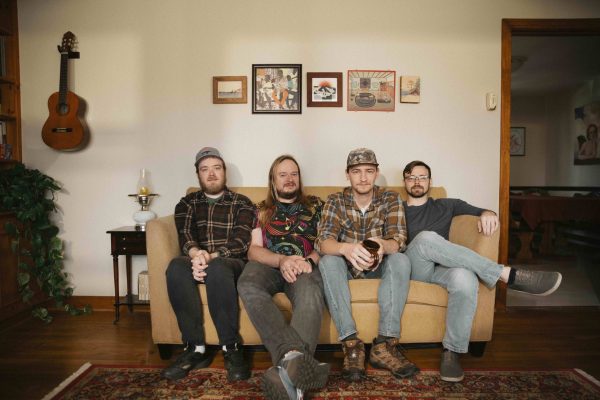
TopHouse is comprised of Jesse Davis (songwriter, guitar, and mandolin), William Cook, (violin), Joe Larson (guitar and lead vocals), and Andy LaFave (piano).

In the weeks following a December 2024 performance in Milwaukee, we had an opportunity to chat with the four members of the band. Our discussion covered a wide range of topics, such as their long-standing friendships predating the band’s formation, the impetus for the widely differing approaches of their releases, Practice, and Theory, why they want to avoid having their music pigeon-holed within one genre, and the sources of the Celtic influence in their music.
Here is an extract from our discussion, edited a bit for clarity.
Americana Highways: Please describe your start as a band.
Jesse Davis: William and I met in college in Missoula around 2013-2014. We started doing street performances with instrumental songs and he mentioned that he had this friend Joe in another town. William said they used to play in a band together and Joe was going to move here. I thought it would be great if that happened, and it did. Joe moved to the next town, we began to play together, and I think that officially marked the birth of TopHouse around 2016.
William Cook: Yeah, it was 2016.
Jesse: Then we were just kind of playing around Montana, around Missoula for a time. We moved to Nashville in 2019. Meanwhile, Andy was on a side quest teaching kindergarteners the power of music and during or after Covid started, he said it was time for a career change. I don’t want to put words in your mouth, Andy.
Andy LaFave: That’s exactly it.
Jesse: Andy then moved to Nashville as a kind of a change of pace thing, but not originally with the intention of joining TopHouse. However, within about 6 months. . . .
Andy: It kinda happened.
Jesse: That’s when the 4 of us got started in 2020.
Joe Larson: William, Andy and I all grew up together. We’ve known each other since we were like 10. Andy and I had the same piano teacher. We were in lots of terrible bands together through middle school and high school. So, it was a pretty natural fit to have us all end up in Nashville.
William: The other piece of this is that I met Jesse initially through the composition program at the University of Montana. We met through a mutual friend. We’ve known each other longer than the band has existed, which was pretty cool.
AH: Where did the name TopHouse come from?
William: So, there were a few different choices. Initially, all of them were pretty terrible, like “Irish Jujitsu.” I was looking through my journal entries a while ago and apparently there was a name like “A Thousand Miles” that came up. TopHouse stuck because Jesse and I and our mutual friend all lived on the top floor of a house. We used that as a possible name for an earlier project. Somehow it became this project’s name. I don’t know quite how it happened, but it was fun making the logo. That was the other thing. It was memorable and we could put a little slash over the word TopHouse, and it looked like the word was house.
Andy: We asked all of the women in our lives if they had names they liked the best and TopHouse was the winner. I think the 2 finalists were Irish Jujitsu and TopHouse and, well, you know which one won.
AH: Jesse, William and Joe–did you all move to Nashville about the same time?
Joe: Yeah. William, Jesse and I all moved here at exactly the same time. From the beginning of our band days in Missoula, it was our goal to move while we were waiting for me to graduate in business. Jesse and William were both in composition. Once I graduated, the three of us just packed up our cars and drove to Nashville. Andy moved about 6 months later.
AH: What was your motivation to go to Nashville?
Joe: I always thought there was always a dual motivation. Maybe one was a naïve sense of ‘you gotta move to Nashville to make it.’ Like finding connections or a label or a studio to move into or whatever that all means. We didn’t know what any of that meant at the time and we still don’t (laughs). There was the making connections side and on the other side of the coin, I think we knew this would be a crossing point in our own personal lives. If we moved, that meant we really had to take this seriously. It was nice to move and then we were mentally really in ‘it.’
Jesse: There was now a mental and physical separation between all of our home and community back in Montana versus we are now in this place to do this thing. We were thinking “If we are not doing this ‘thing,’ then what are we doing here?”
William: To be deadly practical, I had a job offer and Joe and Jesse were in very serious relationships and if we had stayed in Missoula, that probably what would have dictated our lives. Instead, we said “Nope we are going to go and play music instead.”
Jesse: To be clear, we weren’t in relationships with each other! (laughter)
AH: In the beginning, it sounds like your initial quarters in Nashville were pretty cramped. I’ve seen a reference to a 400 sq foot Airbnb where you lived.
Joe: Yeah, there was one door in the whole building, and it wasn’t even to the bathroom. The bathroom had like a little curtain attached to the kitchen. It was definitely a tight spot. The smoke alarm probably went off like 6 times a day from cooking.
Jesse: William went through a phase of cooking pork with Cajun seasoning. We would be sitting in the other room, which was like 5 feet away, and we would all start crying because the Cajun seasoning would just hang in the air. The pork was really good, though.
AH: You moved at an inopportune time just before Covid hit. What did you do during the height of the pandemic?
Joe: It’s interesting because Covid wasn’t really detrimental for us. We weren’t touring at that point anyway. Music wasn’t our main source of income. I was working at a landscaping job, and I could keep doing that.
William: It gave us the opportunity to hunker down and make YouTube videos. We covered songs and played a bunch of music in our Airbnb. In a weird way, it was a mixed blessing for us.
AH: You have just released your EP, Practice. Please say a bit about that EP and what the songs represent to you?
Jesse: This is kind of a cool thing. We had a whole bunch of songs written and halfway done. Maybe 10 to 12 songs. I remember sitting down and thinking, alright, are we going to make an album. We first realized we could split these 12 songs into two categories. One category would be this sort of idealistic, hopeful worldview where you can look inside and ask what kinds of ideals are you are going to reach for. The other half of the songs were about these real-life situations like, oh, my relationship ended, I’m struggling with depression or addiction. Just those real-life situations where life punches you in the face and the ideals get dropped out of the window.
And we thought this is kind of a cool delineation that we could put into 2 EPs. So, we did Theory, which has these idealistic songs that are very hopeful and optimistic and then we did Practice, which is a cool project for us. We are known for happy and optimistic songs that brush over the hardships in life. Practice is cool because it’s raw for us—it’s one of our more real projects in the sense that it’s more emotional and deals with life’s challenges. As a project, we are really stoked.
Practice ends with the song “Falling,” which is about learning how to feel again and how to love again. I think if we had to come up with a thesis for Practice it would be this–life can hit you in the face, but love wins out. Hope wins out. That represents the broad paint strokes of the project.
AH: Please tell me about the influences on your music over the years.
Jesse: That’s tough to gauge because our influences seem to be continually shifting. I feel like it could really be anything from a Rachmaninoff concerto to a metal song. I guess I don’t know how to answer that.
AH: Let me rephrase that a bit. It’s pretty clear to me that Celtic and Irish music influences are pretty strong within your music. Perhaps you could start by talking about these influences.
William: There was a point where we ended up playing a Celtic festival when we really didn’t know many Celtic songs. It’s kind of a hilarious story. We were playing in a coffee shop very early in the band’s history, maybe after we’d been around for 9 months. Someone walked in and we were playing our one Celtic song. They hear our music and they’re like “Oh man, do you want to play our Celtic festival?”
I’m the organizer, so I said ‘oh yeah, we’d love to’ because we had never played anything that big before. So, we locked ourselves down after that and we learned all these Celtic songs in order to play the Celtic festival.
I think that was a turning point where a lot of those ideas entered our songwriting.
Jesse: Also, I think the Celtic DNA might have been there already to some extent because Joe, William and I grew up in Butte, Montana which is a very, very Irish mining town. It’s like one of the most intensely Irish towns in America. We were kinda surrounded by that influence. So I think the DNA was there already if that makes sense.
AH: What was the one Irish song that you knew at that time? Was it “Galway Girl?”
Jesse: I think it was “Wild Mountain Time.” Probably The High Kings version.
AH: Have you given any thought about expanding your touring through the Midwest Irish Festival circuit?
Jesse: I’d say that we have given that some thought. We love playing with Scythian and I’m a huge We Banjo 3 fan. The answer is definitely yes, we’d love to play the Irish Fest circuit. Whether we do it or not I guess time will tell.
But right now, our goals are to not be too associated with any specific genre. In the same way, though, we are grateful for all of these genres that have come before and defined our music. We are also trying to not become too associated with bluegrass. There have been a number of bluegrass jam festivals where we have had opportunities to play. We’ve just become a little more choosy about where we will be playing.
I think we might fit better into Irish festivals than we would in bluegrass festivals, but we would still want to be choosy. It sounds kind of snobby but we’re trying to be careful about where we play.
There are definitely Irish festivals that we would love to play. Milwaukee Irish Fest is one we have heard a lot about. The Dublin Irish Festival in Columbus, Ohio is also one where we would like to play.
AH: How do you divide your responsibilities between singing and songwriting?
Jesse: Joe and I kinda split songwriting but it certainly wasn’t an assigned task or anything like that. With our creative roles and our roles in more administrative capacities, it just sort of seems that we take on roles that fit naturally with each of our own abilities. Now that I’m thinking about it, it’s just kind of fortunate the way our roles have divided up.
Andy, for example, is a whiz with social media things and is more in the current cultural moment. That is a natural fit for him. William is a computer nerd and a mad violin genius, so he gets to do a lot of video editing on top of setting up some solos. He also has a marketing degree, so he fits into that realm. We’re pretty fortunate for the way this has all divided up.
AH: After seeing your live show in Milwaukee, it’s apparent you guys don’t take yourselves too seriously. Beginning with William’s monotone introduction to the set, and the ‘bad dad’ kind of jokes that occurred during the set, to me it was clear you guys were having a lot of fun up on stage. Are all of your performances that fun and infectious from a humorous standpoint?
(The group laughs).
Joe: I love that this came across because it is very true.
Andy: We hope so! Humor is in the eye of the behumored!
Joe: Humor is an increasing part of our persona as we’ve progressed, or regressed depending on your point of view. I feel like if we aren’t having fun, then what are we doing? It’s fun to act like that on stage. It feels natural and it’s who we are as people.
Jesse: We’ve been told by a few people now that they don’t feel they are necessarily at a show but it’s more like they’re hanging out with four random guys on stage. I actually really like that interpretation of our shows. If you can show up someplace and just feel comfortable as though it’s a hang out, it seems like that’s a good thing.
AH—Thanks for the opportunity to sit down with us, guys!
For more information about TopHouse, including their upcoming tour schedule, please visit their website: https://TopHousetheband.com
Related Post: REVIEW: TopHouse “Practice” EP