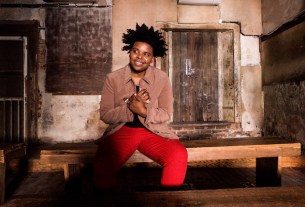
Andrew P. Oliver photo by Dan Johnson
Brother Oliver’s Andrew P. Oliver Talks Producing For Forthright Records
Andrew P. Oliver is one half of psych and folk rock band Brother Oliver, a band which in their native Greenville, South Carolina, has had a “Brother Oliver Day” instated in their honor, celebrated on August 30th. Since 2011, he’s also been one of the owners and operators of Forthright Records, a music label and film entertainment studio, working alongside his brother Stephen and their visual director Dan Johnson.
Most recently, you might have come across their new film documentary on Apple+ and Prime, How To Break a World Record, focusing on mandolin player Stephen Oliver, as he tries to break the Guinness World Record for the longest marathon playing the mandolin.
All of this has made for a very busy few years for Forthright Records, but that has also included Andrew Oliver continuing to record and release music of his own as a solo project, as well. In all of these different spheres, you’ll find him in the audio production seat. I spoke with Andrew Oliver about how he carved out that role for himself and about its interconnected nature when it comes to working on projects for Forthright Records.
Americana Highways: You have a label and are a producer. Does that mean that you produce other music, or just for your own solo releases and for Brother Oliver?
Andrew P. Oliver: I have done a fair amount of that in the past. In the last three or four years, I have done very little of that, because we have been so busy with our own projects. I’ve really prioritized our own, in-house production. We’ve released a ton of music in the past few years compared to maybe the past ten years before that. We’ve also done a couple movies, producing them.
I did the mixing and the mastering for those on the audio side of things. I’m not opposed to doing more engineering work for other artists in the future, but I’m taking this stance that I want to work on songs and with other artists who really excite me. For me, it’s not just about paying a rate and scheduling. It’s more, “Does this project actually make me feel something? Do I get excited about the concept of working with this?” I’ve been fortunate enough to stick with that so far.
AH: I can definitely decide it needing to be personal for you. I did notice that you all have made a documentary, recently too, which I imagine was a huge amount of work. The other thing that’s distinctive about your company is that it’s also a film company, which is pulling you in multiple directions. And on top of that, you did a soundtrack for the film.
AO: The movie came out in June, and we’re hoping when the next big platform picks up, we can release a soundtrack. Creating a soundtrack was a lot of work, but it was a lot of fun, too. We used a lot of our own music in the film, obviously, but we also used a lot of other artists. We sourced a lot of music from artists who we had personally discovered, worked with, or know, and were able to make the soundtrack a little more eclectic. Honestly, we wanted to use the best song for the scene, no matter what. If we looked at our catalog and felt like we didn’t have the perfect song for a scene, we would go and seek out someone who did have that perfect song.
AH: I’m sure those artists appreciate that, because the documentary has been released on Apple+ and people can stream it in various ways, and that’s a wide platform for exposing audiences to new music.
AO: We’re still pretty early in the release. Right now we’re on Prime and Apple, and a handful of other platforms. We are in a window where people can buy and rent the video, but after that, we hope it gets picked up to a subscription-level, and that’s typically where you see the biggest influx of audiences. Fingers crossed! But the response to the movie has been really strong. It’s much more enveloping than our previous experiences, because people watch it as a documentary shot in a reality style, and that makes it feel like they’ve been hanging out with us for a couple of hours. It’s cool because they reach out afterwards and it feels more intimate. Music is intimate, too, but most songs aren’t two hours long with an incredible, and sometimes painful amount of detail about yourself!
AH: Does it take some adjustment to see so much footage of yourselves, and then be the editor, too?
AO: Yes, it’s odd. We’ve been doing video work for a few years, but making a movie is taking things up a level. We did have the time of our lives, though, because we Produced the movie ourselves. Dan Johnson, who was the editor and director of the film with me, is a really close friend of ours. Obviously, my brother Stephen, was the main character of the film, so it was like hanging out with friends constantly. In post-production, we also get the privilege of deciding on the final cut, but our strategy was to keep things authentic and raw, so it’s not like we were cutting a bunch of stuff out because we thought, “I don’t look good in that light!” [Laughs]
AH: That would be an understandable temptation!
AO: We didn’t do that as much as people might think. If it was important to the movie, we left it in.
AH: How did you get into doing production work, and how does that relate to your trajectory with forming Brother Oliver?
AO: For me, starting recording music and production goes back to when I was 16 in high school. We used to make silly videos, like skate videos, in high school, so I’d edit little video clips together. I forget why or how, but me and a friend of mine, Dakota, decided we wanted to make a song. It dawned on me that I could edit audio in the audio track of my video editing software. I didn’t have the music software, but I used the video software to output a blank video with audio, then used a website to strip the audio out. I didn’t have all the tools that I have now. We made a little song in the garage and recorded it with the microphone on some apple earbuds. We hung it up like a little microphone and sang into that. I had so much fun doing that, that I got addicted right there. We just kept making songs, and making more songs. I would make beats and electronic music back then.
Fast forward a few years, and me and my brother decided that we wanted to make some more serious music. I was starting to play guitar and wanting to write songs, and he was learning the ukelele and the mandolin. Then we started a kind of Folk band. Naturally, I started recording that stuff, and I wasn’t good at it, per se, but we would do it all the time. We were obsessed with it. After a few years of doing it all the time, I got better at it, and I got more equipment and gear. I ended up building out a little bit of a studio.
It’s funny listening back to our earliest records for Brother Oliver. We were younger at the time, and we were inexperienced, but there’s some good material on those records. What people don’t know is how much work it took to get it to sound even decent because we were such novices on our instruments. We could barely play them through when we recorded them, so I’d have to piece together something like 70 different cuts to get a decent take together! People just hear the end-product. These early songs are just Frankensteins, but that process makes you learn very fast. If you can take something that’s not ideal, and make it sound good, that’s not easy to do. Now that when I when I work with musicians who can just nail a take, it’s a breeze!
AH: What this makes me realize is that recording and production have been a big part of the development of Brother Oliver’s sound. You shaped those recordings into what you wanted to sound like and then followed that lead. You’re of a generation who had more technology involved in that genesis.
AO: Yes, it’s like production assisted us in getting us where we want to go, and therefore we were able to get there that little bit faster. If you had dropped us into a studio then, we just didn’t have the skills, and it would have been a rough road. But because we were willing and able to do so much ourselves, and I would sit there for twenty hours getting a mandolin part to match a drumbeat, we were able to make it work. Nowadays, we don’t do that! If we can’t play a part, we approach it differently. But back then, we wanted to make and release music, so we did whatever we had to do.
AH: One outcome for that is that you didn’t have a lot of input coming in from someone else about what Brother Oliver should sound like. Input can be helpful and useful, but it can also take you off the path of originality if it’s too much at the wrong time. What do you think of that?
AO: It’s been great. We’ve never put rules on ourselves. We’ve always made what we like. If it sounds good to us, that’s what we like.
AH: When you’re writing now, for your solo releases or for Brother Oliver, are you thinking towards production? Or are those different hats for you that you put on when the time comes?
AO: When it comes to Brother Oliver music, I definitely write from a very authentic place. I’m not writing in a way that’s thinking about production in the moment, I’m just trying to write the best song in terms of the melody, the progression, the lyrical content. Then, once that’s done, then it’s, “How do we record this? How do we capture this?”
Now, there are exceptions that are mostly with my solo work. Occasionally, we do this for Brother Oliver work. Sometimes the music is the production, where I go into my music software, and that is my playground. I’m just playing with sounds, I’m looping this, I’m trying that. Sometimes the production is the musical instrument, and that’s how I’m composing the songs from scratch. A lot of my solo work is like that. My solo work is very hip-hop, instrumental, jazz-fusion, and most of that originates from “the box.” There’s a lot of live instrumentation that I incorporate into that, but with Brother Oliver, we approach that more traditionally. We’re writing a song, and then we’re recording the song later.
AH: During the pandemic and following, more people started taking official production courses, and more people started taking their demos, and realizing that with the right finessing, they might be able to release those. Is that your observation, too?
AO: The industry has definitely started going that way. I’m a product of it. I was one of those people who realized that I could get a USB microphone and a laptop and start recording high-quality stuff. In college, and immediately after college, I was trying to figure out where I could fit in in the music industry at the time. I was thinking, “Maybe I could work at a recording studio.” Every time I talked to the owner of a studio, the outlook was never rosy. It was always bleak. Recording studios still have a great place in music. They provide aura, they provide more technical equipment, instruments, and things at your disposal. It’s also nice to have somewhere to get away and focus, so there is still a place for the recording studio, for sure. Especially if you’re a large ensemble, or you’re trying to do live tracking. It depends on what you’re trying to achieve.
The rise in self-production is inevitable. For me, it’s ironic, because ten years ago, I had a pretty nice studio with quite a lot of gear, but over time, that gear has become condensed, and more condensed. The amount of gear that I have has become less, and less, and less. I was hardly using most of it. I can make music that I think is good, to me, and seems to be enjoyable to other people, that requires very little on the gear side of things. For what we’re doing and making, that works right now.
Thanks so much for the conversation Andrew P. Oliver. You can find more information here on the record company website: https://www.forthrightrecords.com/