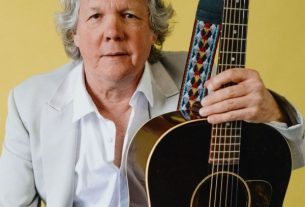
Brad Tursi photo by Marina Chavez
Brad Tursi Parallel Love Draws on Personal Growth and a Lifetime of Influences

Brad Tursi is best known as a professional songwriter in Nashville and a professional guitar player for the Grammy-nominated, multiple ACM and CMA award-winning band Old Dominion. Having gathered his more personal songwriting together for a number of years, he finally completed the songs, added a few more, then recorded and released them as a solo album, titled Parallel Love, this summer.
What he found was that his lifetime influences, old and new, came to the fore and allowed for the wide-ranging style of the album that’s both country in places, and a little rock ‘n roll in others. Producing most of the album himself was also a step further into the limelight, but his many years of creating fully-rendered demos gave him sure footing and a few key collaborations helped him bring more country to the album. I spoke with Brad Tursi about the decisive steps that took him towards Parallel Love, with even more solo songwriting in his future.
Americana Highways: I know the album has had a long gestation for you. Is there a sense of completion now that other people can hear these songs?
Brad Tursi: It’s funny because of how long I’ve been making music, also in my band Old Dominion, that you kind of expect people to know that you have this other thing inside of you. I realized that it was a little bit of a shock to a lot of people. They had no idea. It’s funny to realize that people don’t know what you might be capable of! [Laughs] It’s been really cool. It’s nice to have this whole other avenue that’s more akin to the music that inspired me to become a musician in the first place.
AH: You write songs for other people, too, don’t you? And that’s been your livelihood for some time.
BT: Yes, and that’s why I moved to Nashville in the first place, 17 years ago or so. I had been in bands my whole life up until that. I was signed to Atlantic Records in another band, Army of Me, that was kind of a pop rock band. I’ve been in bands from the age of 15. I actually swore that I would never be in other bands! [Laughs] I moved here, kind of to be a “pure songwriter.” I knew that was a way that one could make a living in music. I learned so much about songwriting, and I still do it now.
AH: That makes it even funnier that people were surprised by this album, because obviously, you are both a professional songwriter and a professional guitarist. When you’re writing for other people, versus when you wrote these songs on Parallel Love, is there a different mentality? Do you do things differently if it’s for your own project?
BT: The short answer is, “Yes,” there’s definitely a difference. In the beginning of my songwriting career, I’d wrote songs that were more personal to me, and maybe I’d bring them in to get “finished.” Maybe they’d get turned into more of a commercial, pop sensibility. As a songwriter in country music, you’re trying to write songs with some pop appeal.
Nowadays, if I have a song that’s very personal to me, I usually end up finishing it by myself, and taking it where it needs to go. I don’t worry too much about its success in getting pitched to other people. I’d rather take those ideas and write them purely for myself. A lot of times, that takes me much longer to write songs, because I can really sit with them. You don’t have to be done at three o’clock. It can take weeks, and sometimes months, to feel it out. That process is definitely different from getting together at a publishing office and writing whatever happens to show up that particular day.
AH: I’ve heard some people feel like they know from the beginning if a song is “theirs” and they’ll record it, and that some people have bits and pieces of songs and don’t know for sure for quite a long time how things will turn out.
BT: That’s the thing about this particular album, there are two songs that are probably 12 years old, and there are some songs that are only two years old. When you have a song that’s 12 years old, and you’re still not sick of playing or hearing it, it’s probably time to record that song! [Laughs] It must have something to offer the world.
AH: That is so true. If I were someone who was surprised that you did a solo album, I might also be surprised that you produced it yourself. Was that a natural step for you?
BT: Yes, in the sense that because I was a songwriter in Nashville for so long, I eventually started to make demos for the songs that I wrote, so I produced on my own, hundreds of songs on Pro Tools. I’ve programmed the drums, played the bass, played the keyboard, and the guitar. I have a pretty good sense of how to put things together.
But on this record, four of the songs were all done in the studio with a studio band of amazing musicians, like “Question The Universe.” You put your trust in those world-class musicians, and you suggest things. It’s me making the decisions on the arrangements, and the mixing. Two other songs were Produced by Marc Scibilia, and that was a scenario where I went to his home studio, and he played most of the instruments. That was the two of us working together. He was creating a lot of the sounds for those two. I think what’s cool about it is that the album sounds cohesive, but is accomplished in drastically different ways.
AH: There’s some different texture, for sure. “Question The Universe” was a song that really surprised me because it’s got this brightness to this, and it’s layered. It’s a great sweet spot between Americana and confessional music.
BT: I think I’m at the point in my musical career where I’m a culmination of my influences, whether it’s James Taylor, Neil Young, or friends who I’ve learned from. It gets to a point where it sounds like it sounds because of all of that information. I wasn’t setting out to write a particular type of song, but that’s what’s beautiful about music. Whatever came before in my life led to that song and its sound.
AH: It’s a good argument for being patient and letting songs have a long development, because by the time you recorded some of these, you’d taken on even more input. The sound must have been different than if you’d recorded it twelve years ago.
BT: Oh yes, and even a song like “Lover and a Friend” is one I started on the guitar, and I really didn’t finish it until I moved it to the piano. Then it took on a life of its own. That might have been a few weeks later. If I had just finished that song in a few hours, who knows if I ever would have gotten to that other place?
AH: Was it difficult to decide what songs to work on for this album?
BT: There are hundreds of songs that I’ve written, but even since I made this record, I’ve really focused more on writing by myself, and I’m really looking forward to making another one. I’ll probably start pretty soon here. I’ve spent more time writing for myself than for other people these days, which has been fun. I have a pretty big pile now!
AH: What are the pros and cons of working by yourself on solo material versus group projects?
BT: The thing is, everyone used to write songs by themselves when they started, when they were 13 or 14 years old, then you get into this habit in Nashville of co-writing everything. I think it starts to become a comfort. When you start writing by yourself again, it can be a little scary at times. You’re used to having other people there to help you. But I think if you can stick with it, and take the time, and let the song show you what needs to happen, it can become a more pure expression of yourself and what you, alone, have to offer.
There are two of three songs on this album that I did co-write, though. There’s Stephen Wilson, Jr., who’s a fantastic writer, who I wrote “Church Bells and Train Whistles” with. There are people out there who are exceptional, and you’re lucky to be able to work with them. Also, I’m from Connecticut. I love country music, and I’ve learned a lot about the South living down here, but sometimes you can’t fake country words. Just because you know the words, doesn’t mean you know how to say them correctly! I’m not even going to try to write a real country song without some real country people around me. [Laughs] You start realizing that certain songs need other people to bring them to life. There are plusses and minuses to both approaches, and both are beautiful way to create music.
Even with “Parallel Love,” I had that chorus, “Two wildflowers growing towards the sun,” and the music had that country groove and feel, but Dan [Isbell] said the first line, “You mend the fences, and I tend the garden.” I never would have thought of that. That really sets it off down the right path.
AH: With “Parallel Love,” there’s definitely a real country sound, but the analogies are carried pretty far so it feels really fresh and modern as well. It’s a modern expression as well.
BT: That came from reading one of many self-help books about relationships! There’s that concept that sometimes people get intertwined, and they are looking for that other person to “help them be happier.” But it’s more successful when you can keep your individuality, and you grow together in a parallel fashion. Then you’re there to lean on each other, and be there for each other, and sometimes people are going to grow separately. But you’re doing it together as a team. It’s not so much a modern concept as a psych-analytic concept that got simplified into that song.
AH: That’s absolutely what I was thinking about when I listened to it, the role of individuality. I think the tone of the song is compassionate, too, towards the partner, and it’s self-deprecating, too. It’s not an ego-driven statement, it’s adaptive.
BT: Yes, it’s more about realizing that you both can get caught up in your own worlds, but it’s a moment of realization that you still have each other’s back.
AH: You mentioned earlier the song “Church Bells and Train Whistles,” and that also has a kind of modern twist. Those are two key symbols for parts of a personality, almost.
BT: Yes. I think I read that little phrase somewhere. The whole record is really from my point of view, and that’s of a musician, and someone who does travel a lot. And it’s always, constantly, balancing two different lives, but loves both of those lives. It’s a phrase that resonated with me because I’m always leaving, I’m always coming home. It’s actually a beautiful way to live once you settle into the fact that you’re going to be tired most of the time! [Laughs] You’re always doing something fresh, moving in and out of these two worlds, and that’s kind of what the song is about.
AH: I can see that. I think using these old images of church bells and train whistles helps explain things, too, because those are symbols that go back a hundred years.
BT: Yes, exactly. They are iconic images of freedom and stability or nomadic qualities and instability.
AH: I think it’s a wider human thing, too, in terms of personality, wanting both freedom and stability somehow. The song “Crazy Life,” about the music life also speaks to some of this.
BT: A lot of people have both things in their hearts. It’s okay to feel both those things and, hopefully, you’re allowed to explore that in life, whether you have a partner or don’t have one. It’s that “parallel love” thing again. Sometimes you want to feel on your own, out there in the world, and sometimes you want to feel held and wrapped up. Both of those things are true.
Thanks very much for chatting with us, Brad Tursi! Find more details and information here on his website: https://www.bradtursi.com/