



Kasey Anderson photos by Matthew Leonetti
Kasey Anderson To The Places We Lived Marks a Satisfying Milestone
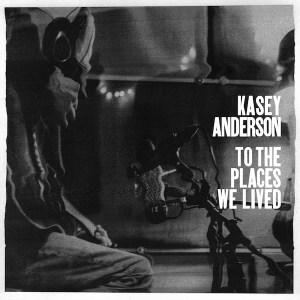
Portland, Oregon-based artist Kasey Anderson will be releasing his solo album, To The Places We Lived, on October 4th, 2024, as a “spiritual sequel” to a much-loved 2010 album, Nowhere Nights. He describes it as his last commercial release, a turn in his trajectory as a creative person wherein he intends to be less concerned about taking part in the formal side of the music industry in future. Fittingly, it’s also an album where he works in a very personal way, drawing on his life experiences over recent years, even while creating a close interrelationship between the songs on the new albums and the songs that appeared on Nowhere Nights.
The themes on the album are various, expressed through observations about past experiences, sifting through them for meaningful truths. A song like opening track “Believers” reflects on the importance of hope, while others “Back To Nashville” and “Lost Parade” reflect radical truths about a life in music and about picking up the pieces of one’s life after a destructive experience. Because work on the album lasted for several years, Anderson was able to invite many friends to contribute to the tracks, resulting in a wealth of possibilities, that, in the end, Eric Ambel and Kurt Bloch were able to help shape into a final form. The result is “one voice” speaking throughout in a meaningful way that shares Anderson’s own journey and continues the journey of the characters we first met on Nowhere Nights. I spoke with Kasey Anderson about the big life experiences surrounding To The Places We Lived, and why it’s such a satisfying milestone for him.
Americana Highways: I understand that this record will be your last traditional, commercial release, if those words apply. Are the constant changes in the music industry part of your decision to do that? It’s a very hard landscape.
Kasey Anderson: Thank you. I appreciate all you just said. It is a record that I wrote intentionally to be very personal, because I had avoided doing that for several records between Nowhere Nights and this. In terms of it being the last commercial, traditional release, yes, I think there is a way that artists can look at the way that the landscape is changing and become really disheartened, and become really cynical. I am in a really privileged position in that I have other work. I have a full-time job with a non-profit, so I am less invested in the commercial success, or lack thereof of this release, or any release going forward.
I’m really fortunate to look at a changing landscape and instead of thinking, “I have to figure out how to navigate this in a way that is satisfying to me both commercially and artistically,” I can look at it and think, “Okay, cool, I can do whatever the fuck I want to do, then, for the rest of my ‘career.’ I don’t have to adhere to any rules.” I think that’s what most of us thought of as the ultimate goal when we got into this. I was never thinking, “Man, I hope to get to be so famous that I will be selling out stadiums.” I think I was always saying, “Man, I hope I get to the point where I can do whatever the fuck I want to do.” I’ve always approached my career that way, for better or worse. Now I’m in that position. [Laughs]
AH: You’re not shocking me by anything you’re saying. Releasing music is becoming such a varied thing. There are certainly huge numbers of people who are bucking those trends.
KA: I know that my wife and my kid are also happy that I’m not saying, “Hey, I can do this, but I’ll just be gone 300 days a year.” That would not fly. It’s an interesting point, because I believe what it’s going to take to change things is a collective of musicians who are large enough and strong enough to say, “Hey, across the board, nothing in this industry works.” Everything about this industry is predatory in any number of ways. I have only experienced a few of them because I have benefitted from being a straight, white guy. But this is a predatory, ass-backward industry and there are increasingly fewer chances for people to make a living doing this work.
AH: The headline this week has been “CD sales are surging.” And that’s great, but the sales in previous decades were simply enormous compared to what they are now, so it would take a lot to get back to a workable living for people.
KA: Right. What does surging mean in the context of CD sales for an artist working now? Maybe someone sold 40,000 copies. I don’t really look at the charts or Soundscan, but when I remember Counting Crows selling 10 million copies of their first album. Nothing close to those numbers exists anymore, for the most part.
AH: There’s no going backwards, only forwards, for sure. Though it’s great that people are buying physical media for a number of reasons, including artists being able to sell directly to fans.
KA: I’m glad that physical media has come back, too, because it means that maybe people are appreciating what’s on those records in a different way. They are engaging with it in a way that demands a little more attention, when they are putting it on a record player. It’s how they are engaging with it.
AH: I know there’s a close relationship between the songs on this album and the songs on Nowhere Nights. How deep does that connection go? Is it loose or very specific?
KA: I wrote this to satisfying my own desire, and some other peoples’ desire, to figure out how the rest of these stories on Nowhere Nights went.
AH: That’s very interesting, because you’re engaging in a conversation with a certain group of people, the fans who follow your music, by doing that. So these songs weren’t written in isolation.
KA: No, it’s not isolated at all. Even with albums that are not as personal as this one, when I’m writing, it’s a document of the world around me, and it’s also a document of the time in my own life when I’m making an album. This record is a document of five years, and in that five years, my dad died, Covid happened, my wife was pregnant, and my daughter was born. An entire lifetime happened in five years, and I can hear it in that record. If I was the kind of person who approached music in an insular way, I feel like that would be really selfish. I spent a lot of my life doing really selfish things and I’m very disinterested in continuing to live that way.
AH: Having a kid, too, is just the cherry on top of everything changing in a relatively short period of time. It’s cool that you emerged from this period of time by creating some continuity through your new album, looking back to Nowhere Nights. It seems like that would be helpful, creatively and personally.
KA: Oh, yes, that was sort of the guiding light for this record, that this was going to be a sequel to Nowhere Nights. I don’t know that I would have taken the time to write nine or ten songs if I didn’t have that. The way that I write records is that if an idea for a song comes to me, I assume that’s the first song on the record. The first idea I get is the first song on the record. “Believers” was the first song that came to me, I wrote it, and I worked it out. Then I thought, “Okay, I’m going to intentionally write the last song on the record.” For this one, that was the title track, “To The Places We Lived.”
Then, the project, for me, and what made it fun and challenging, was to ask, “How do I get everyone who might listen to this from ‘Believers’ to the title track in a way that is satisfying to me?” The first song on Nowhere Nights is about leaving a place, and the first song on this record, “Believers” is about what happens after a person leaves a place. So it picks up on that narrative.
AH: That’s an amazing interweaving pattern. I also noticed on this record, there are two beginnings, both at the beginning and the end. There’s a kind of reflective signaling between those two points.
KA: I appreciate that you notice that the end of the record is also a beginning, because that was important to me. For me, this is “the end of that conversation,” but it’s not. I leave the audience there, but I continue to keep moving forward.
AH: There’s a pretty consisting feeling in this group of songs, too, of sifting through memories and experiences, but highlighting what you’ve found to be meaningful out of them. Even in really bleak landscapes, that comes out, and collectively, feels like you’ve gathered valuable things together. That has a hopeful feeling to it.
KA: I hope so. I owe that to my own recovery, and to having a partner who’s really supportive and helps me look at life that way, and, of course, having a kid. I also think, though it’s easy to say and much harder for any of us to live, that it’s analogous to the way that I think about the music industry. I think any of us, at any point in our lives, can get lost in really dark places, and really cynical places.
Today, it’s very easy for me to look at the world, and see a number of intersecting apocalypses, and say, “This sucks. I’m not participating in this anymore. No part of this is working for any of us.” But I don’t think anything good comes from that. I think what helps me, day to day, is to say, “This fucking sucks, but what can I take from it? What can I use? How can I imagine a better life for my family, a better life for the communities I’m in, a better life for the world that I’m in?” That’s what’s useful to me, and I hope that’s what’s in these songs.
AH: It’s hard to direct the mind away from all that negativity. I meant to mention that in the song “Believers,” we also see a relationship that changes over time. And allowing for change is another way to find growth and positivity.
KA: I really agree with that. I think if the charge for me, as an artist, is to write honestly about my life, while the beginnings and endings of a relationships are exciting, they are not as interesting to me. There’s not as much meat there. I think there is a ton of fertile, creative soil, in the way that relationships change, people change, and the world changes gradually, and sometimes incrementally. It’s more challenging, nuanced, and more interesting to me, to write a song about how to stay in love with someone.

AH: I understand that Eric Ambel and Kurt Bloch were involved in this record. Can you tell me a little bit about that and what that entailed?
KA: Eric played on it, he mixed it, and I gave both Eric and Kurt Bloch producer credits on the record. We tracked the record mostly in 2019 at Jackpot here in Portland, and then over the course of the next four years, I shelved it a few times. I shelved it when my dad died. I shelved it when I knew that my daughter was going to be born. During Covid, when everyone was at home, I was listening to the songs and thinking it would be cool if I asked various musicians to play. I involved some more friends, who hadn’t been physically there at the initial recording sessions.
That was really rewarding, but in doing so, I just had piles of tracks on each song. I’d have seven guitar parts. I would say to people, “Do whatever, I’ll figure it out.” But I got to the point where I could not figure it out. That was when Eric and Kurt Bloch were so valuable. [Laughs] I just said, “Someone needs to take it away from me. I’m going to break it.” Eric made my first three records with me, and I’ve written tunes with him. He’s one of the people who I trust most creatively, and when I give him a song, I always say, “Do what’s best for the tune.” I know it’s always going to come out okay. He’s been such a huge influence on me, and such a creative touchstone for me, that I have never made a record where I haven’t asked for his input. I can’t speak highly enough of him as a person, a buddy, and an artist.
AH: It sounds like the essential problem was that you had too much choice, too many equally good options.
KA: I did! There are six versions of this record, truly. At one point, before I made someone take it away for me, I made a version that used a plugin that ran everything through a warped cassette tape. I have that on my hard drive! I thought, “This is cool! I don’t know if it will work for a release.” That was one of the joys and the challenges of this thing. There were so many folks, and they played so well, and everything is now included, but just not included on every tune. I had to have Kurt and Eric take it and decide whatever was best for the songs.
AH: And they also created a great amount of continuity between the songs after making those individual choices, song by song.
KA: Yes, there’s an individuality to each tune, but also a cohesion to the whole album that I think was really achieved by Eric and Kurt.
AH: When you first told Eric about the idea of this album, that you would like to make a sequel to Nowhere Nights, what did he think?
KA: He was really excited and over the course of working on it with me, for five years, he is one of a couple of people who has said to me, “This is really special. You’ve done a singular thing with this record. It really sounds like one voice speaking for the entirety of the album.” That was such a huge compliment to me.
AH: That’s wonderful. And yes, that’s true. I agree with him.
Thanks very much for sharing with us, Kasey Anderson. Find the music and more details here on his website: https://www.kaseyandersonmusic.com/
Enjoy our previous coverage here: Interview: Kasey Anderson on His Band’s New Album, Prison Reform, and Standing For What’s Right