




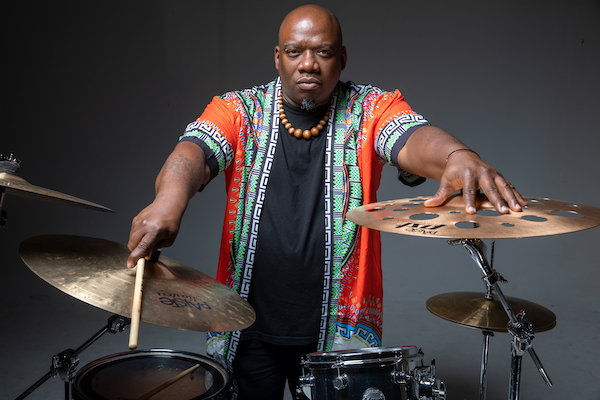
James “Biscuit” Rouse interview
James “Biscuit” Rouse Celebrates Buddy Miles’ Boundless Energy With Biscuit and Buddy
On September 27th, 2024, drummer, singer, songwriter, musical director, and producer James “Biscuit” Rouse will be releasing his first solo album after working as a sought-after drummer and vocalist in many bands. A Philadelphia local, Rouse decided to bring a twist to this first release and largely dedicate it to interpreting the music of one of his heroes, George “Buddy” Miles. Miles is best known for his work with Jimi Hendrix, Carlos Santana, and Bootsy Collins, but he’s also known for interpreting tracks like “Down by the River,” written by Neil Young.
After interpreting some of Miles’ music live on a Band of Gypsies Revisited Tour with Vernon Reid, Rouse received encouragement to keep exploring Miles’ music, resulting in several years’ work leading up to the album, Biscuit and Buddy. He had the support and encouragement of many who had worked with Miles in the past, and the presence of guest musicians Doug Wimbash on bass, Vernon Reid on guitar, and Marcus Machado on guitar. Rouse will be sharing that music live at two album release performances set for September 3rd, 2024, at The Bitter End in NYC and September 13th, in Philadelphia. He’s also accepting the Buddy Miles award at the R & B Hall of Fame induction on October 6th in Cleveland. I spoke with Biscuit Rouse about this special project and what draws him to the music of fellow vocalist and drummer, Buddy Miles.
Americana Highways: Were there challenges to putting together your first solo project, and one that handles one of your hero’s legacies?
James “Biscuit” Rouse: It’s a whole other level of being an artist. I’m so used to being an MD or a sideman, and there are things I didn’t really have to think about.
AH: It’s definitely changing seats. Now you’re in the driver’s seat.
JBR: Yes, but I want that. I’ve learned things, and I’m still learning things.
AH: When did you decide that you wanted to record some songs by Buddy?
JBR: It was doing a Band of Gypsies Revisited tour with Vernon Reid. We had done a tour in 2017 and 2018. It sparked things. Vernon [Reid] said, “You’re the perfect person to do this.” Greg Tate, who was a writer for Rolling Stone, and also had a band, passed recently. He saw us play, and he came to me and said, “You’ve got something. You need to do this. You’ve got the right energy and character. You really need to do this.” I said, “Oh, okay.”
At the time, I was transitioning between projects in my life, so I decided to dig deep and do this. It kept progressing. I was hanging out with Marcus Machado, who’s like the next Jimi Hendrix. When we hung out, it was kind of similar to Jimi and Buddy hanging out. There was something similar. That sparked things.
AH: That’s a huge vote of confidence from Vernon, especially. He would know. Did they use any other words to describe what they thought you had in common other than “energy”?
JBR: It was the energy, they said, and the vibe. I’m also a clown, like him. I’m hearing from folks that knew Buddy and experienced him that he had a big energy and a big presence. Just looking at pictures, you can see that!
AH: I can’t believe his life, when I look at his life story. It is really something, the eras he worked through, and who he worked with. There needs to be a biography of this guy.
JBR: There needs to be. His daughter said that they were working on something, maybe a movie, but I’m not sure what’s happening with that. It will happen. It needs to happen.
AH: There are some figures in music who had this incredibly changeable life, and it kept changing over time, and that’s him. He didn’t hit one development point or style and stick with that.
JBR: No, he just kept steamrolling, and getting bigger, until he died.
AH: That’s part of why he’s thought of as being this “non-genre” person, right? Because he just kept adapting.
JBR: Right. They try to say that he was the blues, but no, there’s more to it than that. Yes, the blues, but that’s part of our culture. The blues has sparked so many other genres, and you can hear it in other genres. These days, music is too classified, and everyone is borrowing from other things.
AH: Since you were playing his music before, on tour, I’m guessing that you are also a multi-genre person.
JBR: Yes, growing up in Philly, and listening to the radio as a kid, it was a large span of music. Then, when it came to playing music, it was a large span of music. I was the youngest one, playing with all the old heads at the VFO parties. They played everything from blues, to rock, to soul, to R&B. You name it. Jazz. It was all there. Also, I was born and raised in church, a preacher’s kid, so it was the whole gambit. That makes a well-rounded musician.
AH: Are you a multi-instrumentalist, or has it always been the drums and vocals for you?
JBR: Drums have always been my passion, drums and vocals. My aunt would always fuss at me, “Go sing!” I didn’t want to be bothered with that. But I appreciate both sides of the coin. With piano, I’m functional to figure out what I want, and then I call a piano player. Bass is the same thing. I’m forcing myself to sit down to really do it. The older I get, I have a problem with “musical tourette,” always looking for something to do. I have enough friends, who know me well enough now, that sometimes we’ll work through different parts of what I did or what they have brought to what I did.
AH: Did you pick the songs of Buddy’s that you included on this album out of the ones that you’d already been playing on tour, or did you pick some new ones in order to bring your own interpretation?
JBR: With that project, we only did “Them Changes” and “We’ve Got To Live Together” from the Fillmore East show that the Band of Gypsies did. But you can’t do Buddy without “Down by the River.” I also like discovering new music. It became a rabbit hole, and I was thinking, “This is great, this is great, this is great.” Then I had to condense it down and decide what the best songs would be to do. My thought process was, “What represented different eras of Buddy?” That was from different albums. I just went from there.
AH: I was thinking that, because he had different sounds and fixations during certain eras, and it has to be a broad sweep if you’re telling audiences who might not know about him, “This is Buddy.” But that’s more work for you, to try to adapt such different songs! I applaud you for that.
JBR: I had enough people around me who were from that era, and I could cross-reference with them, and ask them, “What do you think of this?” They might say, “Nah, go back to the table. Do it again.” I appreciated that. It made me continue to be creative about. I had to keep in the back of my brain the idea, “Don’t go too far. Don’t take a song to somewhere where you can’t recognize it.”
AH: That’s an amazing resource, to get the opinions of these people who are still with us, as well as their wisdom and ideas. But the whole point is, these songs are your interpretations.
JBR: I was asking them, “What do you hear? What don’t you hear? Did I hit the mark? Did I miss the mark? Is it, sonically, in the right place?” My wife was asking us, “What are you doing? Why are you spending a month on one song?” [Laughs] There were so many sonic things going on. When she heard it, she said, “Okay, I get it. But it took so long!” After we got it done, the song “I Still Love You” took us two months to mix. There were so many things, color-wise, to do. When we did that, things opened up. I love that stuff. It’s an art form.
AH: I could tell from your original music that you really like experimental approaches. Are you as exacting with your own songs when you’re recording them?
JBR: Yes, I’m the same way with my originals. Sometimes I take as long. Sometimes I’ll work on something, then stop, then come back and tweak things. Or I might not like how I sang a part, and go back, but I kind of know when to stop. There’s a gage in me that says, “Stop!”
AH: How did you choose which of your own songs that you’d include? Did you see some element of similarity?
JBR: With “Enough is Enough,” we were knee-deep in the pandemic, and I was pissed off every day. I called my lyric-writing partner, and said, “I need to write a song. I’m annoyed.” I think that’s around the time that Trump was talking about giving yourself a shot of bleach. We were in the studio, and said, “What the hell? You do that, you’re going to kill yourself!” Watching the news and that whole experience just made us start writing. Sonically, I said, I wanted to go with Cult of Personality. We listened to a bunch of Living Colour, Bad Brains, and a Band Called Death. We took elements from them. That’s how the song came about.
AH: The guitar in that song is really awesome. You know it’s going to be a serious song when you hear that lead-in.
JBR: When we actually start rehearsing that song, I wonder how long that’s going to take us to dial it in as a band. The timing on that is not simple. It’s crazy. I feel sorry for the guys, but I know they’ll get it!
The song “Shine” came about because I used to play in a band called Screaming Headless Torsos. David Fiuczynski, who’s a professor at Berklee, and I were in Berlin, and he was noodling, playing this riff. My ears are always going, and I said, “What is that you’re playing? That’s a motif for a song.” He said, “Oh, that’s just a guitar exercise I give my guitar students.” I asked him, and said, “Yo, what are you doing with that? Can I use it?” He said, “Sure, I don’t care!” Then, my son, who at the time was three years old, was in the majority of the recording sessions when people were coming over to record. He just started singing, “Shine, shine, shine…” I said, “Sing that line!” And that was the hook. That’s what that song is.
AH: Is that also him at the beginning?
JBR: That’s him! He sang it perfectly. I was sitting there thinking, “This kid!”
AH: Do you think there are other songs that Bobby was involved with that he’s not credited on, or might be undiscovered right now? He seemed so prolific.
JBR: Oh, yes. People all worked at the same studio a lot. That’s not far-fetched. I’m sure there’s other stuff from Parliament [Funkadelic] that he played on.
AH: He’s a man of mystery. The song “Them Changes” is a great one to put out as a single, because it’s a favorite among musicians. I’ve heard that Eric Clapton plays that one. What influenced your interpretation?
JBR: Parliament Funkadelic influenced the way I did that whole track [Laughs]. You’ll hear it. Just the energy, and the way that Marcus Machado did it. Everything is referencing something else. It’s just listening, building off of, and embellishing. Pretty much the whole album is inspired by Buddy and Parliament. Those eras are raw, unadulterated Funk and Rock.
With me, coming from Torsos, which is rock, soul fusion, and punk. My mix engineer said, “Do you want the nicey-nice mix, or do you want it raw?” I said, “I want people to dance!” Watching Buddy’s videos, those people were dancing, and he was sweating. He was sweating through his clothes in these videos. That’s what I want. I want people to dance, so that had to come across in how we did the arrangements and in how it was mixed.
Thanks very much for chatting with us, James “Biscuit” Rouse. Find more detailed information here on his website: https://www.jamesbiscuitrouse.com/