





Erin Ash Sullivan photo by Danbury Jamb
Erin Ash Sullivan Brings a Seamless Sense of Perspective To Signposts and Marks
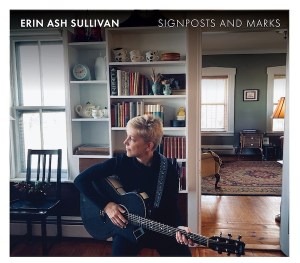
At the end of July, New England-based singer, guitarist, and songwriter Erin Ash Sullivan released her second full album, Signposts and Marks, working again with Doug Kwartler as producer at Hollow Body Studios in Massachusetts. You may be familiar with Sullivan’s work if you keep track of songwriting competitions, where she’s had a great deal of success, or you may have come across her work as a writer, particularly of children’s books.
What Sullivan creates with Signposts and Marks are not only finely-honed songs, but stories that share a very specific perspective without taking focus away from the stories themselves. Her perspective is seamlessly built into the imagery and emotion of the songs in a way that invites audiences into her world, but also allows them to pursue their own associations along the way.
Signposts and Marks is a collection that speaks from hindsight to promote compassion among human beings, but also openly explores the conflicts that can arise in long-term relationships and the self-examination that demands. I spoke with Erin Ash Sullivan about approaching her second album, the role that songwriting competitions have played in encouraging her work, and about how she handled these stories, spanning humor and sorrow.
Americana Highways: Did you approach your second solo album, Signposts and Marks, in a similar way to your first album?
Erin Ash Sullivan: My first one came out in 2021, also produced by Doug Kwartler up at Hollow Body Studios in Chelmsford, Massachusetts. We learned a lot on our first go around with the first album, so it was really fun going into this one with lessons learned. It was my first time doing an album, so I learned a lot about how picky I wanted to be, and trusting my gut if there was something about a take that I didn’t like. Doug also knew me better as a performer, so he was able to hold me to that kind of standard. That, coupled with Doug’s creativity in terms of arrangements makes it feel like a very special document for me.
AH: One of the challenges of solo work seems to be that there’s such a lot of possibility. It’s a forest of choices.
EAS: That’s a really good way of putting it. Also, I think you can run the risk of being too diverse in your choices from song to song, so that when you put the songs together on an album, they don’t hang together well. One of the things that we were going for on this album was that we tried to make cohesive choices all the way through, but made sure that the songs didn’t sound the same. There was something about the arrangement that we’d throw in, like a saxophone, that gave the song its special quality. But it also continued to belong to the same body of work.
AH: That’s a challenge to keep two different things in mind at the same time, the short-term and the long-term goal.
EAS: Exactly. Doug does really interesting work as a producer because he likes to come up with an initial palette of sounds based on the whole draft of an album from me and some input I give him. He then sends me a draft and says, “What do you think?” Once it’s complete, I can go in and give feedback. That’s important for his creative drive.
AH: I understand that you’re a writer in other forms of art, as well, so I’m sure you’re familiar with the idea that in writing, creating a rough draft to work with is pivotal. After that, it’s a whole different ball-game. That sounds like the same thing.
EAS: That’s exactly it. You’ve got to get the initial idea down. There are obviously strengths to doing it in other ways, but this was a really fun way to do it. It does require a lot of trust between two people to do it this way. You’re saying, “Here’s my idea, my vocal track, and guitar track, now go play in the sandbox!” Then he has to trust me to give honest feedback about it. In prior years, I’ve done exploratory projects with other folks, and you can feel yourself getting second-guessed.
AH: You mentioned your gut instinct, and how important that is. When you have those instincts, you definitely need someone who is listening to you.
EAS: In my case, in the past, I didn’t have the language for it. For me, it was like trying to tell someone what kind of haircut I wanted!
AH: That is the perfect example. It is almost impossible to explain to anyone what kind of haircut you want. It’s a brick wall.
EAS: I’m like, “I want it short!”
AH: Can I ask you about your involvement in songwriting contests and competitions at festivals? I see from your track record that you have quite a few accolades and it seems to be something that might have spurred on your solo work. Has that been a useful structure for you?
EAS: 100 percent. I think, for me, the order of operations was to do a ton of open mics, so that I could find my people, then enter a ton of contests. It’s great practice, since it makes you build a thicker skin. When nobody knows who you are, it’s one of the few ways that you can force people to listen to your stuff. And, I was really fortunate early on, because in a couple of these contests, I was really successful. It gave me a little credibility, and it allowed me to be more present in situations where, maybe, I would not have been able to be before.
AH: It seems like something that you can dare yourself into.
EAS: Yes, and also the people who you meet are your cohorts in those competitions with you. I think of them as my “class” of people who I move around with as we navigate all this together. I’ve overlapped with some fantastic songwriters like Grace Morrison, and Sam Robbins, and Phil Henry. We pop up in the same places, and it’s lovely to have those connections. We talk about what we’re working on and how we’re booking our shows. That’s all very affirming. Just showing up and being there, that’s when the opportunities open up.
AH: When it comes to this group of songs, I do see some connections between them, thematically, but I don’t find that to be heavy-handed. It feels more like they come from the same zone of reflection.
EAS: That’s a good way of putting it. If you try to write the main idea of this album, it would be, “What does a middle-aged woman think about?” The answer is: being in a relationship for a long time and how you make that work, watching your kids grow up, and watching the older people in your life get old. It’s all the sandwich generation stuff, for sure.
AH: I think a lot of the relationship stuff that you touch on could work for any age group also. I appreciate that you write from your specific perspective and stick to that, but the arcs about conflict and resolution are particularly recognizable for everyone.
EAS: That’s good to hear. I do hope it feels more universal.
AH: The song “Goat on a Stone Wall” is a fun place to start, with a very cute, animated video. There’s a playfulness in using animals in a song, and it’s a very Folk thing to do, but the message is still quite grown-up and relevant.
EAS: I wanted to get at that whole idea of what happens when you’re in a long relationship and one of you is too spicy for their own good. Then they can’t keep their big mouth shut and is always sorry about it. It was fun to draw some metaphors. I literally live in this tiny town and there’s this very sassy goat.
AH: That’s great! The goat is a cameo.
EAS: Yes, it hangs out on a stone wall, so I thought of that when I walked past it one day.
AH: I recently visited a goat farm, and there was actually one goat who they had to keep away from the others.
EAS: [Laughs] Yes, I am that goat.
AH: The things that you associate with the different animals are interesting because they aren’t based on any established tropes. They are your own thoughts and reflections.
EAS: I remember trying to think about how we rupture relationships, so I thought of mending the nest like a bird, biding one’s time, and being focused. Then I assigned that to animals in that way. I actually wrote that song as part of a songwriting workshop with Cosy Sheridan, and she’s great, because she’s so sparse with her words. That is not a strength of mine. I like to use a lot of words. So I brought the draft to the group, and immediately said, “I’m so sorry this is so wordy. I have to pare it down.” And one of the things that she said was, “Sometimes, you don’t. Sometimes that’s what the song asks for and that’s what you’ve got to do.”
AH: The imagery makes it feel more concise, I think. It’s so visual and helps tell the story.
EAS: I do like concrete images, and I think of that a lot when I’m writing my songs. I want to put people in a specific place so that they can visualize themselves there.
AH: I thought the sound was really intriguing on that song because the imagery might have made you feel like you have to go down a simplistic route, but that isn’t how it goes.
EAS: Because the song is so based in nature, I was picturing more of a homegrown Bluegrass feel, and that’s what I was talking to Doug about. So, when you listen to the arrangement, the mandolin is really present, the percussion is less present, but you can really hear the stand-up bass. I think Doug did a great job of making that real.
AH: I see the feeling or idea of compassion come up a lot in these songs, and I might even say that’s a theme for the album, but how does that play into some of these conflict-related songs, like “Rest Stop Bird” and “Don’t Want To Keep Score”?
EAS: Right, some of them are about moments of selfishness, or realizing that you’re both at fault, and sometimes there’s no coming back from that. “Rest Stop Bird,” for me, feels like one of the saddest songs on the album, because this relationship is over, and both people want it to be over. She’s leaving, and he doesn’t care that she’s leaving. It’s the whole idea that the worst thing that can happen is that people don’t care.
AH: Indifference is like death.
EAS: Yes, it’s heartbreaking.
AH: I also felt that it was the saddest song on the album. The imagery is really haunting, and there’s this image of a nest being barely a shelter for any creature. But, it does have a nice, sweet sound that goes with this incredibly sad story! I think you’re careful with that and don’t make it too pretty, though.
EAS: I think that’s sometimes where you can use the sweet to trick people into experiencing something that’s a little grittier. They think they are being serenaded, but it goes a little darker.
AH: I love how the song goes kind of spare towards the middle, so that you can see the underpinning structure of the song, then it comes back up again. If it was getting a little lulling, there’s a bare-bones feeling, to focus on the emotion.
EAS: The rhythm for that song actually comes from something when I was a kid. We would drive across the country in my parents’ VW bus. I just have this memory of sitting in the back of the bus at night and watching the telephone poles go by in rhythm. That’s the visual in my head when I was thinking about that song.
AH: That’s neat because a lot of folk and songs in the Americana tradition have been influenced by the rhythms of the railroad. But our lives have been much more conditioned by cars and roads. There’s got to be a difference there in terms of rhythm.
Thanks very much for your time and sharing with us, Erin. Find more details on Erin Ash Sullivan here on her website: https://erinashsullivan.com/
Enjoy our review of Erin Ash Sullivan’s album here: REVIEW: Erin Ash Sullivan “Signposts and Marks”