








“Leading the Charge”: A Conversation with Joe Bonamassa
By Brian D’Ambrosio
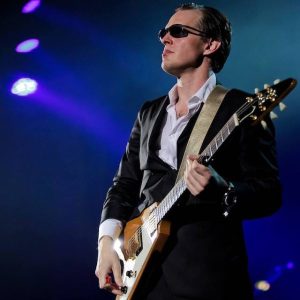
From Beale Street in Memphis to the Delta Blues Museum in Clarksdale, there is an excess of worthy landmarks and destinations dotting the blues lover’s atlas.
New Hartford, a small town of about 20,000 people in Central New York, might be one of the unlikeliest destinations of distinction. But it is the hometown of blues sage Joe Bonamassa – and certainly noteworthy now for that very reason.
“New Hartford is actually a surprisingly musical community,” said Bonamassa, hours before he took to the stage at the Sandia Amphitheater in Albuquerque, New Mexico, on August 2nd.
“My great grandfather was a musician and my grandfather was a musician. My dad was a musician. There were musicians everywhere in New Hartford. It was a mixed bag of Ellis Island immigrants. My dad is Italian-American. My mom’s half-Polish and Hungarian. My grandparents on my dad’s side were Italian. You absolutely went to school with all kinds of different cultures, mostly European and Mediterranean types of kids.”
Growing up, life and music were inseparable, and he embraced it early, like food or water, wholeheartedly and without reservation. His great-grandfather, Dominick “Buddha” Bonamassa, played trumpet in the 20s and ‘30s. His grandfather, Leonard Bonamassa, Sr., played the trumpet in the 50s and ‘60s. His father, Leonard “Len” Bonamassa, learned to play the guitar in earnest in the early 1970s and owned a guitar shop.
“That’s what made New Hartford a cool place to grow up – the music,” said Bonamassa. “Everybody has to be from somewhere. We can’t all be from Austin, Texas. Some of us are from New Hartford. It’s a cool neighborhood.”
Bonamassa’s success is more than just a matter of technique and talent; it’s the interplay of familial, social, and cultural circumstances being brought to bear.
Joe said that he picked up the guitar for the first time at about age 4 in 1981 (a gift from his father). Three years later, he was playing Stevie Ray Vaughan and Jimi Hendrix lick for lick. By age 11, he was sitting in with Danny Gatton and the virtuoso guitarist’s band. Music drew all of his curiosity, opening up boundless possibilities of growth and discovery. Len’s record collection was a journey, an adventure without end.
“We would go to Camelot Music, the record store in the mall,” said Bonamassa. “They still sold albums and they had cassettes, and you could buy a B.B. King record, or a Steve Morris record, or a Cream record. Dad had a good collection right off the bat. We’d listen to everything from Muddy Waters to Jethro Tull.”
At age 12, he opened for B.B. King, and, before he was out of his teens, he was able to meet or play with many of the linear descendants of the Mississippi and Chicago blues, raw, pure connections to the original line of pickers, seers, and sinners that created the music.
“I have many fond memories of hundreds of shows with B.B. and with all of those cats who were alive and playing,” said Bonamassa. “I think of Albert Collins and James Cotton and there were a lot of great blues musicians on the scene. Buddy Guy was my mentor. I shook Willie Dixon’s hand when I was a kid. I was able to meet John Lee Hooker before he died. I’ve got to meet all of my heroes, like Eric Clapton.”
Coincidentally, Bonamassa shares a birth date with the inimitable Robert Johnson. The uniquely elevated and revered Johnson was born in Hazlehurst, Mississippi, on May 8, 1911.
“He would have been 66 years old the day I was born,” said Bonamassa. “I share a kindred spirit with the Delta guys. Son House. Lonnie Johnson. Obviously Howlin’ Wolf and Muddy (Waters), and my mentor, B.B. (King)”
Bonamassa said that there is no great secret to his creative strategy of conceiving and making a song or a record. He draws from a number of sources and instead of adoring them from afar, he has tried to incorporate them into his music, a jumble of elements grafted and mated to one another.
“The Jeff Beck Group floored me. Cream floored me. Jethro Tull. John Mayall and the Bluesbreakers. The Beano album and A Hard Road. The Blues Alone. So many influences. I’ve learned from everyone, and I’ve stolen stuff from everyone.”
In his late teens he formed a band called Bloodline, which provided him the opportunity to spread out as an independent act. He and his bandmates would set up in basements or lofts or dark carpeted lounges or blue-collar drinking bars, though the crowds there would ordinarily be as slight as the paycheck received.
“We would play anything off of I-81 or I-90, from Poughkeepsie to Buffalo, and all points in between,” said Bonamassa. “We’d head south on I-81 and play Ithaca or Binghamton, or Scranton. A lot of those spots no longer exist, like the Trout in Buffalo and the Red Creek Inn in Rochester.”
Sixteen studio albums, twenty live albums, and three Grammy nominations later, Bonamassa, 47, is the same inspired seeker who first learned the Hendrix and Vaughan notes on the guitar four decades ago.
And his epic guitar collection is only growing – 500-strong and counting.
“The guitars find me and I make every deal,” said Bonamassa. “You buy one and then find another one, and then they find you.”
One of the most popular contemporary blues performers, Bonamassa said that his goal is to continue to open up, to explore, to expand, and to let each guitar achieve their promise, holding in his hands the depths of the earth and the highest mountains as well. His spiritual tie with the blues remains immediate and undeniable. Indeed, a night with Joe Bonamassa is a night of tenacity, connection, skill, and intense practice, the productivity of an intimate disciple who is now an accomplished teacher himself. The magical, improvisational quality of Joe’s music makes him a perpetual crowd-pleaser, but it also makes it easy to see him as a deeply serious artist.
“There is quite a blues scene today,” said Bonamassa. “The blues is definitely not museum music. There are a lot of forward thinking people in the blues who are doing really well with blues, and with blues based music. For me, I’m just part of the scene. We lead the charge in some areas. We watch others do great things in other areas. I’m proud of the work we’ve done.”
Find Joe Bonamassa’s tour dates and more details here on his website: https://jbonamassa.com
Enjoy our previous coverage here: Show Review: Joe Bonamassa in Milwaukee