


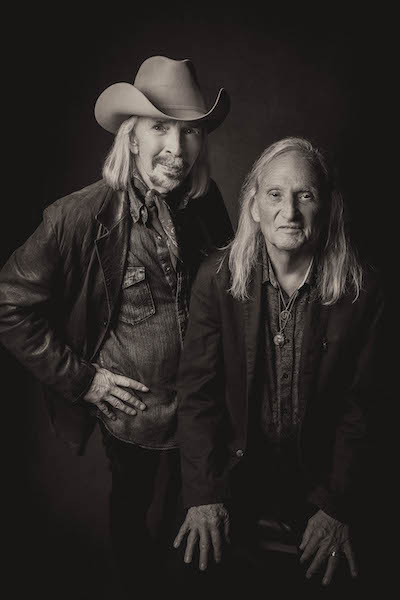
Dave Alvin and Jimmie Dale Gilmore photo by Leslie Campbell
Dave Alvin and Jimmie Dale Gilmore’s ‘TexiCali’ Thrives On Possibility
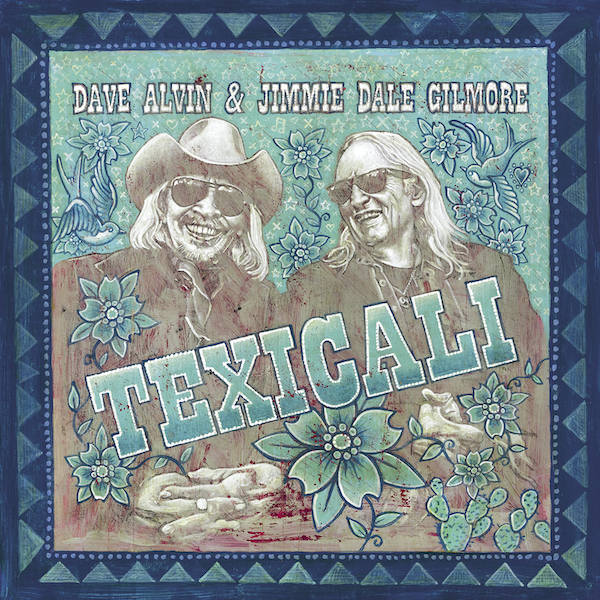
Dave Alvin and Jimmie Dale Gilmore recently released their new album, TexiCali, via YepRoc Records. It marks their first release together in six years, and was built around their experiences performing with their touring band The Guilty Ones, which in turn prompted them to record in a more full-band way than they had in the past. As the album title suggests, the music brings together some of their differences in background and geography. Dave Alvin grew up in California following the blues closely, whereas Jimmie Dale Gilmore, who many fans also know from The Big Lebowski, was firmly steeped in traditional country music in Texas before discovering a great love for the blues and rock’n roll. The overlap is evident in TexiCali, where Blues accents weave their way through the multi-genre tracks.
Another interesting element about TexiCali is that some of the songs are older, having never been recorded, or are reworkings of older songs in a totally different sonic vein. Alvin’s ability to envision sonic possibilities also often carries an artistic faithfulness to a song’s origins, for instance, taking the decade in which a song was originally written and bringing in musical accents from that time period. Coming together to create TexiCali was definitely a labor of love for Alvin and Gilmore. I spoke with them about collaborating on this record, and the ways in which their own origin stories linked to the Blues have impacted their outlook on music.
Americana Highways: I see you all have been out playing. Have you been performing these new songs from TexiCali?
Dave Alvin: A couple of songs, yes. We were doing “Death of the Last Stripper” and “We’re Still Here.”
Jimmie Dale Gilmore: I think we were doing “Borderland,” too.
Dave: We did “Borderland” every night, yes!
AH: How did you come by these new songs? Were all they all brand new, or were they songs that hadn’t been completed or recorded, but had been waiting?
Jimmie Dale: Well, some of it is really some old material. “Borderland” is one that I had recorded before, on Braver Newer World, produced by T. Bone Burnett. It’s an extremely different treatment of it.
AH: I know that “Trying To Be Free” had a long history, too. Did it come from a demo?
Jimmie Dale: Yes, I had totally forgotten about it. My wife Janet found it in my stuff, when we gathered up my archives. They were not very well organized. [Laughs] She found that one and really liked it. She said, “You should show this to Dave.” Dave liked it, so we did it.
Dave: With “Borderland” and “Trying to Be Free,” it was about heavy rearrangements. With the previously recorded version of “Borderland,” I thought it was fine, and nice and ambient, but I felt like there was a song hidden in there waiting to blossom. With “Trying to be Free,” I thought, “Well, he wrote this in the 60s. Let’s give it a little bit of Motown, a little bit of sax, a little bit of The Who.” We threw everything into the arrangement on that one, thinking, “Let’s make it sound of its time.”
AH: There’s a really neat combination of sounds on that one for sure.
Jimmie Dale: It’s really interesting to me that with a bunch of the songs on here, Dave is somehow able to envision them beforehand, and come up with ideas that I never would have in the world.
Dave: It’s also good to have a band that can play anything! If I have an idea and say, “Hey, let’s make it sound like Polka music from the Island of Martinique in 1932…” [Laughs] It was everything from Blind Willie McTell Blues to doing a Butch Hancock song in reggae.
Jimmie Dale: Or the Stonewall Jackson song, “Why I’m Walking”! I remembered that back from my Country days, and I couldn’t imagine it the way we would play it, but Dave just had this idea.
Dave: I always have heard him singing that song in my head, but I thought, “Let’s do it as if you were recording it in 1950s and in New Orleans.” Jimmie was like, “What??”
Jimmie Dale: The original is so very country, not at all like the way we did it, but it’s such a pretty melody, and done up with this really grooving thing.
Dave: It’s rock’n roll! It’s rhythm and blues. Jimmie is singing it like a country vocal, though, with the band behind him.
AH: You all have been working together for a while, so do you feel like you can always understand each other when you’re trying to communicate musical ideas?
Jimmie Dale: We seem to have very similar tastes in what we like, but how we imagine things is totally different. That seems to be the beautiful thing that’s come about from all of this. Dave and I had a whole lot of common background in our young, learning days. We learned from a lot of the same records, and artists, and knew some of them. There were people like Lightnin’ Hopkins.
But I was already so enmeshed, from my early childhood, in really serious country music, that my whole vocal style, and way of thinking and phrasing, comes from that. But, when I discovered rock’n roll and the Blues, that became the music that I really liked the most, though it wasn’t what I played the most. Then, with Dave and The Guilty Ones, I get to actually play some of the styles that I like the most.
AH: Does that mean that you find yourself doing things, vocally, that you haven’t done before? That you have to figure things out?
Jimmie Dale: Oh, yes, some of it. For some of it, it was very hard. They are not that different, but they are different. On “Broke Down Engine” by Willie McTell, there’s a different leaning to the Piedmont Blues than the Delta Blues.
Dave: There’s a different lilt.
Jimmie Dale: I had to take time adjusting to that. On the first hearing, I thought, “If I had been exposed to Blind Willie McTell back in my formative times, like I was Son House, boy that would have already been in my repertoire!” But I wasn’t really knowledgeable about it. There’s something about the feeling of it. The Delta Blues, which kind of morphed into the Chicago Blues, which was more electric, like Elmore James, who I was really influenced by.
AH: It gets into these circles of influence, because Dave mentioned The Who earlier, and with these British artists, they encountered and were influenced by different kinds of blues also. Some may express one tradition, some another.
Dave: I think most of the British artists heard just about everything in terms of the Blues. In the late 50s and early 60s, you started getting Willie Dixon and Memphis Slim going over. So they had a pretty good background in the various styles, except West Coast, I’d say. Some of their records were how I found things out about the Blues. When I was 13 or so, I was asking, “Who’s this Skip James guy? I better find some of his records. What do you mean they are only available on 78s? I better find some 78s!” [Laughs]
Jimmie Dale: I probably heard The Stones doing Robert Johnson around the same time that I probably discovered Robert Johnson. I also got to know Robert Plant a little bit, and he’s an outright scholar of the Blues. He has studied it, travelled, and went to visit all those old guys. I already loved his music, but my respect for his musical knowledge really went stratospheric. Dave is like this. He has a memory and an encyclopedic knowledge of all these forms of music. I sort of know the music and love it, but Dave remembers who did what.
Dave: Our brains are just wired differently, Jimmie, but that’s complementary!
Jimmie Dale: I have the same interests, but you have the memory, Dave.
Dave: That’s slowly leaving! [Laughs]
Jimmie Dale: Mine is quickly leaving. Well, it’s not quickly, since I’ve had a long time to lose it. I have a few years on Dave.
AH: Dave, when you know that much stuff, and you have that encyclopedia in your head, what makes you able to put your blues knowledge to use without feeling that you’re bending or changing the traditions too much? What makes you so open to these genre combinations?
Dave: It’s just how I’m wired. When I was a kid, growing up in California, there were a lot of kids in the area of Long Beach and Compton, who were great musicians and a little older than me. Most of them were guys that were fascinated by note-for-note reproductions of people like B.B. King. I’m not putting that down at all, and you can find that in bluegrass, or honky tonk, or rockabilly. Or even at your local bar with a Cheap Trick cover band. That’s good because it keeps the vocabulary alive. My brother Phil and I, and Jimmie Dale, were fortunate that we got to see the last of the real guys in person. We got to look at their fingers, or say hello in person, or even shake their hands. In some cases, we even became close friends with them.
People today don’t have that option, they can’t go see Muddy Watters or Willie Dixon. Keeping things note-for-note is good, and when I started playing, if the Chess record was two minutes and thirty seconds long, damn it, our version was two minutes and thirty seconds long! But for me, I’m really not good enough to be a note-for-note guy. I’m not into finding vintage amps or vintage guitars that will sound exactly like the ones that were used. If you’re into that, that’s great!
But for me, music has always been about A.M. radio when I was a kid. I could hear everything, from Merle Haggard, to Sam Cooke, to Herman’s Hermits. I could hear the Blues. For me, making music, I’m still a kid twisting the dial on my mom’s Studebaker car radio. When I sit down and write a song, I don’t think, “I’m a blues guy, so I just have to write blues.” I ask, “What do I feel like playing today?” Or, “What are these words? Are they folk?” Maybe the song knows what it wants to be, or maybe it’s about what my interests are in that moment.
Jimmie Dale: It occurs to me, Dave, that it was not just the music that Lightnin’ Hopkins and those other guys played, it was the attitude they had. It was so wide open. They absolutely didn’t care. They didn’t have this idea of “doing it right.” There was no such thing. There was just the idea of “doing what’s good.” And they were masters of it. It was a different thing.
The Blues is so clearly the basis of so much music, of all the music I like, including country music. There’s some European Folk music that wasn’t the Blues, but what American music has produced has come from the Blues. The Blues either actually started it, or influenced it so much, and I think part of it was that wide-open idea, “It doesn’t have to be exactly right.” I think that came through in their vibe as much as in what they were playing.
Dave: The great guys and women were individualists.
Jimmie Dale: Yes, extremely so. They took that to the extreme.
Dave: When I was about 13, that was around the first time that I heard Big Joe Turner and T-Bone Walker in one show, in the same band, with the Johnny Otis Orchestra. And one of them sang the Blues entirely differently. It was all about, “These are individuals. This is their expression.” The last thing that they were thinking about was whether they were authentic or not! [Laughs] Everybody knew that they were. That’s the biggest lesson that I learned as a little kid following these guys around.
Thanks very much for the conversation, Dave Alvin and Jimmie Dale Gilmore! You can find more detailed information on their respective websites here:
Dave Alvin: https://www.davealvin.net/
Jimmie Dale Gilmore: https://www.jimmiedalegilmore.com/
Enjoy some of our previous coverage here: Show Review: Dave Alvin and Jimmie Dale Gilmore at Birchmere