





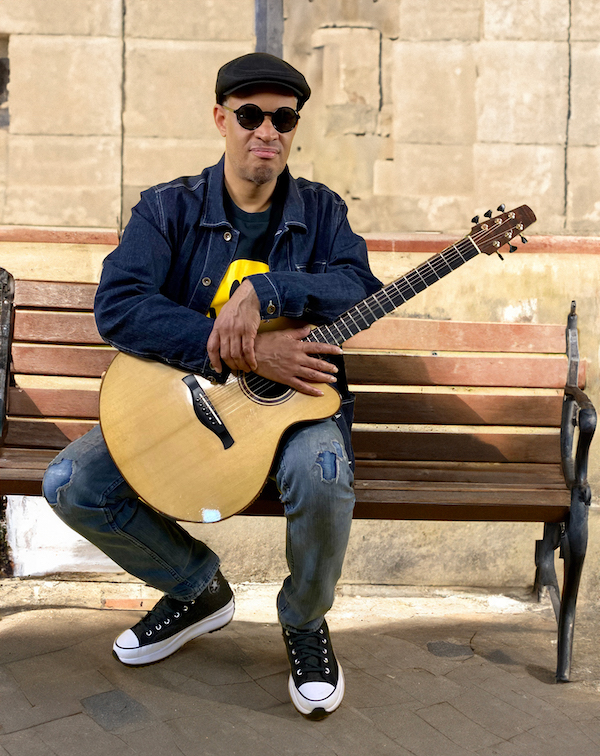
Raul Midón photo by K. Midon
Raul Midón on Taking a Personal Road To Lost & Found

In late April, blind singer/songwriter and multi-instrumentalist Raul Midón released his new self-produced album Lost & Found, featuring various friends and accomplices including Andrés Forero (Hamilton, Phish, U2) on drums and percussion, Richard Hammond (Hamilton) on bass, and Federico Peña (Black Lives: From Generation to Generation) on keyboards and piano. Midón sees the album as a blend of smooth-folk, alt-pop and jazz, but among his many releases, this collection has a little more of a slant towards the singer/songwriter, confessional tone while continuing to make musical allusions to the traditions that he loves most.
Thematically, Lost & Found is also wide-ranging, but there’s a certain perspective that gently persuades the audience, and perhaps the artist himself, to try to let go of things that weigh us down and move towards the future with more purpose and determination. That sense of expectation gives the album quite a lift even when Midón boldly addresses life’s challenges in his music. Those challenges extend beyond the songs to daily life for musicians where economic insecurity means that making music has never been so much of a personal enterprise. That’s a challenge, too, that Midón takes head on. I spoke with Raul Midón about changes in making music over time, the themes that crop up on Lost & Found, and how he usually puts an album together.
Americana Highways: There’s a wide range of types of songs on this album, and I appreciated that they address various difficulties and challenges in life.
Raul Midón: There’s a lot of dimensions to life and if you write long enough, eventually you have to get into some of that.
AH: I’m definitely in agreement with you on that. I think some artists due to the lockdowns and turning to livestreaming got more open to discussing life’s realities with their fans and in their music. Do you think that’s freeing?
RM: I think we are just dealing with a saturation of music and part of that is due to the lack of revenue that people get from streaming. Really, the only revenue that people have is from touring, so I think every true artist just makes music for themselves. I don’t sit and write songs thinking, “How is an audience going to react to this?” I do think about that when I start to play the songs, sure. I think the creative process is not about wondering what the audience is going to think of the lyric, at least not for me. There’s a certain amount of unpredictability to how an audience is going to respond, even if you’ve done this for a long time.
AH: You’ve created many albums. Does that mean that you’re always songwriting and this group of songs has just been chosen from ongoing songwriting of yours?
RM: That’s right. I don’t write towards albums necessarily. I have the luxury of having my own studio, so I go every day and work on something. Sometimes it sees the light of say and sometimes it doesn’t. [Laughs] Usually, it’s a process of selecting from what I’ve been working on and thinking, “What sort of album will this be based on what I have done?”
AH: Also, sound-wise, you’re across the board. You don’t limit yourself regarding genre when you’re writing either, right?
RM: Yes, I’ve always found that limitation a little weird. I guess it’s a business thing and a marketing thing. People have to go to a certain radio station to hear what they expect, and I guess that’s understandable. I do that myself. If I want to hear meditation music, I go to a meditation channel. As a musician, I’ve always just incorporated aspects of music that I love listening to into what I do. It tends to make it less genre-specific, I guess.
AH: I felt like I could still identify the things that you were referencing musically on this album, and that’s something I found engaging. I imagine it’s possible to blend genre elements in such a way that things become fairly bland, but if you are able to keep those ingredients distinctive, that’s like a conversation.
RM: Right, right. Absolutely. There’s always a singer/songwriter aspect to what I do, there’s always a Jazz aspect to what I do. There’s always, for lack of a better term, a certain Latin influence to what I do. That’s always going to come through, it’s just a matter of what you lean on at the time, what your emphasis is. For Badass and Blind, that was a pretty Jazz-heavy album, in the sense that there was a Jazz trio aspect to it, with acoustic piano, bass, and drums. Whereas this album is a little more leaning on the singer/songwriter aspect of it. For instance, a song like “When We Remember,” could have been recorded in 1964 or 2024 in terms of the sound.
AH: That’s true! When I think of albums, I tend to think of settings where it might be at home when played live. For this album, I thought of smaller venues, but maybe summer or springtime with an open-air feeling. There’s a gentleness to a lot of the songs, but there’s also a lot of emotion and musical conversation.
RM: If you think about playing music in a stadium, that would tend to be more raucous just because a lot of the people will be looking at you on a screen, they are going to be so far away. Maybe the intimacy would get lost a little bit. I know a songwriter who says they write for stadiums and I’ve always wondered what that means!
AH: I’m not sure what that means either. Maybe very simple, clearly enunciated lyrics.
RM: I guess. I’ve been to some stadium shows, not a lot of them, but I wouldn’t say those are the shows that have made the most impact on me. I think theaters are pretty ideal. It’s still a big audience, but it doesn’t have that far away feeling to it. I remember playing at the Fitzgerald theater, that was memorable. The Beacon can be good, in New York.
AH: You’ve been engineering your own records for some time, but there’s a wider trend in that direction in recent years.
RM: That’s becoming almost an economic necessity. All but the very, very biggest artists aren’t even getting label deals anymore. The labels are not the monopoly that they used to be, so it doesn’t make sense. The “traditional” way of recording isn’t practical anymore. People talk about inflation, but the thing that has “deflated” is technology. What you can get for a couple of grand now compared to what you could get twenty years ago is unbelievable in terms of what it does. With a computer, a couple of microphones, a mic pre-amp, you can make a record that sounds every bit as good as a record out of a studio with hundreds of thousands of dollars, maybe millions of dollars’ worth of equipment.
That’s just what technology has done. There are still certain things one has to spend money on, like microphones, but the computing power and the plugins are incredible. You download it on your computer and you have a classic Les Paul sound, whatever you want. But, as I always say, the technology has gone through the roof, but the quality of the music has not improved with it! [Laughs] That just goes to show you that technology doesn’t make better music. It makes easier music, that’s it.
AH: Do you have any thoughts on why that might be? Is it that people don’t know how to work on their music and hone their abilities now?
RM: It used to be that you had to be somewhat of a musician to be in the music business. You don’t anymore. It’s the “triumph of the amateur.” It has made it possible for people with very little musical training to make records. As a musician, I may scoff at that, but there is no going back. In a sense, it’s made it possible for almost anybody to make a record.
AH: I see what you’re saying absolutely. I think there’s a practical side of things that goes alongside that decline, which is that people used to learn how to do things from each other, whether it was older people teaching younger people, or just people sharing with other people. Now, things are more isolating, and there’s not that chain of passing things on.
RM: Absolutely, and it’s a sad aspect to things. To learn how to be a musician and to learn how to play an instrument, there is nothing that replaces one-on-one interaction when it comes to teaching music. You can watch all the videos you want, and you can do as many Zooms as you want, but it’s not going to replace a person who is invested in teaching you one-on-one. That is the only way that you get good as a musician. You can get a lot from these other things, don’t get me wrong, but learning to play an instrument, you have to have that interaction. This is because everybody learns a little differently and a good teacher will figure out how it is that they have to teach you. It’s going to be different from another student than they might have.
AH: What’s difficult for each student will be different, and with a good teacher, here’s someone who believes that you can do it and kind of won’t let you back down. That persistence helps with expanding and growing. Some people have friends co-produce their albums for that reason, too.
RM: Absolutely. I think everybody does that to a certain extent. I do a lot myself, a lot, but even for me, singing, playing, writing, and recording, when it comes to mixing a record, I always get somebody else. I could mix it. I have the skill and ability. But by the time you get to the point of a song being done, you’ve heard it a million times, and it’s just a natural thing, the brain starts shutting things off because you’ve heard it so many times. It’s always good to get some outside input.
AH: When you were choosing these songs to put them together, did you see a commonality between them? I do see some similar attitudes, for instance addressing how to live right now, what one’s current perspective is going to be. There are a few references to letting go of more negative things and trying to look towards the future with some positivity.
RM: There’s a certain therapeutic aspect to being an artist. Sometimes you write songs for yourself as therapy. [Laughs] During the pandemic, things got pretty scary for most of us, I think. But with musicians, all the tours were cancelled and you were thinking, “What the hell am I going to do?” That crept into this album, for sure.
AH: The song “A Condition of Love” was surprising to me since, as I was listening, I was thinking, “That’s all really great advice about life, but I don’t know if I can do that.” Then, the song goes on to say, “Yeah, I can’t really do that.” [Laughs]
RM: Right! I’m still trying to do that. [Laughs] It’s an ongoing process is what I’m saying. It’s easy to be positive when things are going great for you. It’s more difficult when you come up against obstacles, and we all do. That’s when you’re really tested, you know? It’s easy to love when everything is great, but when you’re up against some sort of disagreement or barrier, then comes the testing.
AH: I love this phrase and idea of “slowly drifting” in the right direction.
RM: It feels like that. It feels like it’s happening, but sometimes it’s happening so slowly that you’re not sure if it’s happening or not. It’s like what happens with healing. I think the body is constantly trying to heal itself, but sometimes it feels like it’s not happening because it happens so slowly.
AH: It’s like glaciers moving. The song “When We Remember” was one you mentioned earlier and is a really lovely, sweet song. Is it your father with you in the video?
RM: Yes, it is, as a matter of fact. I happened to go home when I was touring. What you see in the video is actually where I was born, near the river in New Mexico. That’s my dad who I’m walking with. It just worked beautifully with the song.
AH: It seems like a very grounded, a very real place, with water and landscape, and desert, so that goes well with the theme of the song in an interesting way.
RM: It’s an interesting place from a geographical perspective. The southern and eastern part of New Mexico is flat and high desert, very much like Texas. But the part of New Mexico that I’m from is closer to Colorado, so it’s mountains and it’s still considered desert. It doesn’t get a lot of rain, but there’s a lot of skiing and hiking.
AH: Something I find interesting about the song is that it deals with time passing in an unsentimental way, as if saying, “This is just reality.”
RM: Yes, absolutely, but it’s also memory and how we remember the time passing. In a certain way, we can choose to remember things in a certain way, and we do. We always think of “the golden days.” It’s just sort of a human tendency. Sometimes that keeps us from appreciating the moment that is “right now.” It keeps us from realizing that this moment is going to be remembered as a golden day a few years from now.
Thanks Raul Midón for chatting with us! Find more details and information here on his website: https://www.raulmidon.com/
1 thought on “Interview: Raul Midón on Taking a Personal Road To “Lost & Found””