







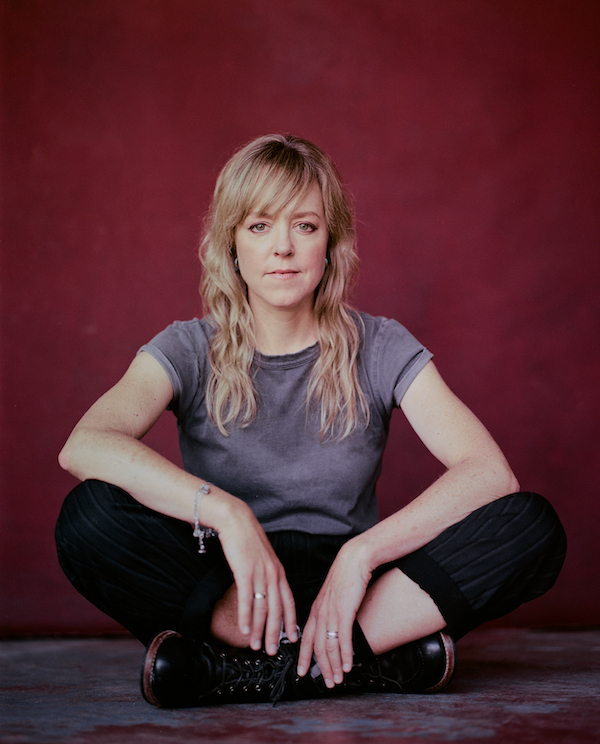
Emily Barker photo by Luke David Kellett
Emily Barker Brings Time and Intention To Fragile as Humans

Singer/songwriter Emily Barker recently released her album Fragile as Humans via Kartel Music Group, following on from her 2020 album, A Dark Murmuration of Words. While Barker’s ongoing evolution as a songwriter and performer is something that fans can readily trace through her work, Fragile as Humans stands as a particularly interesting crossroads where Barker really challenged herself in her songwriting approach and recording techniques to hone in on intentionality in lyrics and in nuances in sound.
That approach was partly inspired by developments in her creative life through taking online music and writing courses, experiences which increased her “tool box” and made her feel ready to employ some of those new tools. But it was also furthered by finding a similar-minded approach in Luke Potashnick (Gabrielle Aplin, Jack Savoretti, Katie Melua), who Produced the album. Something that also makes this album special is that expansive time was allowed for the writing process, and there was even road-testing of those writing choices before recording. All of that makes Fragile as Humans a very direct expression of Barker’s creative vision and makes for a powerful statement. I spoke with Emily Barker shortly after she returned to the UK from Australia for a number of performances, including quite a few lined up for UK record shops.
Americana Highways: What strikes me about the creation of this album is that it seems so intentional in terms of both songwriting and recording, and the level of craftsmanship that you set out to bring to the album meant that was a long process.
Emily Barker: Yes, thank you. I did take my time with the writing, and I had time because a lot of the songs were written during the pandemic as well. I’d done a Berklee music course to keep myself inspired. It was a 12-week theory course, actually. It was all about the relationship between chords, and I learned so much. I suddenly had this toolbox that was so much bigger.
I’d also been writing poetry for five or so years now, and I’m always doing an online course. I used a lot of time for learning, then I thought, “I’m going to put all this learning into practice.” Initially, during the pandemic, I didn’t have a lot to say. I wasn’t feeling very inspired. But after a while, I felt like my future self would look back and wonder how I spent my time, so writing felt like the right thing to do. I got to work!
AH: When you’re taking courses or workshops, do they involve exercises which might result in new songs, or is it more general?
EB: It’s mostly more abstract. Sometimes you’re doing an exercise and it becomes a platform to leap off of, and that can result in a song. One of the songs on this album came from a harmonic exercise. Maybe I’ve always been like this with learning, but I absorb it, and then I fairly quickly forget it. But it’s there somehow. I don’t know that I can articulate now all the theory that I learned in that time, but it’s there somehow, more sonically. I feel like I could use those tools.
AH: You came to work with a new producer on this album, Luke Potashnick, right? I don’t think you’d worked together before, but he seems to have played a significant role in how you shaped the songs.
EB: No, we hadn’t worked together before, but I’d heard of a band that he was in called The Temperance Movement. I reached out to a great producer and engineer called Dom Monks. He’s worked with so many people. Dom said that he really felt like Luke would be a good fit for me, so I went to meet him. As soon as I met him and we started talking about the five songs that I’d sent him, I loved what he picked up on. He heard some of the harmony tools that I was using, loved the lyrics, and had such a cool vision for the album. It felt like we should get to work.
AH: It seems clear to me that with the kind of meticulous approach that you were already thinking of, Luke’s mindset really fit. To see that through takes both parties chipping away, I think.
EB: Yes, he worked so hard, and is very meticulous. He was a wonderful editor, as well, and I haven’t really worked with a Producer in that way before. He’d say, “What do you think about this line? I think this one could be improved.” I was up for it, especially after doing all those poetry courses, where you get so much critique. It’s actually brilliant because it makes you justify your choices. Luke and I did a lot of that, and it wasn’t massive changes, but he picked up on lines where I felt like “Hmmm…I think that’s good enough.” He’d say, “I think you can do better.”
We did some preparatory work, and this was before I went on tour with Mary Chapin. I started performing the songs with the edits live, at the shows, and that was such a good way to see how they felt, and bed them in. Then, when I came into record them in 2022, I was ready to roll and hit “record.”
AH: That’s amazing that you were playing them in that way. Did Mary have any feedback for you?
EB: We were on opposite schedules at the time, though she caught a couple of songs at the time. But she’s listened to them now, and loves them, and that’s always nice when a friend who you revere feels that way. It’s wonderful.
AH: I heard that the place that you recorded with Luke was a very historic location, actually, the 16th century Wool Hall in Beckington, UK. Is that the place we see in some of the live play videos?
EB: Yes, that’s the one! It’s an old hall where they used to sort the wool from the sheep. It’s all stone. Luke and his wife, and kids, moved from London in 2019, and started renovating it. The studio used to be owned by Tears for Fears, and Van Morrison has recorded there, and Joni Mitchell, and The Smiths. It’s got all this history, but Luke essentially rescued it from tumbling down. It’s not huge, but it’s such a nice, live room and you feel so comfortable there.
AH: The setting of recording in that studio seems appropriate to some of the songs, which seem to have a sense of British landscape to them.
EB: You’re right, the albums sort of straddles locations. By that point, my husband and I had decided that we wanted to move back to Australia, but some of the songs were written in Britain after we’d decided that we were going back to Australia, like “Call It A Day,” which was written in Britain, but thinking about going back to Australia.
AH: It’s very clear-sighted in the lyrics of that song that you point out very clear pros and cons to living in Britain. You don’t sugar-coat things.
EB: I had to be honest about that! [Laughs]
AH: One of the songs that’s so unique is “Loneliness” and we have a live play video of that one, too. The vocals must have been a really big choice. I know that you worked really carefully on vocals with Luke, too.
EB: It was awesome to put the songs under the microscope in that way. I did a lot of the vocals, initially, live, with the band, where I was singing and playing guitar or piano. We were all performing at the same time. We had this live atmosphere. “With Small We Start” was the original vocal, but for most of them, we got all of that down, then went back to the vocals. Then I did my vocals, line by line. I really like producers like Luke who like some imperfections. There’s no pitch modulations here, or smoothing the edges. For some of the songs like “Loneliness,” we kept it so intimate. I really like what he did in the chorus with that one, how he makes it suddenly shrink. That’s a very cool effect.
AH: I noticed that. Something I think is really cool is that, while many of these songs are very dynamic, “Loneliness” comes from such a quiet place, almost whispering, to an energy level that feels explosive, though actually isn’t if you compare it to louder music.
EB: I’m so thrilled with how that turned out. It felt sort of cinematic, playing with theme of loneliness.
AH: One of the more startling songs, I think, is “Fragile As Humans,” your title track. And I say that because it admits just how much other people influence us. Maybe in modern life, because we celebrate individualism so much, it’s rare for us to admit that kind of impact. This song really spells that out in very detailed lyrics.
EB: I teach songwriting as well, and I’m constantly telling students, “I want to hear the details.” I’ll say, “Tell me about this person and this situation.” Then we’ll have a conversation and I’ll write some things down. To me, that’s where the interest lies, as a listener. Once you’ve got those sort of details, and something that you can really picture, as a listener, then you have permission to make more sweeping statements, maybe in a chorus.
Adrianne Lenker is amazing in her songwriting, and she’ll talk about and mention her friends in her songs, but that doesn’t feel like it excludes you from the story or the song. You sort of replace the names with friends of your own, or imagine your own. It actually makes you feel closer to the song.
AH: There’s definitely something psychological about it. It’s funny how the whole phenomenon of naming people has developed in music. Often it just sounds cool, but sometimes it’s probably true.
EB: Right, I don’t know any Roxannes! Ruby’s a common one in songs, too.
AH: I think in conversation, we shorten the stories that we tell each other, thinking we are taking too long. So we get to the point. It seems like songwriting is a backwards process of reintroducing salient information. Or maybe the things we might otherwise censor. Was Luke asking you to include more details in your lyrics in that way?
EB: Definitely. I think the biggest rewrite I did was for “With Small We Start.” The first two verses and the chorus stayed the same, but we changed the last verse quite a bit. I want to talk about feeling a connection with a crowd, and refer to the idea that no matter how small you are as an artist, there’s still potential for connection. That’s since the song is all about finding beauty in small things. It was originally coming across as a bit contrived or meta, somehow, so I rewrote it, and it now links with environmental things a bit more. But yes, Luke was pushing for more detailed.
That was particularly true with “Feathered Thing.” I’ve decided to talk openly about the fact that song is about a miscarriage, after trying for a few years and having IVF. It’s sort of about loss and grief, but I didn’t want to go into detail too much. I wanted to keep it open enough that anyone who has experienced grief or loss could relate, even without knowing what it was about. Even without saying that, Luke still pushed me to go deeper into the emotion about it.
AH: The amazing thing about that song, given that context, is how powerfully uplifting it feels. I was surprised, since I knew the background, and was blown away by that aspect of it.
EB: I wanted it to feel like a power, as well. I think you need that to get through tough times. It’s like saying, “I’m standing here, and I’m doing the work that I need to do to get through this.” I’m happy that you had that uplift from it.
AH: Did you have a particular overall feeling about sound on this album, or was each song more of an individual canvas? I notice an interesting balance between lighter and heavier elements. The song “Life is for an Hour” could be taken a bit heavier in terms of subject, but the beat and the rhythm to it are very energetic. Though it does feel dramatic.
EB: That’s cool, yes. It’s got a mid-tempo, Soul thing to it, and we had Feist in mind on that one. I always think that emotions are so close to each other, that you might be experiencing grief or loss, but at the same time, you might still be experiencing moments of empowerment, or moments of humor. They are so close together all the time, and you move between them.
I love it when I hear a sad song that’s upbeat. It doesn’t wallow in the mood of the lyrics. I love proper sad songs, too, but I think it’s this thing that the emotions are never far from each other. I quite like it, as a listener, when you hear the melody of a song, but don’t necessarily listen to the lyrics right away, so when you come back to it, then it surprises you.
Thanks very much, Emily Barker, for chatting with us. You can find more information here on Emily’s website: https://www.emilybarker.com/
Enjoy our previous coverage here: REVIEW: Emily Barker “A Dark Murmuration of Words” is Sincerity and Expertise