


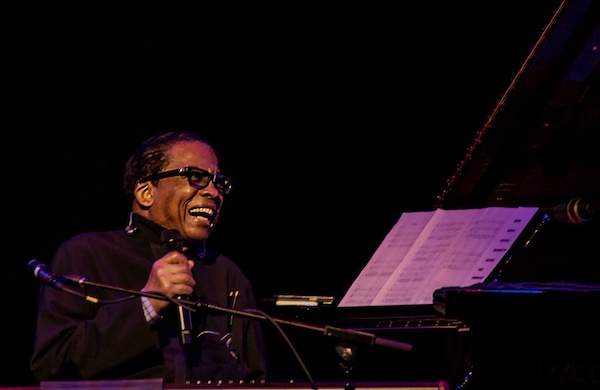
Herbie Hancock at Chapman Music Hall in the Tulsa Performing Arts Center
The legendary Herbie Hancock brought his spring tour to Tulsa this past Sunday night performing a career spanning set to a packed house at Tulsa Performing Arts Center’s Chapman Music Hall.
After greeting the welcoming audience, Hancock declared the way the night’s music began would likely seem, “a bit strange and weird.” Naming the opening song as “Overture,” he described it as “bits and pieces of the prehistoric past,” and hoped that if we had come to hear a particular song, that it was included. I’d wager that over the next thirty minutes of “Overture,” Hancock and his talented band accomplished just that, tapping into every significant music style and sound Hancock has dipped his talented fingers into over his storied career. Bop to fusion and funk, classical and world to electronic and hip-hop, it was all accounted for here. “Overture” also allowed for Hancock’s band to find their groove with one another, sparking creativity and improvisation that built over the course of the evening.
For this stop in Tulsa, Hancock performed as a quartet. Absent were frequent collaborators, Terence Blanchard and Devin Daniels, and though missed, their absence was merely an afterthought, as the music certainly excelled regardless. Joining him this evening was Trevor Lawrence Jr. on drums, James Genus on bass and Lionel Loueke on guitar and vocals. Lawrence’s rhythms were impeccable and subtle, while Genus’s extended bass solo was my favorite of the evening. Loueke in particular played a prominent role in the opening medley of eras. From his scat-styled, Xhosa-inspired tongue clicking, to his finger tapping the fretboard of his guitar teasing “Rock It,” he was immensely fun to watch.
The remainder of the set saw the quartet stroll through a beautiful rendition of the late Wayne Shorter’s “Footprints”which was my personal highlight, followed by “Actual Proof” from 1974’s Thrust. Come Running to Me” from 1978’s Sunlight album featured Hancock’s usage of the Vocoder, and metamorphosed into some downright entertaining and engaging philosophy. The as yet unrecorded “Secret Sauce” allowed the quartet a lot of room to spread out and explore, before a night ending and fiery “Chameleon” from the 1973 groundbreaking Head Hunters, that saw a mesmerizing duel between Loueke’s guitar and Hancock’s Keytar that concluded with Hancock’s repeated rock star jumps in the air that defied his 83 years of age. (He’ll be 84 later this week on 4/12).
Hancock has always been at the forefront of technological advances in music whether it be his using the Fender Rhodes, Vocoder, Keytar or various synthesizers, all of which Hancock had at his disposal on this evening. But for me, I relished each time he turned and devoted his entire attention to the piano.
It was during those times that I seemed to see Hancock smile the most, and the truth is, it really is one of the best smiles I can remember seeing. Fortunately, Hancock smiled a lot throughout the evening, most frequently reacting to what his counterparts were doing. He seemed to be having the time of his life, and that somehow defined the evening for me. Despite having played all of these songs countless times over his incredible career, Hancock still seems to crave reinventing and reinterpreting these works each night and I feel privileged to have been a part of it.
Herbie Hancock’s spring dates continue through April 20th in Los Angeles, with a fall tour beginning August 10th in San Jose, California. You can find more information on the tour and everything Herbie Hancock by visiting here: https://www.herbiehancock.com
I’m a huge Herbie Hancock fan and saw the Charlotte 2024 show BUT if you are thinking he is playing jazz then think again. Zero swing. Very disappointing. When it’s Herbie Hancock you expect jazz. I don’t know what this was.