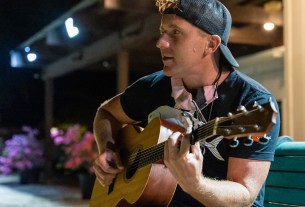
Malcolm MacWatt woodpile photo by Gary Paul
Malcolm MacWatt Dark Harvest Reflects Past and Present Realities
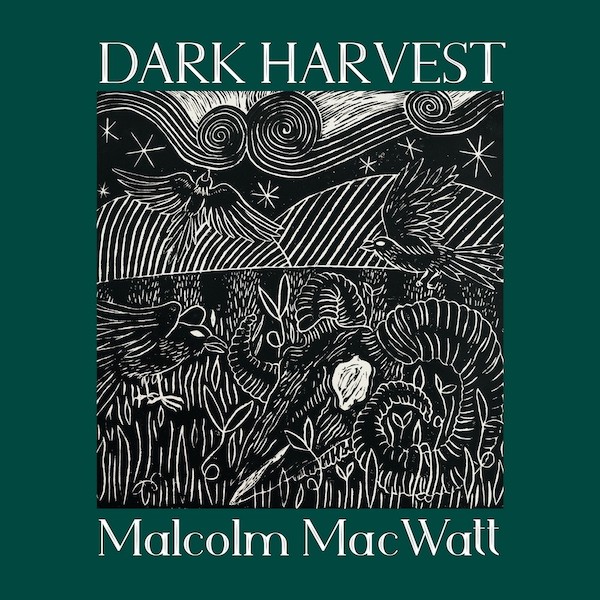
Scottish Americana artist Malcolm MacWatt has come to the attention of American audiences in recent years through working with US-based label Need To Know Music founded by Brian Brinkerhoff. MacWatt’s first release via Need To Know was Settler, which addressed elements of transatlanticism in MacWatt’s musical and cultural experiences and brought together Celtic and Appalachian musical traditions. Now, MacWatt has released Dark Harvest where he writes and continues to play all the instruments, but is once again joined by esteemed guests for certain tracks, like Nathan Bell, Angeline Morrison, and Rory Gallagher.
Malcolm MacWatt’s largely self-taught approach to music pairs well with a certain DIY boldness in observational writing, too, and in that sense, his work has a great deal in common with protest music and punk movements. It’s a powerhouse combination of traditional sounds and directness in lyricism which really captures the imagination, particularly on Dark Harvest where MacWatt takes on the dark corners of history as well as the undertones of mass-mindedness that are all too prevalent these days. I spoke with Malcolm MacWatt about how he approached songwriting for this album, his musical foundations, and why this album carries somewhat heavy themes.
Americana Highways: What was it like for you selecting songs for Dark Harvest? Did you have many to choose from?
Malcolm MacWatt: I’d written 27 or 28 songs and I ended up recording 20. I thought, “These 20 fit more into what we’re doing.” Then, as time went on and the world became a little darker and a bit scarier, and it came to putting the album together, I thought, “This one’s too happy. This one doesn’t fit the rest of them.” I argued my corner a little and ended up getting 14 songs, which I wasn’t expecting, and was happy with that.
What happens is that I record the stuff on my end, I don’t get it mixed, I don’t get it mastered. Brian’s got his people who he likes to work with, and that’s True East mastering in Nashville. It’s cool from my point of view because it gives me that link with America that I like to have with my songs. In many ways, I consider myself an Americana artist because I love those American stories, but if I can find a little Scottish angle into it, I’ll go with that.
Initially, before working with Brian, I had a little EP called Scale, that came out due to lockdown. At that time, I kind of wanted to be like Jason Isbell and I’m a massive Telecaster fan. But I couldn’t go into studios due to Covid and play with other guys, and I was in London, where I didn’t really want to be. I wanted to be in Scotland, at home, up where there’s no people. So I did this little EP about Scottish connections to America and it was really well received. Then I got this call from Brian. He said, “I like your other songs, but I like this stuff in this vein, if you have any more of it.” I appreciated that and I really like him as a friend and a mentor. He cares about the music and to have somebody on your side is brilliant.
AH: It’s pretty cool that he’s hearing the music only when it’s pretty close to completion. He seems to be respecting the art in the sense that he meets it once it’s created.
MMcW: I would certainly welcome any input and I’d listen to him. There are no doubts about that, but he really liked Settler and understood where I was coming from. He understands the overall feel that I want for something. Most mixing engineers want the maximum sonic bang out of what you’re doing, but I don’t want any of that. I want it to sound like you’re sitting here in the room with me. I want my mandolin player sitting next to me here. Even though it’s all me, in my head, it’s a band and we’re all sitting together.
AH: I understand that this time around you felt more ambitious about involving specific songwriters and performers. That shows a kind of conceptual move forward for you in terms of songwriting, I think. You see yourself more as part of a community now.
MMcW: For my previous work, I thought of possible people afterwards, after writing, but for this one, I didn’t really want to do that. I already had people I wanted to work with. I was writing songs for folk that hadn’t even said “Yes!” I could hear them as I was writing. I just really wanted Nathan Bell on “Dark Harvest.” He’s a political animal and I knew he’d appreciate what I was trying to do. I’ve toured with him and I know that he loves Scotland, so he was one guy I definitely wanted. Angeline Morrison was someone else where I’d already written the song. If Angeline hadn’t said “Yes’” to it, I wouldn’t have done it. It wouldn’t have had the right sound. If Brian had said, “I could get you Bruce Springsteen!,” I wouldn’t have turned him down! But it was about having the confidence to do what I wanted to do, even putting an eight-minute song on the album. Brian might have thought, “Really?,” but he said, “Yeah, okay.”
https://youtube.com/watch?v=s0EkobXBEW4%3Fsi%3D5y0p-R9CI755Tg1o
AH: I can understand that the flipside of having the freedom to do what you want until a late stage of recording is potentially wrestling with crippling self-doubt because you’re all by yourself until then. But it just seems like you were thinking bigger here, recognizing possibilities more for Dark Harvest. And you didn’t get in your own way in case it might work out.
MMcW: I think you pretty much nailed that because once you’re on a run, you sit down every day and just work on a new song, then a new song, then a new song. I recorded them pretty quickly, since I pretty much did 18 songs in a row. I couldn’t move onto the next song until I’d gotten that one done. That’s an easy way for me to work because I actually don’t read music, and I can’t write it. When the idea’s there, I get it down. When it works, it works. If it doesn’t, I’ll come back to it.
Luckily, working like that, you get these happy accidents that just happen, and you keep them. There are a couple of things that took longer. I remember spending four hours working on a fiddle piece and I was quite happy with it. Then the guy who does my mixing said, “This just gets in the way.” And just binned it! [Laughs] I think the great thing, at that stage, is that I have enough distance to do that. Now, when I hear the song back, I think, “Thank God that’s not there.” It’s great being on your own, but it’s also nice having people who you can trust who want to make you sound as good as you can. Once I hand the songs over, I try not to get too involved in the mixing. They know what I want.
AH: How did you come to play so many instruments, making recording these songs alone possible for you?
MMcW: Well, I love the Appalachian sound and there’s something in that that just speaks to me. The banjo is a character in itself and has its own voice. I think of all these instruments in terms of their character and what they are saying to me. It’s kind of like dealing with something familiar. I learned to play the guitar when I was 13 and I had the typical hairy, bearded history teacher who also did guitar lessons as an after-school club. All the songs I learned were American and bits of Americana, like “Camp Town Races.”
I think right from an early age, it was that, “three chords and the truth” thing that got me into the guitar. But when I was really young, maybe ten years old, I fancied playing the violin. I picked it up and I think quite early on, I was able to make a nice sound. That was unusual. I think violin is one of the hardest instruments, and it always sounds horrible at first. When I went into high school, playing a violin wasn’t cool. I wanted to be Jimmy Paige. I didn’t want to be no fiddle player! I hadn’t played a violin for many years, and even then I’d learned to sight-read a bit, but I was never really reading the music. I’d just hear it, and learn it. I struggled with formal education in music and dropped it quickly. When I realized that I could just play things because I wanted to, that was a big revelation. So it was great to have that early foundation, with a bit of discipline, a bit of technique, but then after that, it was all about the DIY attitude of playing.
AH: It seems like feeling that there are different personalities in the instruments would tie into how you write. Do you feel you’re hearing certain things, like a conversation between instruments?
MMcW: Absolutely, and that’s something that I really try to have in the music. It’s not to have a bunch of virtuosos playing over each other, it’s to have these guys playing together. You can take the music somewhere, then the next instrument takes it beyond that. Some of that is deliberate and some of that is just knowing my limitations. The instruments with frets, like mandolin, banjo, and guitar, are ones I can take more chances on. The frets keep things in tune. The fiddle is something I don’t take as many chances on, so I play it a little safer. Once I’ve reached the end of the line with my fiddle playing, I say, “The mandolin can take it from here.” And it usually works out!
AH: This is what people say about personal styles. Style is purely based upon one’s own strangeness and limitations. People play based on what they can do! That’s true for everyone.
MMcW: Absolutely. That’s definitely how I like to work. Happy mistakes are part of that, as well, when things just work out. Even if I’d had a degree in music and was able to plan things, I don’t think I could have gotten what sometimes happens. It’s luck.
https://youtube.com/watch?v=LU8aNokyUZg%3Fsi%3DoNUFky_yxmu8HFJ-
AH: One of the recent singles that came out really interests me, “The Nightjar’s Fall from Grace.” It also has a really impressive video. I like how the different god-like beings are represented. The song is like you’ve created a new myth or folktale and it makes sense in the modern setting.
MMcW: Thank you. There are so many different narratives going on in the world and I know that right now everyone seems to want to control the narrative. I think there’s space for all narratives to be happening at the same time, and that was the idea of the Nightjar. The idea that one bird felt that he had the right to talk over everyone else and everyone else’s different voices was a problem. They are all valid and valued. It was a crazy idea I had, that there’s a god going, “Naaaaa.” It was the old gods, which is the way I see Nature, that is stifled by too many people saying, “This is the right way. This is the wrong way.”
AH: It’s a little reassuring, in that Nightjar story, that there is some kind of authority saying, “What the hell are you doing?” A more pessimistic view would have left things in a state of inequality and darkness.
MMcW: Yes. I think there’s so much pessimism going on in that album. I never really thought about it, but now that you say it, maybe a part of me was saying, “Put a little light in here.” The world is so different than what I think we should have come to expect. This is 2024. The Cold War was 40 years ago and it just feels, here, like there’s a mass of gaslighting going on. It’s in what we’re being told to believe. We’re told to believe war is alright. Right now, in the UK, we’re being told that the government is considering [compulsory] National Service again. Military service!

AH: Wow, didn’t that end around the end of the 1950s?
MMcW: The very fact that we’re even talking about it seems insane. Everybody knows it’s insane, but we’re having to talk about it. Conflicts are going on, and you have to wonder if it’s about the rich and about money. The way I see it, the world seems to be getting more extreme and more polarized. You mention the 1950s, and in the 50s, at the end of the Second World War, there was a bit of hope, and these ideas of collaboration. There was a sense of talking things through. Not so much now.
AH: There was a sense of forward momentum to that. I had wondered if it was harder for you to spend time with these darker subjects for several of these songs. Is there a sense in which it’s helpful for you or necessary for you to bring them into your music?
MMcW: I don’t think it’s cathartic for me in that sense. It’s just what seemed to be around. The only thing for me that I want to get off my chest is probably these ideas that I have around Scottish independence. I really feel that and get frustrated with Scotland for not wanting that. My wife’s a real feminist and my grandmother was, as well, and they are two women in my life who point things out to me that, as a man, I might not have thought about, like patriarchy and misogynistic views.
Once you start looking, you see more all around. Things like that do bother me, and I thought at the time that Dark Harvest was being written, that there were some real dark things happening. I suppose those things end up in the songs and then there are other historical things that are still going on, and you think, “We haven’t learned from that at all and it’s still happening.” It’s still happening because of the establishment and the media. In the UK, there’s also this whole overriding neo-liberalism around the idea that the economy is the most important thing and to hell with the people. It seems to be about making a few people incredibly wealthy and there’s a huge amount of corruption that goes hand-in-hand with that idea.
https://youtube.com/watch?v=VCTFRKkGVG8%3Fsi%3DpCK87lLPZom725rg
AH: I see some of those ideas, both about Scottish independence, and about the super-wealthy, popping up in “Heather and Honey.”
MMcW: It makes Margaret Thatcher and Reagan seem positively benign because those people probably did believe that they were doing something positive for their country, but right now, it’s about, “I’m doing something right for me, to increase my power, my wealth, my influence.” It’s everything I don’t believe in.
Thanks very much for speaking with us, Malcolm MacWatt. Find more details and information on his website here: https://www.malcolmmacwatt.com/
Enjoy our review of Dark Harvest here: REVIEW: Malcolm MacWatt “Dark Harvest”