




Eric Brace & Thomm Jutz Bring The Now To Simple Motion
Nashville-based songwriters and artists Eric Brace, Peter Cooper, and Thomm Jutz fell into a trio configuration after Brace and Cooper worked with Jutz as producer on their own duo music, and the fact that this happened so naturally says a lot about their musical and personal ties to one another. Following Peter Cooper’s passing in 2022, Brace and Jutz had to decide what to do with a European tour that had already been booked for the three. Following through on their previous commitment as a temporary duo proved transformative and paved the way for their album Simple Motion, which arrives from Red Beet Records on February 16th, 2024.
While it would be forgivable to jump to the conclusion that Brace and Jutz created an album in honor of Cooper, that’s actually not the case since making an album together was something that arose naturally under its own steam. However, for Brace and Jutz, there is a certain sense of Peter Cooper’s presence throughout Simple Motion. While creating music that would memorialize their friend adequately would be “simply impossible,” according to Jutz, it would have been just as impossible to craft music that wasn’t influenced by his presence and perspective, as well as their mutual trajectory together over the years. I spoke with Eric Brace and Thomm Jutz about the genesis of the unique album Simple Motion and the mental and musical journeys it captures.
Sharing the origin story of the album with me, Brace and Jutz explained that working as a duo arose so naturally after performing in the UK together that it made “perfect sense” to continue by making an album together. Since Jutz had a studio, and both artists live in Nashville, it was no big leap to finding time to work on and record these songs together. Interestingly, however, they do feel there is a continuum between the songwriting and recording that the three did together in the past, and the process of making this new record, since, to Jutz, certain directions in production were a natural development from their previous work together. In many ways Simple Motion is the next album that the group would have made together regardless of such changed circumstances.
Regarding the recording process for the album, which was laid down in Jutz’s studio, Jutz shared that first they recorded the tracks with just Brace, Jutz, and bass, and then a separate live session was recorded among other instrumental players. This meant that, essentially, each song was “recorded in two parts” which were then blended organically. For that reason, the songs have a more live feel than they might have had Jutz recorded each instrumental part separately and then combined the tracks in a less hybrid mode.
Eric Brace jumped in to share that he often feels self-conscious when live recording because he feels less skilled than the other musicians around him, however he does really like how his contributions turned out on the track “Sea Fever.” Jutz doubled-down on this semi-live approach, however, saying that he’s considering getting both sets of musicians together at one time in his small studio in the future, “all on the floor.” It’s something he’s resisted so far, assuming that might keep the sound from being as perfect due to limited space, but now he’s at a point where he is asking, “So what if it doesn’t sound perfect? Who cares?” He added that he knows he’s a pretty good guitarist and the other players are excellent, so the end result would, inevitably, be good.
Significantly, both Brace and Jutz are at a point in their decades-long exploration of songwriting where they feel that their writing needs to come from the unconscious. This they prefer to developing songs as part of a conscious decision to write with certain outcomes in mind. This is something that guiding light Tom T. Hall impressed on them through his approach to music and they readily agree with, since writing in any other way is simply not interesting to them anymore.
When I noted that the song “Simple Motion” is a late night/early morning song, that “London” is a nightlife song, and that “Nashville in the Morning” is an early morning song, all times that seem more liminal and on the borderland of the unconscious processes, Brace commented that he often writes about time, and those times particularly interest him. Though Brace hadn’t necessarily recognized it at first, he now sees time as an operative idea throughout his contributions to Simple Motion.
Commenting further on “Simple Motion,” Jutz shared that he wondered at the time if writing about trains was too archaic or whether it was something that could connect to modern audiences. But, as Brace added, train ideas seemed to arise for both of them after their tour of England together, where they were often using trains, so they overcame any doubts and followed this imagery for the song. It’s also another way in which the idea of “motion” contributes to the cohesion of the album, I noticed.
Jutz explained that writing the song “When London Was The World” was something that also related to their UK tour together, since in conversation they agreed that they still felt that London was a very central place in the world, culturally and musically. Discussing the idea, they came up with an approach from the perspective of the main character of the musical Cabaret, which was in turn based on Chris Isherwood’s book Goodbye to Berlin. The Emcee character in the story is someone who could charm and seduce anyone, even the Nazis, but it wasn’t enough to keep him safe in Berlin, which becomes a motif in the song that audiences might well relate to in our modern times.
Brace reflected that the song “Sea Fever” was an “outlier” on the album in the sense that he came across the James Masefield poem by e-mail in a poem-a-day subscription before being struck by the musicality of the language and structure. Doing a bit of research, he came upon a few musical adaptations for the poem, but none that really struck him as particularly evocative. Brace then introduced some new repetitions to the poem to create a chorus, and when he sent it to Jutz, the latter immediately took an interest in it, too. In the end, Jutz actually produced “Sea Fever” differently than the other songs on the album, giving it a distinctive flavor and feel, and also confirmed that it needed to end in a rather sparse way, without further verses or instrumental solos.
I commented on the unusual mood established by the vocals on “Sea Fever”, bringing an almost antique quality to the song, something which also seemed in keeping with the vocally-driven feeling of the song. While the music is also very carefully developed and presented, there’s a sense of a dialog between the vocals and the music that creates an interesting tension. Brace confirmed that the song has unusual sonic qualities, he shared, but also felt strongly that this was due to the production approach that Jutz envisioned for the song.
On a more personal note, Eric Brace shared that only after working on the song did he realize that the lines “And all I ask is a merry yarn from a laughing fellow-rover,” clearly referred to Peter Cooper in his own mind. Cooper, Brace explained, was a very funny person whose sense of humor enlivened the experiences of his fellow travelers. So this song, in particularly, expressed Peter’s presence in an overt way that also points to his subtle presence throughout the album.
Jutz’s own interest in “Sea Fever” led him to choose it as the final, concluding track of the album. Previously, when Jutz and Brace were working with Peter Cooper on albums, Cooper had been the most involved in album sequencing, but this time around Jutz knew right away that “Sea Fever” was the final track, and also that it should end somewhat abruptly. Unlike most people’s approach to sequencing albums, Brace and Jutz started from the position of this last track and moved backward from there.
Discussing how these new songs were written, Jutz and Brace shared that they worked in quite different ways on each song. The first line of the song “Arkansas,” for instance, was something that Brace overheard in a shop one day. Texting Jutz the line with the comment, “This is a song, isn’t it?,” Jutz replied right away in the affirmative and they got to work.
Brace recalled that the first song from the album that they consciously collaborated on with the intention of making a new collection was “Frost on the South Side.” In fact, it really helped determine that they were headed in the right direction, now working together as a duo, when Brace sent some lyrics to Jutz, asking what he thought of them, and only a very short time later, Jutz sent back the music for the piece, fully-formed. The ease of the collaboration was apparent and suggested they should continue under full steam.
While the topics for these songs may have stemmed from Brace’s and Jutz’s unconscious, that doesn’t mean that the two avoid reflecting on the implications of working with the unconscious. Jutz, in particular, noted that this means they are essentially working with archetypal ideas in many of their songs. These archetypal ideas then have a greater potential for bringing a feeling of meaning to the songs, especially for the artist, but also for the audience.
Expanding on this idea by drawing on discussions from his songwriting classes, Jutz observed, “There are only two things that people write about in music, HOME and TIME.” He considers both to be archetypal. According to Jutz, under the umbrella of “HOME” come relationships of all kinds. The idea of “TIME” relates more to your vantage point, where you are “standing” at a given moment in time, he elaborated. This duality is also true of the songs on Simple Motion, he feels. He admonished, “It’s important to work with the archetypes that hold meaning for you, otherwise, the song won’t hold meaning for you, nor anyone else, it seems.”
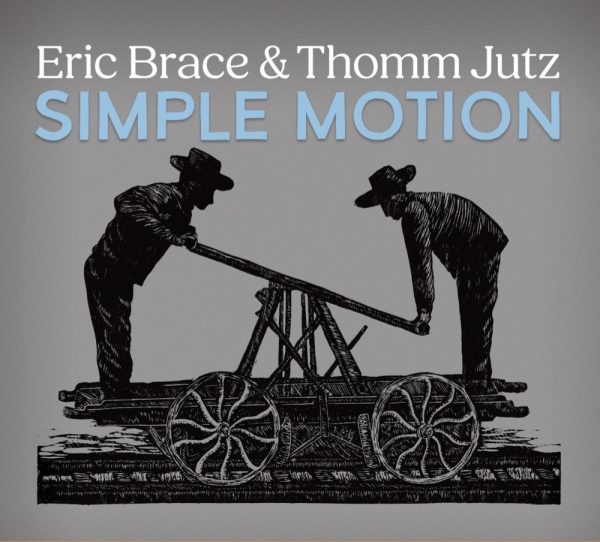
When I commented that the cover art for the album rings an aesthetic bell, Brace shared that it was created by carving the image into vinyl tile and stamping it onto paper, and was brought to life by Julie Sola, the same artist who created the cover for I Love: Tom T. Hall’s Songs of Fox Hollow and Hangtown Dance Hall (Eric Brace’s album with Karl Straub). Brace had the initial image in mind, that of two men pushing a railroad cart in tandem. Having seen the album art, Brace realized that, of course, the two men were he and Thomm Jutz, continuing to push their music forward with a new set of songs.
I observed that the cover art is the perfect image to encapsulate their collaboration on this album since it’s a very different process to write an album solo than it is to work with a collaborator. Brace agreed that the polarity that’s created in the energy of songwriting and recording becomes recursive, returning, and invigorating.
I asked both Eric Brace and Thomm Jutz to comment on how they feel about their place in musical tradition, whether they feel that they have to carry the weight of the past through traditional music, or whether they feel free to make a break for the modern and the new. Jutz feels very strongly, he said, that music makers are “part of a continuum whether they know it or not.” Acknowledging that may make a big difference, he reflected, in “how you feel about past traditions, but it doesn’t affect the simple reality of it. It’s there whether you know it or not.” “We are just acknowledging it,” he added, referring to he and Eric Brace.
It’s worth noting that interacting with the past is something that’s very much part of Jutz’s normal, daily approach to music, he shared, since he likes listening to songs from the 1930s and earlier. This leads him to wonder if earlier forms of Folk music, particularly, once existed and we just don’t have the evidence of it. When he listens to the earliest recordings available, he wonders, “Were there wax cylinder recordings, now lost?” He also considers what such songs might have sounded like in earlier incarnations, for instance in 1915. The fact that we just don’t know is part of a fruitful speculation for Jutz because we are now working with the same patterns and configurations that appeared in traditional music, whether we recognize that or not.
Brace took up this question of dealing with the past or the present of music and said that for him, the forms and elements of the past are now “so steeped” in him that they are “second nature,” but at that point, he also begins to feel free to use any of those elements as they occur to him. He feels that he used to be more concerned with the idea of “the new” and was actively trying to be new via his songwriting in the past, for instance when he played rock music in rock bands. Now, though, the idea doesn’t bother him much. He does, however, recognize the need to be “now” in his work and feels both necessity and responsibility surrounding that. Working from the perspective of the past wouldn’t be “creatively rewarding” for him and wouldn’t necessarily connect with audiences either.
Bringing in further clarification, Jutz laughed and said that one thing that he will never be is “retro.” It just would not be possible for him. He acknowledged that some artists embrace that approach and explained that he doesn’t wish to stand in judgement of their work, but it’s just not his goal. He cited Bob Dylan as an artist who has often pulled in elements of the retro, particularly in his clothing, to express his identity as a “showman” in a music tradition. Jutz certainly respects that, but it’s just not Jutz’s aesthetic. However, the recognition of the past, and the patterns that it has instilled, will always be part of what he does, Jutz confirmed.
In passing, Brace noted that he’s actually currently working on a project that takes on 1930s songs, so he’s been thinking about traditional music a lot lately.
When it comes to making sure to include the “now” in their newly written music, I observed that the individual moments in time that the songs on Simple Motion capture become part of the songs’ modern feel. By seizing upon the moments and impressions of modern life, even those from our interior lives, and making sure to include them into the storytelling, they bring a fresh and modern feel to their work. Brace feels that they gained that approach, he explained, from Tom T. Hall and the ways in which his songwriting was celebrated by their friend and bandmate Peter Cooper. While it wouldn’t make any sense to try to write about Hall’s past and his lived moments in the way that he particularly captured them, Brace and Jutz continue the tradition by capturing their own moments now. Hall’s approach, Brace explained, impacted Nashville songwriting as a whole, and it’s still felt. But at any rate, Brace concluded, “It would be impossible to live in 2024 and not write like someone living in 2024.”
Thanks for chatting with us, Eric Brace and Thomm Jutz! Find more details on their website here: https://www.redbeetrecords.com/
Enjoy our previous coverage here: REVIEW: Eric Brace & Thomm Jutz “Simple Motion” and here: For Peter Cooper, There Was Always Another Story Waiting To Be Told