




Kitchen Dwellers’ Max Davies Chases Down Seven Devils
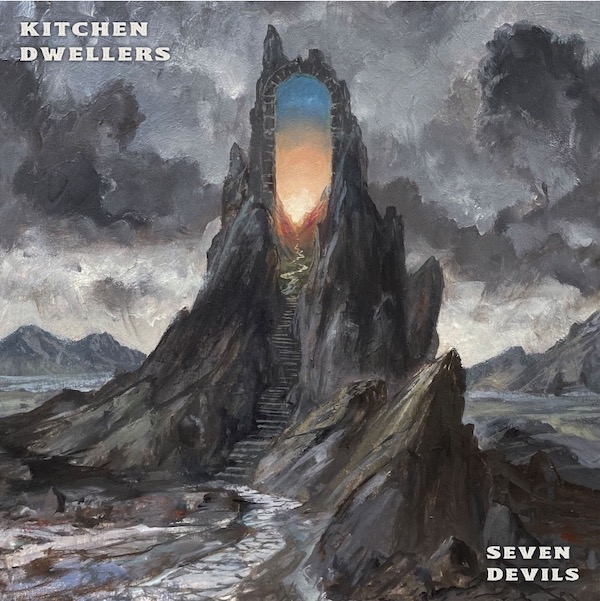
On March 1, 2024, Montana-based experimental bluegrass band Kitchen Dwellers will release their new album Seven Devils, having closed out the year with a three-night New Year’s Eve run, and gearing up for touring that takes them straight into the album release period and beyond. The performances have introduced the new album’s title track to audiences and a video captures that experience live at Red Rocks. Some elements of that video make it an excellent prelude to the album itself, as we get the sense of the two parts of the song which express frustration of a protagonist, then a kind of mysterious feeling of descent.
This descent idea was inspired by two traditions, including Dante’s Divine Comedy and Inferno, and also the cultural and religious traditions of The Seven Deadly Sins. The album has been carefully laid out to dramatize an inner journey for a protagonist where, after a crisis, he emerges a changed person. If that all sounds a little complicated, then rest assured that each song also has its own territory to cover, expressing something personal about modern life from the band members, but also speaking to universal struggles we face. One of the album’s singles, “Pendulum,” for instance, circles around the idea of addictions as a part of modern life. The band features Shawn Swain on mandolin, Torrin Daniels on banjo, Joe Funk on upright bass, and Max Davies on acoustic guitar, and all members contribute to songwriting. I spoke with Max Davies shortly before the holiday period about how they chased down the themes and moods of Seven Devils.
Americana Highways: I’ve heard that in some of your New Year’s shows, you’ll be playing three sets! You all have got a lot of original music now, but do you also mix in some traditional music or covers live?
Max Davies: We really spice it up. We do a little bit of everything now. We’ve been a band for so long now that we do have a bigger repertoire to draw from, which is nice when we’re playing over three nights, like New Year’s. We just did a Midwest run, and we tried for the whole week not to play the same songs. We’ll do original music, we’ll do some covers, whether that’s rock or hip-hop. Then we blend in some traditional bluegrass, either instrumentals or traditional songs. Then we do some cowboy stuff, country stuff, and it’s a big old mix, which keeps it fun. That’s why we see some of the same people every night!
AH: That’s really admirable. Not even the biggest rock band in the world tries to play totally different music between nights in the same region. I saw the video for “Seven Devils” and it looks like you were playing that song at Red Rocks sometime in 2023. Are these songs already working their way into your sets?
Max Davies: For the new album coming out, “Seven Devils” is one that we’ve been playing out for a little bit. We almost put it on the last record but decided not to. We also have an older song “Here We Go” that we’ve been playing, but actually it got revamped for the album so sounds different than we used to play it. We also have released another song from the album, “Pendulum.” We haven’t played that live yet, but we’re excited to play that.
AH: Though the album is coming up in March, I was very intrigued to start thinking about it because it has some interesting ideas to it, but also looking ahead, you have a ton of shows coming up, so it makes sense to start releasing music along the way.
MD: Yes, we’re doing the whole mountain town run around January and then we’ll get into Texas, and then in February, we’ll be along the West Coast before we do the big album release. That rolls into shows in March and April, and we’re hoping to tie the album in as much as we can.
AH: I think people will find “Pendulum” very relatable. It is pretty explicit about internal states, questioning, and self-observation. So it was a great one to release ahead. Of course “Seven Devils” says so much about a searching and questioning attitude that it’s very familiar, too.
MD: Throughout the album, every song is pretty explicit about its subject matter. Each song relates to a separate human experience. “Seven Devils” really sets the stage for things. The album is meant to be one whole piece from start to finish. We kind of wanted to set it up like a protagonist’s journey. Torrin drew this correlation to The Divine Comedy and Dante’s Inferno. We started talking about the Seven Deadly Sins and how we can relate each song to one of them and take the audience on a journey. It was really fun to organize the songs and we even have the interludes. We played around with a lot of different sounds, styles, and instruments, and we have guests. It takes you up and down, and inward. A lot of the songs are personal, but all the subject matter is stuff that everyone deals with and can relate to.
AH: The album trailer that’s out is a great introduction to the ideas on the album, which clarifies that this isn’t all coming from a particular religious perspective, but from a more humanist perspective and a psychological one. When you were all were thinking about the idea of the Seven Deadly Sins, were you thinking in terms of complex things in life that we all struggle with, or perhaps damaging things that we encounter in life?
MD: Definitely both. Everyone in the band writes both music and lyrics, so everyone has a lyrical contribution to the album. We sat down and we looked at the subject matter, and what each song’s about, and how that could potentially relate to one of the Seven Deadly Sins. We’re seeing life as happening so fast right now that the world is changing at a rapid pace, and it has caused some of us in the band to write about it. It’s just what’s going on in our personal lives. The songs definitely have to do with thinking a little bit mor inwardly and thinking about how we find our own happiness and contentment. Some of the songs address things which are going on in the world, like gun violence, while in “Pendulum,” it’s about addiction.
None of it’s supposed to be preachy or religious, as you said, but we’re narrating and commenting on what we’re seeing. Torrin mentions in that video that our last album, Wise River, was written mostly during lockdown and Covid, so it was very much about natural states. Many of us live in Montana, and in the woods, so a lot of it was about the natural world and landscape. But I think this album is more about society.
AH: I got the sense that Wise River also had quite a sweep of time to it, a perspective that took in the past as well as the present, whereas this album is very much about right now in the world. It also keeps it interesting for you guys to choose new areas to work in!
MD: Exactly. Every time we go into make an album, we don’t feel that we need to make “Part 2” of anything. It’s just the evolution of what we’re playing and the style of music that we’re playing. It was nice to dive into this project and not feel like we had to follow up on anything.
AH: It is interesting that “Seven Devils” was a little earlier because it feels like it bridges things. We have some landscape elements in that song, but they are broad. The emotion in that song, to me, is a breakthrough of frustration. It’s about asking, “What am I supposed to do now?”
MD: It is emotional, and the chorus definitely gives you that feeling. That’s cool that it’s at the beginning of the album because you’ve reached a crossroads or a point where you’re on the ropes and you’re looking for some type of sign or direction. Something needs to happen, a decision, a first step, or something.
AH: I think at least 80% of Americans could relate to that feeling right now. It’s like, “What’s the next dumpster fire going to be?” But at the same time, we want to move on and rebuild and lean into the positive somehow. Things right now feel unresolved like in the song. But you have an actual “Prelude” to your album, too, I should mention, which is not a very common thing to do. Was that something that you wrote after the rest of the album came together, to see what might fit?
MD: Yes, that was something that came from going through all of our songs. We started to feel that there was a little bit of a motif or consistent theme, whether in songwriting or even in the key of each song. Some of the songs are in the key of D, which can give a heavy feeling. We had discussed with the Producer, Glen Brown, having some vignettes or movements between the songs and we didn’t know how many to include. But we thought it would be really cool to start the album with that. It gives off the feeling that this album is a whole piece, also.
The main chunk of time that we were in the studio, we came up with the “Prelude” on the last day. A few of us gathered in a back room and started messing around. The last song on the album starts and ends with a couple of the instruments doing a triplet thing. We thought we’d incorporate instrumental elements from “Seven Devils” and this last song into the “Prelude.” We thought it was really cool and we recorded it. We weren’t sure how it would work out.
AH: How do the roman numerals in the song titles relate to the themes of the songs or the listening order? Are they the “real” listening order in some way?
MD: No, the roman numerals correspond to which Deadly Sin is the focus. The order in which the songs appear on the album is the correct listening order. The album has an arc to it. We had to think about how the album would flow and we talked a lot about the journey of the listener and crises in the subject matter. The last couple songs are actually about breaking through to a post-crisis self, and we knew that we wanted to put those at the very end. That’s “Unwind.” You’ve gone through the trials and tribulations, and at the end, you come out as a different person. A lot of thought went into the order.
AH: Is there a particular song that you contributed a lot of the lyrics to that you’d like to talk about today?
MD: The one that I spent the most time writing was “Waterford Son.” That’s another one in D. It’s an epic tale of a real person, Thomas [Francis] Meagher, who has a lot of history in Montana, but is also a major historical figure in general. He found in the Civil War and recruited the most Irish soldiers of anyone in the Civil War. He was a war hero. Writing a song that detailed his whole life was amazing. I really wanted to capture his story because I feel like it hasn’t been told very much. That’s on the second half of the album. He was born in Ireland, led a revolt against the British, they banished him to Australia, then he escaped, went and fought in the Cilvil War, and became a governor in Montana. He fought against vigilantes there. Then he disappeared and we don’t know exactly what happened to him.
It’s our own little tale inside the bigger tale of the album. Getting all the detail into the song in a tasteful way was a challenge. There was a part of the song that we all wrote together in the studio, and that’s probably my favorite thing on the album. We wrote it on the spot. [Shawn] Swain wrote some words in there, too. It’s not really our normal writing or instrumentation, since there’s an Irish drum and penny whistle in there. It’s a little different.
AH: The whole writing process that you just explained seems like it was typical of the album, all contributing and making discoveries in the studio. Why do you think that Thomas kept throwing himself into these massive conflicts? It’s like he sought them out.
MD: I think maybe it was just part of his upbringing. He was from a coastal town in Ireland and was known to be a skilled orator to large groups of people. His parents didn’t want him to fight the British, but he always faced that struggle, saying, “Can you see what they are doing? There’s no food to eat. People are dying.” When he went to New York, he married a girl from a wealthy family and could have stayed there, but he felt he needed to represent Ireland in the Civil War. He just stuck to his convictions. I feel like the longer you live your life, the harder it is to stay true to your convictions, but he did.
Thank you very much for speaking with us, Max. You can find more details and information about the Kitchen Dwellers here on their website: https://www.kitchendwellers.com/
Enjoy our previous coverage of the Kitchen Dwellers here: Interview: Kitchen Dwellers’ Shawn Swain On Wise River