







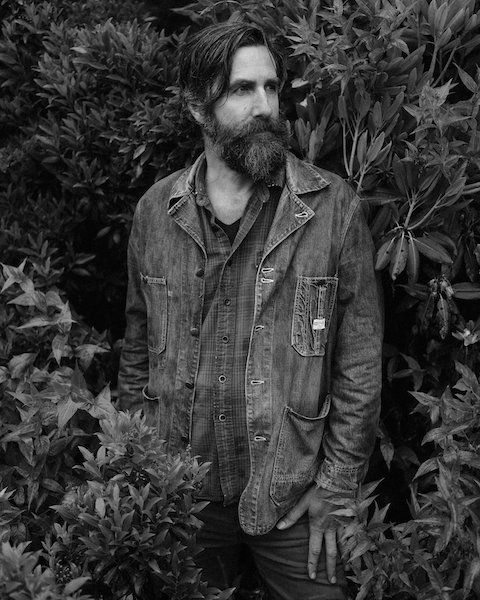
Tyler Ramsey Makes Room For Joy In New Lost Ages

Western North Carolina-based singer/songwriter and guitarist Tyler Ramsey will be returning with his second full-length solo album, New Lost Ages, on February 9, 2023, and shortly after, he wll be heading into an expansive tour, taking in both coasts. The album was produced by Phil Ek (Fleet Foxes, Father John Misty, The Shins) and recorded with him in Seattle at Avast Recording Co. Formerly of Band of Horses, Ramsey’s road into solo work has included sensitive songwriting that also showcases his intricate guitar-playing, and that continues to be a strength on this second record. However, Ramsey persuaded himself to experiment a little more boldly with atmospheric elements, partly due to the encouragement of Phil Ek, and it was an experiment with exciting results.
For New Lost Ages, Tyler Ramsey also has new thematic territory to explore as he takes in the perspective of being the parent of young children living in a rapidly changing world and also reflects on what constitutes a happy life and how we might attain it. I spoke with Tyler Ramsey while he was on a songwriting trip about the things he’s learned to implement to make his life more meaningful as a touring musician, and also about all the new things he encountered, musically and thematically, when creating New Lost Ages.
Americana Highways: I see you have quite a few shows coming up this month and beyond. Do you enjoy traveling, or is it really about the experience on stage for you?
Tyler Ramsey: That’s the whole reason for all the planning. Touring is such a weird life anyway, but the playing is the part that is the most beautiful and the whole reason that you’re packing a suitcase. I think if you do it long enough, you start to learn how to take advantage of the other parts of your day when you’re touring.
It took me a long time to start to say, “I’m going to use this time to go for a walk.” Or to find a restaurant, find some nice food, or do whatever else is interesting in the town. Sometimes when you just go from show to show, you can lose track of what real life actually is. It’s a weird way to live your life. It’s pretty beautiful when everything seems to make sense.
AH: I can imagine that’s a process that takes a fair amount of experience, to chisel out bits of the day and make that part of your life rather than just living so much in a state of waiting. That’s a big win.
TR: It takes some planning, too. You have to figure out what days you have off and where you’ll be driving. The bigger the scale of the touring, the more likely you are to wake up in the parking lot of the venue, sound-checking, waiting around backstage, playing your show, and then leaving. But the way I’ve gotten to do it for my solo stuff has been more the way I wanted it to be the whole time. I’m able to stop and see things along the way. It’s a constant evolution, I think, but I’ve had some great moments on my last record, pre-pandemic, where I got to do some really nice Europe touring where I was still living my life and getting to travel. As opposed to feeling like I’m packing myself away during the day and only coming out at night to play.
AH: There’s a really expansive sound on many of the tracks for New Lost Ages. When you go out playing, are you going to be doing more stripped-down versions or have some other players?
TR: I’m going to be doing a little bit of both. There will be shows with a full band where we’ll be trying to represent the album that way. I kind of intentionally write songs that can be performed just on a guitar with vocals. They can stand on their own in that way. A lot of my guitar parts are intricate and weave in with the guitar parts, so if you see me doing a solo show, I’m not just strumming, I’m doing a lot of parts from the record.
For solo shows, sometimes I’ll bring little accessory instruments that will carry certain parts of the show. I’ve got a rhythm ace drum machine that I lug around. Maybe I’ll have a keyboard, or harmonica, or drum boxes, and other gadgets. But I really try to do both because I really love playing solo shows and I feel like it’s a really cool connection to the audience. I feel like I’ve worked really hard to make the solo performance something really good, but I also enjoy getting up there with a band and rocking.
AH: Do you think of the studio recordings of these songs as something that captures most fully what you hear in your mind?
TR: There are definitely parts of the songs that I can imagine hearing even when they are not there, or I wish I had more limbs to play more instruments live. But actually, when I listen back to the stuff I did the studio, I still think, “Man I wish I had added this, or this!” You can kind of go crazy with that. But my style has always been trying to just keep things simple. I do want to make sure that if I go out and play songs for people, I can represent what I did in the studio.
AH: I heard that you worked with Phil Ek but had known him before now. Was this a situation where you were pretty open to what he might suggest?
TR: Yes, I bumped into him when I was out in Seattle playing a show with Carl Broemel. He and I do some duo shows sometimes. I was walking around before the show to get something to eat, and Phil just happened to drive by. He saw me and texted me, “Are you in Seattle?” So he came by our show and I gave him a copy of my last record, Before the Morning. I said, “It would be awesome to get to work with you and actually finish a project.” Because he had started a Band of Horses record with us but he left that project. He listened to the record and really liked it, so wanted to do it. It took a while to get the ball rolling, but once we did, my whole goal was to give over control to him.
Because normally I hold things pretty close and I don’t allow a lot of straying from my vision of the songs, the way they feel when I finish writing them. A lot of times, I want them to feel that way on the record. But with Phil, whatever he wants me to do, I’m going to do it. Getting to work with him is a huge thing for me. From the start, I said, “Anything you want me to do, I’ll do. Do you want me to work on my lyrics? What musicians do you want? Do I need to rewrite some songs?” I just let him know that I was wide open to his guidance. I’ve had people help producing things before, but I’ve never given over to their vision before.
The funny thing is, Phil didn’t really make me do that much! I was prepared to do as much as he needed, but we tweaked a few things here and there. He really shaped the sounds, and that’s why I wanted to work with him. It’s his attention to detail and every single sound is magical to watch happen in the studio. He helped me nudge things and bring it all together. It was a cool thing to work with him. Now, when I listen back to it, I think it’s beautiful. It sounds like me. I don’t think I got pushed into any directions sound-wise that I’m not comfortable with. It just sounds like I made a record with someone who is incredible at what they do.
AH: I do see a development here with the sound on the record, and in some ways it’s quite brave and interesting where you foray into electronic elements and layers. It goes a little further than I expected in terms of creating a vibe that I think contributes to the feeling and meaning of the songs. It was something of an experiment, but it really works well for you.
TR: It really was an experiment. It was a big leap for me to get into that. Getting the whole project together and funding it myself was a big deal for me. But it surpassed my expectations for sure.
AH: Did you already know what songs you wanted to record, or was Phil involved in choosing?
TR: I sent him all the songs that I’d written that seemed like a cohesive album. It was more than what ended up on the record. He helped me decide on the ones that would definitely be on the album. There was only one that I was fighting for that didn’t make it on the record, but even now when I go back, I know that it still needs work. We were in the studio trying to get it right, but it wasn’t happening, so he suggested we let it go. It was nice to have him. He knew what to do!
AH: The songs that don’t make it are really interesting to me and they often end up being some future direction for an artist that isn’t quite there yet, it’s just around the corner. Or it’ll pop up years from now and be done.
TR: Yes! It’s tough to think that a song is good, then get in the studio and realize it’s not coming together. You try really hard, try to see where it can go, and follow it down paths. It’s a wild process. But sometimes you can let it go, for now. Two songs that we completely finished and totally recorded, but we made the decision not to put them on the record. That was a hard decision to make because I’m super proud of them, too. I’m sure they will come out eventually.
AH: The title track, in some ways, is a little somber, but at the same time, it’s something that people don’t talk about, so that can be really helpful. For “New Lost Ages,” there’s a feeling and a mood that maybe things aren’t awesome in the world. Maybe the idea of continual progress is misleading.
Personally, I was brought up with the myth of eternal progress, that human society was always moving in a forward and improving direction, and it took me a long time to question that. I appreciated the candor in this song dealing with that question and the idea that society can lose ground.
TR: I think we see change, but not progress. We see change, but are we really evolving or moving forward? I thought it was pretty funny that the lead song starts with the line, “You better get yourself familiar with suffering.” Hooray! It’s a funny way to come back into the world with music. But that song was important to me to write. It’s hard for me to explain, really, but having kids alters your view of the world, then you see the world fall apart around that little family that you’ve built.
That was the whole reason for that song, and a lot of some of the other material from this record was based on that. Then, there’s realizing that you can re-focus on what you think reality is. My family and where I live, and the day-to-day of living is our reality. I don’t have to pay attention to all these things that are falling apart all the time. That’s not a good recipe for showing my kids that there’s joy in the world. It’s a recipe for them thinking the worst. So trying to find the joy in things and the beauty that is close to you is something that I’m learning about. Maybe that’s what that song is.
AH: It’s hard because when we see something out of balance, the natural impulse is to try to fix it. When things are too big to fix in that way, the mental strain is depleting. The generational perspective in the song is helpful, too. I was thinking about my grandparents’ perspective, and I had to admit that they’d be disappointed in a lot of things in the world right now. But we have to find where to put our energy from day to day. That can be transformative.
TR: Yes! What if everyone was doing that? What might the world be like? What if we weren’t all in a state of dread and panic? I think maybe we’ve been tricked into not being in this moment that we’re in. We’re constantly bombarded and distracted. What if we were happy waking up in the morning? What if we could see the real beauty in these moments? I think it would alter everything.
Thank you kindly, Tyler Ramsey, for chatting with us. More detailed information can be found here on his website: https://www.tylerramsey.com/