


Chimes of Freedom exhibit opens at Boston’s Boch Center
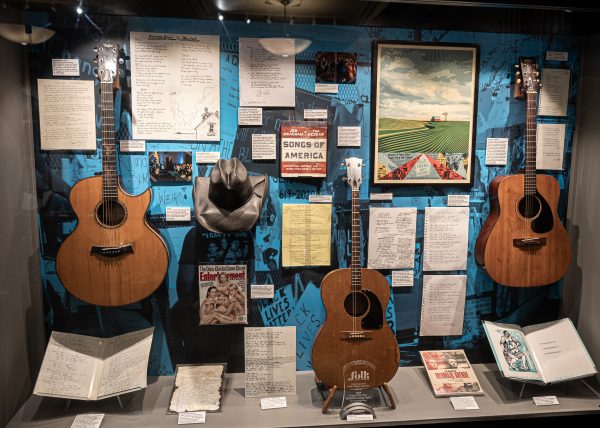
The Folk Americana Roots Hall of Fame, in partnership with the Bruce Springsteen Center for American Music presents Chimes of Freedom, Protest, Patriotism & The Power of Songs at the Boch Center in Boston, opening September 12 and running through February 2027. The exhibit traces the role of music as a force for education, expression and change across generations, featuring artifacts from American music history. Curated by Deana McCloud, it features artists as diverse as Johnny Cash, Stevie Van Zandt and John Prine, to Elton John, all of whom have been instrumental in advancing social agendas through song.
Many of the exhibit’s items are hand written lyric sheets from the usual suspects; Billy Bragg, Tom Rush and Bruce Springsteen, to Tupac Shakur. Of particular interest are artifacts from the archives of Woody Guthrie.
Woody Guthrie’s music has never been particularly comfortable sitting still. His songs were written to travel—from town to town, from one generation to the next, and from one musician to another. Chimes of Freedom celebrated that continuing journey, bringing Guthrie’s legacy into conversation with one of Boston’s most recognizable musical exports, the Dropkick Murphys.


A centerpiece of the event was a conversation involving Guthrie’s granddaughter Anna Canoni and the lead vocalist of the Dropkick Murphys, Ken Casey. Joined by longtime Boston Globe arts writer Jim Sullivan, Casey and Canoni had a casual chat about the collaboration between Dropkick and the Guthrie Foundation. Sitting together in the Boch Center, they offered an engaging look at the work of the Woody Guthrie Archives and the unlikely but remarkably natural collaboration between Guthrie’s writings and the band’s punk-infused Celtic sound.
Casey described Woody Guthrie as ‘the original punk’. Nora, Guthrie’s daughter, invited Casey to Oklahoma at the suggestion of her son Cole to visit the archives which held countless unpublished lyrics. One in particular caught his eye and I’m Shipping Up To Boston was the unexpected result. That initial invitation became a long term relationship, resulting in a couple of acoustic albums, This Machine Still Kills Fascists and Okemah Rising, recorded at the historic Church Studios in Tulsa,
At the heart of it all was Guthrie himself—not simply as the writer of This Land Is Your Land, but as a prolific creator whose notebooks, lyrics, drawings and other writings continue to reveal new dimensions of his work. The Guthrie Archives has played an important role in preserving that material and making it available to artists who can discover new possibilities in words Guthrie may have written decades ago. Another noted result of this was the acclaimed Mermaid Avenue albums by Wilco and Billy Bragg, which brought Guthrie’s work to a new generation of fans.
The Dropkick Murphys collaboration illustrates why that archival work matters. Musically, Guthrie and the Dropkick Murphys occupy very different worlds. Guthrie was a defining figure in American folk music, while the Dropkick Murphys have built their reputation on a high-energy combination of punk rock and Irish-American musical traditions. Yet their connection is easy to understand once the music is stripped down to its essentials. Casey noted that the band has lost fans over the years through their political activism but has gained many in return. A fair trade.
That was perhaps the most compelling aspect of Chimes of Freedom: the realization that song can move a generation toward action, from protests around working conditions and unions, to stopping a war, on to protecting voting rights and democracy itself.
The evening also demonstrated the importance of family in preserving an artist’s legacy. Hearing Guthrie’s granddaughter discuss the Archives added a personal dimension to the story, connecting the public figure whose songs became part of American culture with the man whose enormous body of work continues to be explored.
In the end, Chimes of Freedom was less about looking backward than looking forward. Woody Guthrie’s voice may have originated with a guitar and a notebook, but at the Boch Center it was clear that the conversation is far from finished. With the Archives preserving the past and musicians such as the Dropkick Murphys finding new ways to interpret it, Guthrie’s words continue to chime.
The Folk Americana Roots Hall of Fame is a nonprofit arts organization honoring history while inspiring the next generation of artists and fans. It is located in the historic Wang Theatre at 210 Tremont Street in Boston. https://www.folkamericanarootshalloffame.org/