Two weeks ago, this column discussed singer Joe Brown, who is virtually unknown in the U.S. but has some fans in England, where several of his songs charted in the 1960s. Cliff Richard’s career offers a more extreme example of a similar dichotomy.
Though he scored three Top 10 hits in America in the 1970s, nearly all his many other singles and every one of his albums have flopped here. Most of today’s U.S. record buyers, particularly the younger ones, probably don’t even know his name.
In England and some other countries, the situation has been different, to put it mildly. In the UK, according to Wikipedia, Richard has sold more than 21 million 45s, making him the third-highest-selling artist in singles chart history, behind only the Beatles and Elvis Presley. He has had a whopping 130 Top 20 singles in the UK, including 14 No. 1s, and is the only artist other than Presley to make England’s singles chart in every decade from the 1950s to the 2000s. All told, Richard has sold more than 250 million records worldwide, making him one of the most commercially successful singers of the entire rock era.
His good fortune in the UK and elsewhere seems easier to explain than his stateside obscurity, though the latter might be partly attributable to his being overshadowed by the similarly styled Presley. Richard is a talented and versatile singer who, like Presley, has proved just as comfortable with romantic pop ballads as with hard-driving, rockabilly-influenced rockers. Moreover, much of his best work has featured backup by the excellent Shadows (who were known as the Drifters until the U.S. group of the same name threatened legal action over rights to the moniker).

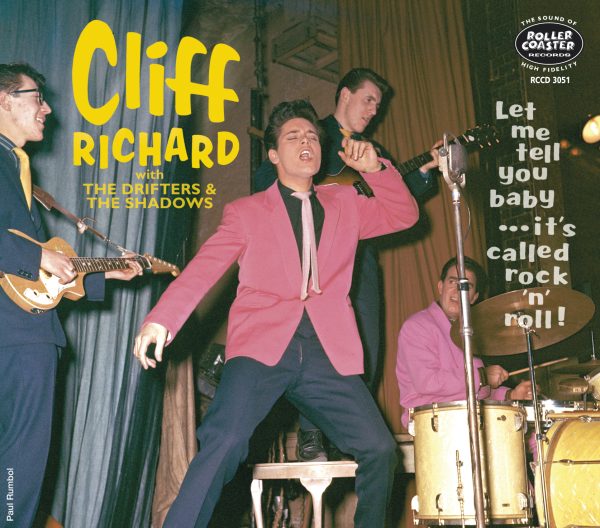
Richard’s capabilities were obvious from the get-go, as you can hear on the two-disc Let Me Tell You Baby…It’s Called Rock ‘n’ Roll, which features performances on the BBC’s influential Saturday Club radio show between 1958 and 1960. The singer—still a teenager at the time of these broadcasts—later shifted into more mainstream territory, but this is the period when he was a bona fide rocker. Previously unavailable on CD, the recordings feature stellar sound quality despite their age.
The 34-track first disc includes numerous covers of American and transatlantic hits, among them Fats Domino’s “I’m in Love Again,” Bobby Darin’s “Dream Lover,” Eddie Cochran’s “Summertime Blues,” Presley’s Leiber & Stoller–penned “(You’re So Square) Baby, I Don’t Care,” and Jerry Lee Lewis’s “Whole Lotta Shakin’ Goin’ On.” Also featured are several of Richard’s biggest early UK hits, including 1958’s “Move It” and “High Class Baby,” and 1959’s “Mean Streak,” “Dynamite,” and “Living Doll.” The last of these was his first UK chart-topper and first international smash, and speaking of chart-toppers, the CD also makes room for the Shadows’ instrumental single, “Apache,” which went to No. 1 in England in 1960.

If you want only the music, you can stop with Disc One of this anthology. But if you want to feel what it was like to be listening to the BBC’s Saturday Club in the pre-Beatles era, continue on to the atmospheric second CD, which reprises most of the first disc’s performances, interspersed with introductions and commentary by Richard and program host Brian Matthew, who also reads requests from fans. Helping to put these radio programs and Richard’s early work in context is the set’s 44-page illustrated booklet. It includes a lengthy essay by British music historian and producer Rob Finnis, plus detailed session information about all of Richard’s Saturday Club performances.
This album, first released more than a decade ago, was difficult to find until recently. It now has a new U.S. distributor and is readily available.

Also Noteworthy