


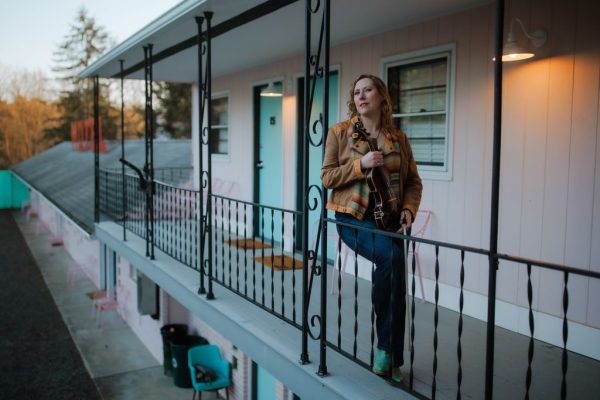
Sara Milonovich & Daisycutter
Sara Milonivich is a songwriter and fiddler from the Hudson Valley, New York – an area where a lot of artists settle outside New York City. The area often attracts folks with a high income to visit for a day or so, while many of the artists in the area find it challenging to make ends meet in the current state of income disparity. Inspired by these tourists with their disposable income commenting their appreciation for the artistic flair prominently displayed and featured all around the spaces, and the underlying question of what people truly value, Sara wrote this song “What We Did With the Place,” set for release this week. It’s an anchor for her forthcoming coming album, which will be released in October via Loonymusik. We had a chance to chat briefly with Sara about the music, society, art and the inspirations that converged to create this song.
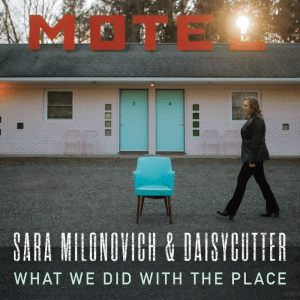

Americana Highways: Hi Sara. We’re so happy to have you join us at Americana Highways to talk about your music. You have a new single out in July called “What We Did With the Place.” What background information can you give us about the song?
Sara Milonovich: Thanks so much for having me! This song is the musical version of “saying the quiet part out loud” – it came from a sarcastic retort I really wanted to yell out in the moment but didn’t. For most of the last 20 years, I’ve lived in a town on the Hudson River that’s been undergoing some pretty textbook gentrification, especially over the past decade.
The usual scenario: artists that get priced out of a metropolitan area move to a nearby economically depressed former industrial town or city, where they can live and create more affordably. A scene develops, which catches the attention of the more affluent back down in those metropolitan areas, and soon there’s an influx in tourism, then more upwardly mobile people start to relocate, followed by the second home owners and “investment property” crowd, and soon enough the cost of living prices out the artists all over again, as well as service industry and other blue collar workers, and some older families and people who grew up in the area, too.
This sort of thing is happening all over the country at the moment, not just the East Coast, so I’m sure folks on the West Coast, or in Denver, Nashville, Austin, etc. can relate.
I was sitting in a coffee shop one day when a group of sweater-and-khaki-wearing weekenders came in, loudly going on and on about how “cute” and “artsy” and “totally adorable” the town was, and I just wanted to yell out, “HOPE YOU LIKE WHAT WE DID WITH THE PLACE!” Which, of course, I didn’t, out of respect for the people working behind the counter, but I knew as soon as the thought bubble came up that there was a song there.
AH: How did it come together? What was the writing process like?
SM: Once I had that hook in my head, the narrative of the song was pretty straightforward, based on a bunch of observations and stories I’d been collecting over the years. For example, the part about the “lumberjack Kerouac”: I grew up on a farm in a rural part of upstate NY (my hometown is still a depressed former mill town), and seeing the hipsters walking around basically cosplaying country life in stiff, brand-new Carhartts and vintage feed jackets acting like they had discovered something new and profound was a really weird feeling. I remember one guy years ago who had a Dekalb seed jacket. I said, “Cool jacket.” He said, “Yeah, I got it because it says Dekalb, like the street in Brooklyn, but I don’t know what it is.” I told him, “It’s a seed company. My dad used to plant their corn.” He just went, “Oh, whatever. I just liked the color.” So that “lumberjack Kerouac” line – and the line about “last time I saw a jacket like that I was back on the farm” – those were all true.
I wanted the song to be a honky-tonk rocker in style, so I wrote a riff on the fiddle that was inspired by what an electric guitar might do. Several of the songs on the album are riff-based songs, but with the fiddle playing the role of an electric guitar. Once that riff was there, and the lyrics were roughed out, it was pretty straightforward to come up with the rest of the framework of the song.
AH: What do you hope listeners take away from hearing this song?
SM: Sonically, it’s a party song, meant for dancing and singing, but I hope listeners actually take the time to think a little deeper about some of the nuances of what’s happening. Of course, the ugliness of modern gentrification is a pretty obvious, and deserving, target, but nobody is a totally separate onlooker in the process. Go back far enough in history, and there’s always somebody displacing somebody else. Before the second-home owners, before the hipsters, before the artists, before the mills and factories, before the Revolutionary War era “settlers,” many of these towns were Indigenous land. So I hope it makes listeners think a little deeper about the concept of who’s “entitled” to a place – if anyone really is.
AH: Who did you work with in the studio, and what was the session like? How was the vibe, and how did the song come together?
SM: For this album, we were lucky enough to work again with Justin Guip (Levon Helm, Hot Tuna, Larry Campbell and Teresa Williams) at his studio, Milan Hill Studio, just outside of Red Hook, NY. He not only engineered and mixed the album, he plays drums on it, too, and he wears all of those hats just awesomely.
Whenever I finish writing a song, I make a rough demo of it and take it to my longtime producer and musical collaborator, Greg Anderson, and we flesh out the arrangement from there. Once we know how we want the song to sound, we take it to the rest of the band and then into the studio. We tracked the basic rhythm parts of this song live, with Justin drumming, Greg on acoustic guitar, Leo Traversa on bass, and me laying down a scratch fiddle and vocal.
We wanted the vibe to feel like a rock band playing live at a chicken wire honky-tonk, so tracking the rhythm section live really helped us achieve that, although we may have had to rein Justin and Leo in from having a little too much fun at times! For logistical reasons, we weren’t able to track every instrument live on the same day, so after we had the basics down, we added Boo Reiners’ electric guitars, Bob Buckley on harmony vocal, and had Jeremy Baum add some extra icing on the B3. Then I went back and tracked the final vocal and fiddle, once the full band sound was in place, which really helped me get the performances of each that I liked.
AH: Gentrification is happening in so many places, and, like you said earlier, it can really change the flavor and vibe of a place in addition to impacting the cost of housing in the market and the people who live there going forward. Beyond what you already explained, what made you want to tap into this topic for a song? Is it something you felt really strongly about? Does this song come from an angry place, or is it one that is more of acceptance, perhaps tinged with a bit of nostalgia coupled with frustration?
SM: The song grew out of that line, “Hope you like what we did with the place,” and my hackles were definitely up when that came to me. It’s meant as sarcastically as possible. I write some songs for people, and I write some songs about people, and I write some songs AT people: this was one of the latter. The way some people act – like a town exists solely for their convenience and amusement – really pisses me off.
I feel like a major difference between the people moving in now as opposed to how it felt in the past is that people used to look at what they could contribute to a community instead of just viewing it as something to consume. Of course, nobody is rooting for a town to remain economically depressed and hopeless forever, and there can be some really positive things that come out of revitalization. But I think, in a lot of these cases, local officials don’t consider any sort of long-term plan until it’s too late for any sort of sustainability. And just accepting that some people are going to be disenfranchised as a sort of collateral damage in the process is something that no one should be resigned to.
There’s never going to be a perfect solution or way to do things, but I think, in a lot of areas, things can be done much more mindfully. Nostalgia often accompanies change, so that’s always going to be present in one way or another, but overall this song is meant to serve as a parting shot from the folks getting priced out. Picture a bunch of artists having a honky-tonk dance party while loading a moving van.
AH: Beyond this song, what kind of themes tend to run through your songs, both in general and on the forthcoming album that this song is on?
SM: A lot of the songs on this album, and many of my songs in general, tend to deal with themes of identity, change, time, and the concept of resilience. This song looks at the changing identity of a town over time, whereas some of my other ones might tell a story of personal identity or struggle instead or deal with change in more abstract terms. Stubborn resilience and survival are also key themes in my music – there might not be a lot of happiness in the stories in my songs, but there’s no quit in any of them.
AH: How has the creative process in general and your songwriting specifically – both music and lyrics – changed and morphed as you’ve grown as an artist?
SM: I started out as a fiddle player before I became a lead singer, and then a songwriter, so even though I often pick up a guitar when I’m working on lyrics and roughing out chord structures, I still think like a melody player first and foremost when writing. I sometimes paint myself into corners this way, writing a melody that I then have to figure out how to sing! A lot of my songs have fiddle lines, riffs, or string parts as integral parts of the song, not just in a decorative role, but baked into the framework of the song itself.
Lately, I’ve been really inspired by the role of electric guitar in rock songwriting – those riffs are such an important part of the song structure, and are as identifiable as a chorus – sometimes more so! I learned a lot of my craft, both as a fiddle player and as a songwriter, by studying more traditional music forms, and I think a big evolution in my creative journey and what I’m writing now has been allowing myself to use every sonic technique and color I have in my creative palette and not feel like I have to adhere to any sort of rules or precedents based in any particular tradition. I’m starting to let myself enjoy the freedom of integrating everything I’ve learned and just making the sounds I want to hear.
AH: Do you find inspiration in different or unique places? What kinds of things typically inspire you to write songs these days?
SM: Songs usually come out of a story I want to tell. Sometimes, the narrative shapes itself around a specific line or event, like it did with “What We Did With the Place,” and other times it’s a more general idea, and I have to take some time with the lyrics to make sure I’m telling it the way I want it to be told. It could be something I experienced or witnessed, or something I heard or read about secondhand. Many are absolutely true stories, but some are composites, and sometimes there’s poetic license involved in how the story’s told.
I really love incorporating imagery, particularly from the natural world, into my songs, as one of my main goals as a writer is to impart a sense of place. What does it look like inside the song – what’s the view, what’s the weather, how does it feel, how does it smell, etc. A sort of song terroir, if you will, to borrow a term from French winemakers. Sometimes, I’ll find a melodic idea and that will lead to a song. I love exploring the different colors and moods of melodies and how they might work with words, and it keeps things fresh to not always start with lyrics. I’ve been writing melodies a lot longer than I’ve been writing lyrics, so I feel like it engages a different part of my creative brain.
AH: You’ve collaborated – in the studio, performing live, etc. What does working with other artists mean to you, and are there standout collaborations that are special to you? What made them special?
SM: To me, the most rewarding part of working with other artists is that it makes you a better artist. Playing in different band situations makes you very aware of dynamics and the role of each instrument in a song, where you really have to focus on the musical choreography. Playing a style like bluegrass really hones your technical chops. Being a studio musician teaches you to be accurate and consistent. These are great skills to have in any musical situation.
I feel like I’ve gotten songwriting masterclasses just by accompanying other songwriters. You get a front row seat to watch someone else work with words. As an accompanist, you have to be really open to figuring out the best way to musically support someone else’s songs, which sometimes might mean letting go of your own preconceived ideas, so it teaches you a lot about being open-minded.
The main rule – no matter the musical situation – is to always respect the song. It’s about what serves the song, not always about what you want to play. As songwriters, we tend to be centered on our own ideas, so collaborating with other artists forces you to step outside of that and look at things from a much broader perspective. Every chance to work with another artist is a unique chance to stretch and grow as a musician yourself.
Probably the one role I never had on my Musical Life Bingo Card was subbing the fiddle/violin chair of the musical, “Come From Away.” I was lucky enough to do it pretty regularly both on Broadway and with the first national tour. Musical theater can sometimes require you to think and play like a violinist, sometimes like a fiddler, and sometimes to create a soundscape that you wouldn’t immediately think of as a melody player. It really got me interested in exploring more extended techniques on the fiddle that created a sound effect or mood, as opposed to just playing a specific melody or solo, and it added a lot of layers to my sonic palette. Plus, it was a pretty amazing experience in general.
AH: Please tell us what else we can expect from you in 2026. And will you be touring at all? Where can fans see you live?
SM: After spending a lot of time in the studio finishing the songs for the album, I’m really looking forward to playing some shows this summer and fall in the Northeast. There are two more singles coming out in August and September in advance of the album release, which will be in October. We’ll be doing some full band shows as “hometown album preview parties” for our local Northeast audiences in late September. There’s nothing that can compare to playing live, and it’s been a while since I’ve put out new music, so we’re gonna make it a party! Along with my producer and guitarist, Greg Anderson, I’ll be heading to the UK for some shows in late October and November, so the bulk of our US touring behind the new album is planned for 2027. Folks who want to see us live can keep up with those announcements at my website https://saramilonovich.com. This music still has that “new song smell,” and we’re really excited to drive it off the showroom floor and hit the highway!
Thanks very much for chatting with us, Sara Milonovich! A truly inspirational song.
You can find the music here: https://ffm.to/wkjqqp1
Enjoy some of our preivous coverage here: Song Premiere: Sara Milonovich and Daisycutter “Last Time For Everything”