


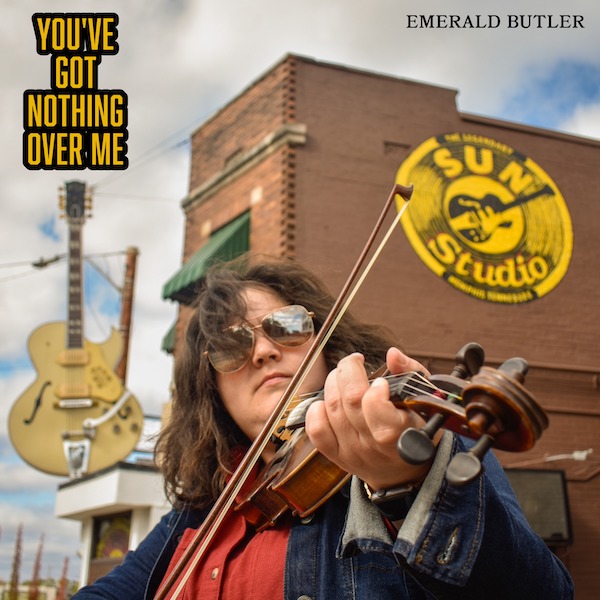
Emerald Butler “You’ve Got Nothing Over Me”


Fiddle player and songwriter Emerald Butler has played with She’s got an upcoming EP Emerald Butler Sun Studio Sessions, set for release later this year, which was produced by Emerald, engineered by Lydia Fletcher with assistance by Dane Giordano, and mixed and mastered by Dan Lewis. A song from that project, “You’ve Got Nothing Over Me,” will be available April 24. We had a chance to chat with Emerald about the song, working in Sun Studio, and more.
Americana Highways: Hi Emerald. We’re so happy to have you join us at Americana Highways to talk about your music. You have a new single out in April called “You’ve Got Nothing Over Me.” What background information can you give us about the song?
Emerald Butler: Well, first, thanks for having me! “You’ve Got Nothing Over Me” is a song that I wrote as a teenager during a period of my life where I was dealing with some bullying and rejection. I didn’t have many people who I felt like I could safely talk to and be understood, so I ended up writing songs about what I was feeling. When I was about 12 years old, I started playing the fiddle again, and I discovered traditional country and oldies rock ’n’ roll music. While most of the girls that I was around were into pop artists like Justin Bieber and Zac Efron, I was into Johnny Cash and Elvis Presley. They’d be wearing leggings and flip-flops, and I’d be wearing western pearl-snap shirts and cowboy boots. Let’s just say that I didn’t quite fit in, and I wasn’t going to change the things I loved to try to be accepted by that clique. One of the songs that came out of that experience is “You’ve Got Nothing Over Me.”
AH: How did it come together? What was the writing process like?
EB: I was sitting in my childhood bedroom, messing around with my dad’s Blueridge guitar. He never learned how to play, and I was a little bored with the fiddle in that moment, so I just commandeered the guitar. Anyway, I was sitting in my room, unconsciously feeling my feelings, and the first line or so – “I may not look the way you do, well, I ain’t walking in your shoes, I may not wear the clothes you wear” – popped in my head. I was trying to figure out what rhymed with wear, and the word “care” popped into my hurting and angry teenage brain. I think a lot of feelings of inferiority began to surface. I was playing scenarios in my head of things that had happened or had been said. Unfortunately, I was probably imagining potential stories in my head to try to prepare something to say to defend myself. I’m pretty sure that my brain was questioning throughout the whole writing process, “What would I say to them? What could I say that would tell them off and make me sound confident?” “You’ve got nothing over me” was the line I came up with. I think that I wrote the song within about 40 minutes. I’ve tweaked it here and there over the years, but it all came out in one sitting.
AH: What do you hope listeners take away from hearing this song?
EB: First, I hope they take away a song that they can sing along with. There are a lot of angry breakup songs out there that people sing along to. I hope that this can be one of those songs for situations outside of romance. I hope that this song helps listeners feel less alone. Loneliness was definitely something that I felt a lot of, and I think that music, in its most powerful moments, can be a bridge that makes way for comfort to someone who is hurting. If I’m being totally honest, I think that I also want the people who made fun of me to hear that they didn’t keep me down. I’m out here following my dreams and getting somewhere. I don’t think I’d be playing music like I do if I just conformed to what everyone else was or is doing.
AH: Who did you work with in the studio, and what was the session like? How was the vibe, and how did the song come together?
EB: I heard Marty Stuart say in an interview once that the studio is like another member of the band. It brings its own sound and vibe. I recorded “You’ve Got Nothing Over Me” at the legendary Sun Studio in Memphis, Tennessee. This is where artists like Elvis Presley, Johnny Cash, Carl Perkins, B.B. King, and Howlin’ Wolf were discovered. It is arguably the birthplace of rock ’n’ roll. If you’ve ever been to the studio for a tour, you’ve experienced the vibe. There’s a lot of history there. The studio was built by a man named Sam Phillips. He originally called the studio The Memphis Recording Service before he started the Sun record label. Sam designed the studio to be a place where artists who had something to say could say it. He was after raw authenticity. He wasn’t looking for anything super polished. If you go back and really listen to those early Sun records, you’ll find that the timing isn’t always consistent, there might be some missed or wrong notes somewhere, and you can even hear a telephone ringing in the background of one record. Sam called it “perfect imperfection.” He wanted to make space for people who were looked down on, so it felt right to record “You’ve Got Nothing Over Me” at the Sun Studio.
Keeping with that idea of “perfect imperfection,” I assembled a group of musicians who had never played together before. The only time we all rehearsed was in my hotel room about three hours before the session. That’s not really recommended for getting a polished recording, but I wasn’t after that. I wanted to do something like what Sam did with Elvis Presley, Scotty Moore, and Bill Black. My longtime friend and incredible musician, Joel Beaver, was on guitar and keys. Joel’s dad, Stan Beaver, is a member of the Rockabilly Hall of Fame and had a hit back in the day called “Rocket In My Pocket.” Jade Watts did background and harmony vocals. Jade is an accomplished musician and elementary school music teacher who specializes in what she calls “playing in the gray.” I feel like that’s along the same lines as “perfect imperfection.” On the drums is my road buddy, Rodney Polk. Rodney and I toured together while backing up Jason D. Williams. Then Rodney roped in his friend, Chad “C.W.” Hasty, on the upright bass.
I had an idea of the direction I wanted to head in with the song. I wanted it to be quintessential rockabilly. Joel came up with this thumping guitar lick at the beginning, then switched into some Scotty Moore guitar styling throughout the song. I definitely wanted to have the upright bass slapping, and C.W. knocked it out of the park. We also used the famous “slap back” tape recording technique that Sam Phillips invented, which really gave the song that Sun sound. Lydia Fletcher and Dane Giordano, the staff at Sun, were wonderful to work with.
AH: What kind of theme or themes tend to run through your songs?
EB: I think that themes of individuality, nostalgia, and heartache run through a lot of my songs. I kind of have that push-pull personality where I kind of tell someone off, then cry because they’re gone. Or I just say good riddance and get nostalgic about it all. I think there is a lot of nostalgia in my songs, whether it’s for good or bad.
AH: How has the creative process in general and your songwriting specifically – both music and lyrics – changed and morphed as you’ve grown as an artist?
EB: I think that most of the newer songs that I have written have more of a modern song structure than my old songs did. For example, a lot of old country songs are primarily verse, chorus, verse, chorus, and I stuck to that for a long time. As I write more, I’ve adopted more of a structure of verse, pre-chorus, chorus, verse, pre-chorus, chorus, bridge, chorus. I think I’m also just more aware of things like different song structures and a few production techniques. I really want to get better at producing. I think when my playing gets better, my songwriting gets better, and my ear gets better, everything will sink in a little more. However, I don’t think these things apply to my new single because of how old the song is and the way I recorded it. Still, I think I’m headed in a good direction for what comes next.
AH: Do you find inspiration in different or unique places? What kinds of things typically inspire you to write songs?
EB: I am inspired by a lot of intense feelings. I guess that’s the positive side of being a highly sensitive person, ha ha. I get a good amount of inspiration from other pieces of art. My last release was inspired by the show “Daisy Jones and The Six,” which was, interestingly enough, starring Elvis Presley’s granddaughter. Sometimes a specific song will inspire me. I don’t copy the song, but it connects with something in me that inspires my own story in words.
AH: You’ve collaborated – on your recordings in the studio, performing live, etc. What does working with other artists mean to you, and are there standout collaborations that are special to you? What made them special?
EB: I am grateful for the opportunity to work with other artists, both as an artist myself and as a hired musician. For the majority of my music career, I have primarily been the fiddle player in someone else’s band. During my time as the “hired gun,” I feel like I’ve learned a lot about how to be and how not to be a good bandleader and business manager. There is a difference between being the artist and being another band member. They both come with their pros and cons, so I try to keep that in mind in whichever position I happen to be. I want to treat people the way that I want to be treated and respected.
I think that collaborating with other artists is an opportunity to learn and grow. It can be hard to balance and switch from the artist to the fiddle player. I honestly deal with a lot of loneliness and insecurity, so I feel like I’m still trying to find a group of people to collaborate with where I feel like I truly belong. Maybe that’s more of a me thing that I have to figure out, but I do try to extend a hand and collaborate with other women. Apparently, that is something that I really care about. While, simultaneously, on the road, I have had this desire to fit in and kind of be like “one of the boys.” I feel like a conundrum sometimes. It probably all stems from the time that I wrote “You’ve Got Nothing Over Me.” I think collaboration is important even when it’s scary. I think that it has the possibility to be a really good learning experience both artistically and personally.
Probably the collaboration that most stands out as really special was an all-female country group I was in called Queenston. It featured Amber Carrington Lewis, Ivy Carter, Rachel McIntyre Smith, and me. This was honestly the first group that I think that I’ve ever been in where I felt like I was really wanted and accepted, quirks and all. It really meant a lot to experience that with other women who had similar musical tastes.
AH: Please tell us what else we can expect from you in 2026. And will you be touring at all?
EB: I have a few shows lined up in the Chattanooga and Nashville areas this summer, and people can find out more at my website, http://www.emeraldbutler.net. I have two more singles from the Sun Studio session that I will be releasing this summer. I’m also working on a music history podcast that I hope to have out this fall. It’s a pretty time-consuming project, but it’s a labor of love that I’m ready to finish and share. If you’re interested in hearing more stories about places like Sun Studio, you’ll want to check it out. It’s still in the works, so I won’t give too much away just yet, but keep an eye out.
Thanks very much for chatting with us, Emerald Butler!
“You’ve Got Nothing Over Me” is Emerald Butler on vocals, fiddle and acoustic/rhythm guitar; Joel Beaver on electric/lead guitar, keys, and vocals; Chad Hasty on upright bass; Rodney Polk on drums; and Jade Watts on vocals.