


Drew Harris of The Naked Sun on Self-Reflection and “Mirror In The Hallway”
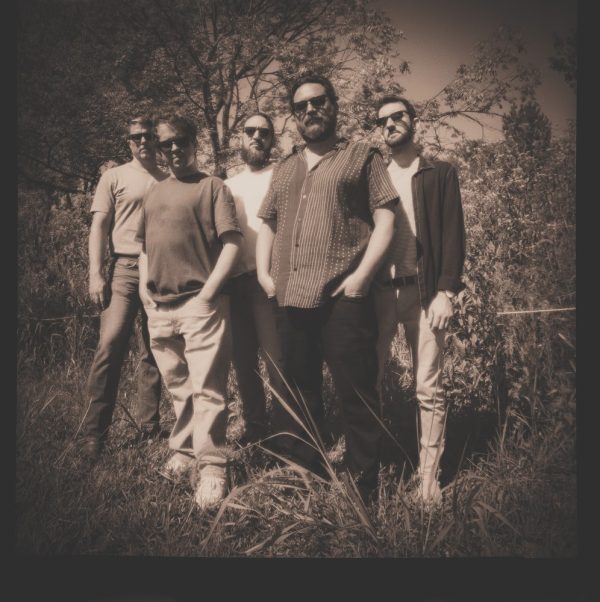
The Naked Sun are a Philadelphia-based Cosmic Americana band who released their third full length album, Mirror in the Hallway, on January 30th, 2026, and celebrated the release with a show in their hometown. It’s an album that had a slow and careful gestation, bringing in greater collaboration between band members Drew Harris (guitars and vocals), Tim Campbell (guitar), Dylan Mulcahy (percussion and keyboard), Tom Tusler (bass and backing vocals), with additional guitar textures from James Ashforth. While the lyrics continue to be crafted by Drew Harris, the gradual building up of tracks comes from many different sonic directions, and the band honed the tracks to a greater degree, leaving plenty of material on the cutting room floor this time around. Individual tracks balance the heavy and the light, creating song structures that are never quite predictable, keeping you engaged.
The result is an album that’s dreamy, inviting, at times dark, but always alluring. It addresses the ideas and experiences that people encounter when they’ve survived the storms of youth but are entering a new and more reflective period. That kind of journey involves stock-taking of the dreams we’ve had and how far we’ve pursued them, but more than anything, it involves grappling with authenticity. Mirror in the Hallway asks if we are still the people who we set out to be, or if we are just going through the motions. I spoke with Drew Harris about some of the ideas that came to the fore in these new songs, and about the working methods that enabled band members to be more expressive and explore more possibilities for Mirror in the Hallway.
Americana Highways: I really like the song and the video for “Dreamin’” that premiered here at Americana Highways. Was there something about “Dreamin’” that made you pick the song to receive that focus?
Drew Harris: I think with a band like ours, and our limited budget, the theme and the vision of the video just really crystalized for me. I knew that that song was about nature. I knew that it was my love letter to nature. I knew that I’d be able to execute that in a simple way. The way that came together is that my wife is from Vermont, and I was in Vermont in October, during “leaf-peeping” season, and I took some video and brought it home. We actually projected the video and some other video onto ourselves as we hung out, played along to the song, that kind of thing. We were tying it all together.
I was inspired by my trips, since we spend a few weeks in Vermont every summer. I was inspired by that to write the lyrics. The music itself was also put together in Vermont, so it had this nature connection. It just kind of crystallized in mind. Sometimes I have gigantic visions for music videos and I realize that they are super-expensive, so it’s back to the drawing board. But for this one, I said, “We can do this.”
AH: I like the projection effect that you did. I think that makes it trippy and a little dream-like. I think it’s actually hard to write a song about nature, particularly one with lyrics. A few times lately I’ve spoken to artists who expressed a connection to nature, but found that they needed to use instrumentals only, which was not their typical approach. So I’m impressed that you found a way to talk about your experience of the natural world.
DH: Thanks. For me, and for that song specifically, I personified nature. The music’s kind of sexy, so it’s kind of a sexy love letter. There’s a line about water touching me. And nature touches us, physically, and it touches us in a lot of ways. I was sitting at Lake Willoughby, and saw a ripple on the lake coming towards me, and earlier that day, we’d been on a hike up above the tree line, and you could just hear the wind going through the leaves. It was just such a totally sensory experience. It was kind of sexy! [Laughs] I thought, “This is one way to do it.” I could see it being sensual.
AH: I feel like the sound of the song is like sinking down into this vibe, and it’s permeating. You’re in a total environment, and I love that you reproduced that feeling in the song. Though there are people, thankfully, who go out and spend time in nature, I think on the whole, in our country, we have a really hard time conceptualizing our relationship to the natural world. We think it’s “us” and “that.” It’s so weird. I feel like this song might help people get over that split.
DH: Well, there is a line in the song, “Some people will never get it, but that’s not you, that ain’t me.” Because that is what I’m talking about. I do say, “Thank you,” in the bridge, too. I’m from the city. I’m fortunate that I had some natural experiences that opened me up to that. I’m a different, and I would say, better person because of it.
I do agree that there’s a “man vs. nature” thing in society, but I feel like if you connect authentically with the natural world, you do look at things differently. You see A.I. and social media and you think, “This is silly.” Because it really doesn’t compare. And nature is free.
AH: Yes! That’s what crazy about how un-accessed it is. Instead we hold a piece of plastic in our hand and that’s supposedly greater. We’ve also convinced ourselves that experiences are somehow too real for us. Like, “Why would I swim in that lake? It’s muddy. Eww.” We even get upset if our pets get dirty.
DH: As much as the hippies and the 60s are revered, I think it’s not that part. It’s very intellectual. But the real hippies were back with nature, dirty, farming and growing food. They weren’t just thinking about this stuff. It seems like that lesson is getting lost. But when I go up to Vermont, that is the norm. People aren’t walking around on their phones all the time.
AH: I understand that your writing methods, as a group, were more collaborative on these songs. Was that true here, too?
DH: Yes. Our ideas were fleshed out and built upon in that way. “Dreamin’” was just a riff that I played in a sound-check, and my drummer, who’s a fantastic piano player, as well, said, “What it that? Do you have a recording?” I sent him a little voice memo. Then he took it back to the piano and stretched it out. He made it a little more of a realized thing. We got more voice memos when we were in Vermont, and I put together verses, and choruses, and the bridge. That’s how that happened. And that happened a couple of times on this record, where an idea caught someone else’s interest.
“Broken Spectre” was a piano thing that Dylan, our sent out to us. Then Tom, our bass player, really liked it, so he transposed it to guitar. Then we built an entire song based off of that guitar riff. “Witches” was an in-the-moment song that we conjured up on a writing weekend where Dylan, again, had the opening riff. That became a guitar riff. He composed it in a moment, and Tim took it over and wrote the guitar riff. Then I wrote the bridge for that. And it was consciously this way, too, since we carved out a lot more time to work together.
I discovered that with this line-up, some of the songs would be turn out similar to what I brought in, but with others, I was liking the outcome a whole lot more when I opened it up and other people got their fingerprints on it. It just became better. And it’s also a buy-in, because we’re a band, in the spirit of a band, it should be collaborative. I’m really lucky to work with these guys. I write the lyrics, but everyone is a songwriter in their own right. I respect all that talent and I would be foolish not to tap into it.

AH: One plus side of that is that the energy and momentum doesn’t have to come from just one person. I find that breaking the ice on a new song can be a hard thing, but if someone is always doing bits and pieces, the process never totally stops, and that’s good.
DH: It’s true! Left up to my own devices, a lot of these songs would be a lot sadder. For this approach, you also have to be vulnerable, and you have to be okay with that vulnerability, because not all songs are going to be great. You can bring something to the table, and maybe it’s not strong enough, or doesn’t fit the vibe for that day. You could think, “Am I not good enough?” I had that feeling a few times because we left a lot on the cutting room floor this time. It was a lesson to me in humility, but also in vulnerability. You show people what’s inside of you, and you hope that others can be responsible with that. It’s important.
The end of “Hades” was like that. The song is about a friend of mine who passed away, and the lyrics are literally about the last time that I talked to him on the phone. I think that he was trying to make a choice of, “Do I fight this thing, or do I let go, and give up?” My phone call to him was, “Don’t give up.” The entirety of that song until the last minute is on the sad/gloomy side. But he chose not to fight, and that made me angry, so anger needed to be in that song. That guitar that you hear come in at the very end, that’s me. That’s my visceral anger. It is jarring, and it doesn’t seem to make sense with the way the rest of the song goes, but that’s why the song needed to be like that. That was a vulnerable moment. I’m very fortunate that the people around me let that happen. The anger does crash into this beautiful song, but for me, that’s probably my favorite moment on the whole record, because it’s real.
AH: It’s funny how hard it can be to be dark, to allow the drama and emotion of that. We often stop ourselves from going that far, but sometimes you just need to do it. The seeming disharmony can be important. We shouldn’t make things too pretty, right?
DH: It’s like what we were saying about nature. We have to get messy. Art is a reflection of life and life is fucking messy most of the time.
AH: Most of the time, yes.
DH: It’s most of the time! We’re always trying to put a polish and a sheen on it with art. But I’m not a Pop singer, and that’s not my job. My job is to tell my story, and other peoples’ stories in a way that I feel is a reflection. And that’s kind of where the mirror in the hallway image comes from. It’s just trying to be honest with other people, and myself. Because I think that we tell ourselves a lot of stories to get through the day and protect ourselves. But at the end of the day, we wonder, “What is the truth about myself?”
That’s hard to tap into because we push it down, and we bury it, often for good reason. It’s hard to walk around in this world with really thin skin. It’s a wicked place sometimes. But to tap into that in measured doses, I think, is really important.
AH: Right, in a productive way. That produces something of value to you.
DH: Yes. And it’s messy, because it’s supposed to be.
AH: That reminds me of something you wrote about the song “Make Believe,” too, the idea of writing checks for the future, deferring things, putting things off to deal with at another time. Letting it out in doses is healthier and could be helpful, even have a positive result. The song “Make Believe” really connects with “Mirror in the Hallway” for me, and also “…Of Persephone,” and “Hades.” They flow together.
DH: There’s definitely a stream of something flowing between them. It can be intensely personal. “Make Believe” is about my marriage, and I’ve been married for ten years. When your older self looks back at your younger self, you can ask, “What the hell did you get me into?” When you get engaged, you think about the beautiful things, and not about when it gets hard.
But you also need to trust that younger self, and that’s where my younger self was challenging who I wanted to be in ten years. I wanted to be the person who grew from this, who became stronger, a better partner, a better husband. But in the song, I’m questioning, “Is this real? Are we doing the things that we promised our younger self that we would do? Or are we making believe that we’re doing those things?”
It’s really just an audit on that promise. It’s important for me to be genuine, and authentic, and if it’s not, to figure out how to make it real, or move on. I don’t want to pretend, and I don’t want to live in a world of make believe. That’s what that song is about, for me. I think I wrote in a post, “Can our old hearts cash the checks that our young hearts wrote?”
My wife and I both work in an inner-city school in Philadelphia, and it’s one thing to be an idealist when you’re 20-something years old, it’s a totally different thing to be in the same situation fifteen years later, dealing with burnout, and dealing with shared trauma. You get into this saying, “I’m going to make things better?” But it’s hard to see the fruits of your labor sometimes. I’m trying to make change, but I don’t see that change happening. But that’s a selfish reason to get into it, because you’re here to help people every day.
Thanks so much for chatting with us, Drew Harris of The Naked Sun. Find more information here on the band’s website: https://www.wearethenakedsun.com/