


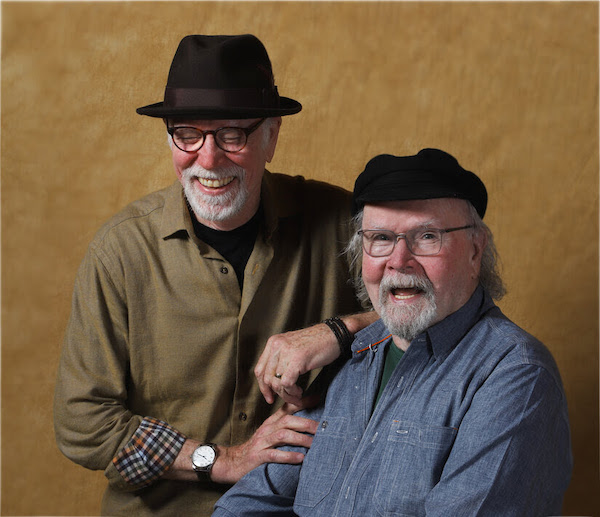
John McCutcheon and Tom Paxton photo by Michael G. Stewart
Staying Relevant, Humorous, and Hopeful: John McCutcheon On Second Tom Paxton Collaboration Together Again
Singer/songwriter and multi-instrumentalist John McCutcheon and singer/songwriter and guitarist Tom Paxton recently released their second full album of songwriting collaborations, titled Together Again, a sequel to their album Together, but unlikely to be their last collaborative release. This is because McCutcheon and Paxton meet by Zoom once a week to write songs together, and the sessions are highly productive. From current events to historical spotlights, from sports to observational life, nothing is ruled out in terms of themes or sonic styles. On the new release, we can listen in on the results of their sessions, and even on the sessions themselves through the narrative snapshot, “Mondays at Two.”
Something that adds to the content, mood, and feeling of these songs is the long experience that both McCutcheon and Paxton bring to the table as writers and performers. Their perspective on music, and on the ways in which music takes its place in society, is so valuable, and yet the perspective they share with us is one of resilience and hope for the future of traditional music. I spoke with John McCutcheon about Together Again shortly before he headed out to California from his home in Georgia for a string of West Coast dates, where he would be playing some of these new songs live.


Americana Highways: We have previously spoken together about your collaborative album with Tom Paxton, titled Together. Between that time, and now, I’ve also interviewed Tom about his album, Bluegrass Sings Paxton, so I have an even clearer sense of Tom’s personality and how you two work together now. His thinking about the world is very with-it.
John McCutcheon: Oh, yes, believe me on that. We were writing about Venezuela yesterday. We both, in our respective careers, have dealt with topical songs. I was introduced to Folk music by watching the March on Washington when I was 11 years old. One of the things I remember distinctly was Bob Dylan singing, “Only a Pawn in Their Game,” which was about an event that had happened only two months before. I thought, “What? You can write songs about the news?”
He hates for me to say this, but when I was a teenager, just learning to play guitar, I was learning Tom Paxton songs. He could write great love songs, and great cowboy songs, great kid songs, and great topical songs. He was one of the few writers out there at the time, with exception of Tom Lehrer, who could use humor! And use humor to skewer, and parody, and make fun of the powerful. I thought this was a great thing.
Tom is one of my dearest, dearest friends, and he’s one of the most positive and joyful people I know.
AH: You had told me that he was funny, but he was a lot funnier than I expected.
JMcC: Oh, he’s hilarious. We’ve spent so much time laughing when we write together.
AH: You both have such a broad view, and have the ability to handle serious things with humor, and humorous things with seriousness. I think that’s a perspective that we all want, but it takes some work in life.
JMcC: I’ve known Tom for 40 plus years, but once we began writing together in earnest, one of the things I discovered was that the perspective that we both brought to it was from a creative life. He’s got 15 years on me, but to many people I’m old, however if you’re able to maintain a creative life well past the time that all your friends are retired, and you still get to do the work that you love, hopefully you have a little smidgeon of wisdom. You can look around and have a perspective that’s much more studied, and hopefully wise, wiser than you had when you were younger.
AH: Musicians often struggle with whether and how to play new songs live, songs the audience probably won’t know yet. You mention that Bob Dylan was playing a new song only a couple months after writing it, and you and Tom write such topical songs, is this an issue for you?
JMcC: In the old paradigm of the music industry, the reason why musicians toured was to promote their albums. Springsteen, for instance, was probably premiering a lot of Born To Run when he toured in support of that. These days, no one is buying albums anymore, and streaming platforms are devoid of album format. I miss cassette players in cars! I miss the days when you discovered a song buried on the B-side that you were never going to hear live.
But for me, there are topical songs. Tom’s great description for that is that they are “short shelf-life songs.” Those, you have to get out there. You also have to determine the “use by” date. I’ve written songs where what I was referencing was immediate at the time, but a couple years later, nobody knows what I’m talking about. You can either put them to sleep, or you can rewrite them, to contemporize them. The way that I tend to do concerts is for the first half, I heavily load it with stuff that’s going to be new to the audience. I almost always take an intermission, and in the intermission, I will say, “Hey, I know I’ve done mostly new stuff because I love them and I want to get them out there, but I know that’s not why people come to concerts. They come to hear the songs that made them want to come back.”
I have forty-five or forty-six albums out now, and I don’t know which ones audiences want to hear. I have no idea if there is a folk music show on the local radio station. So in the second half, I pick and choose. I went and saw Paul McCartney recently, and he didn’t play, “Yesterday!” I thought, “What an unforced error.” [Laughs] He didn’t play the one song that is probably most associated with him, along with “Blackbird,” which he did play. You want Springsteen to play, “Born to Run,” even though he didn’t have a driver’s license when he wrote that song, but I don’t have a problem with singing new songs.

AH: That’s a very practical answer. I can see both sides of it. I want an artist to be able to play new things, but of course I see the audience reaction when there’s a song that they know.
JMcC: I know that I’m going to play, “Stop at Nothing” on this tour, which is a song about school shootings. For a lot of people, it’s going to be the first time that they hear it, and both Tom and I feel like it’s one of the centerpiece songs on the album. It’s unfortunately been topical for a really long time. It’s a different kind of experience that you have when you hear a song for the very first time, and maybe that’s going to be the song that you’re going to want to hear when you come back.
AH: That’s right. It could be that moment for you when the song takes hold.
JMcC: Hopefully, if the kind of symbiosis happens, that happens at the best times between the artist and the audience, people are more open and vulnerable and willing to go wherever the ride is going to take you. It’s easier as a solo artist because you’re reaching out and there’s no chance for the band to turn inwards and play to itself.
AH: One song that fits into what we’ve been talking about is actually the song “The Future,” which addresses the “now” and also the past. And you have a ton of hopefulness there, but you also allow a little melancholy, which I think is important, because it makes the song bittersweet.
JMcC: You wake up one day and say, “My God, I’m 73 years old! How did that happen?” I remember specifically thinking about this song at a festival I went to every year in Winfield, Kansas. Over the years, it’s become a mecca for Americana and bluegrass musicians. I remember seeing Allison Kraus as a 14-year-old. I remember Nickel Creek, when I invited them up on stage were so precious. And most recently, Molly Tuttle and Billy Strings were there before they were household names. When I heard them, I thought, “We’re good shape. There are great musicians coming next.” And yes, it is a little melancholy when you realize that your days are numbered. Tom’s not out there performing anymore, and it’s going to happen to me at some point, either by necessity or by choice. I’d like to have the choice to say, “I like being home now.” Or, “I just don’t need to do this anymore.”
But you feel like you’re part of a continuum. For instance, the song “Pathfinder” was a really easy song to write.
AH: I love that song so much. It’s such a great tribute.
JMcC: It was easy for us because we both were students, and friends, and musical partners of Pete Seeger. Pete exemplified that kind of gracious passing-of-the-torch, but at the same time, taking you under his wing so that you could do it better. Especially for Tom, and me as well, there’s so many people passing away now, who used to populate our world. These stars, and I don’t mean a famous star, but the constellations in your firmament, that were always there, like the north star, suddenly are obscured. And you think, “Okay, what’s next?”
You think, “Okay, I’m just pulling my shift right now, and then I’m done.” For me, I was always surrounded by great, strong arms, who guided me when I was young, and now it’s my turn, to be an elder. And elders pass away, that’s just what we happen. So “The Future” is joyous and melancholy at the same time.
AH: The portraits that you give in the second half are so sweet and meaningful. The subtext for me, which you probably didn’t intend at all, is the question: Is the future of traditional music secure or in danger? This song says, “It’s going to be fine.” But I appreciate that the song is not just aspirational, but personal, and real.
JMcC: One of the albums that we didn’t talk about previously was the album that I did immediately before this one, one that I produced.
AH: Thank you for bringing that up! I wanted to ask you about Mountain City Fiddlers Convention.
JMcC: That album, in and of itself, is a testimony to the health of traditional and bluegrass music. All those people on there are vibrant masters of the craft who knew about the event in 1925, and that is was seminal, and had its own built-in problems. So when I spoke to artists about this album, I said, “I don’t want this to be an artefact. I don’t want you to copy what these people did. I want you to plant your feet and say, ‘This is 2025. This is how I envision it.’”
I think the trajectory of traditional music is so healthy. Look back at the situation when Tom first came on the scene. You could count the people acknowledged as great instrumentalists on one hand. The same thing was true for people who were seen as great singers. The same thing was true for writers. Compare that to today, when there are so many great instrumentalists, so many great singers, so many great writers. This is all despite the fact that is almost no coverage for it anymore, except for places like Americana Highways. It’s not part of popular music. Joan Baez and Bob Dylan were on the cover of Time Magazine. But despite that, it’s stronger and more vibrant than ever.
AH: The sheer number of people who can do these things, and want to do these things, is very high, I agree. I think that showing collaboration, which you and Tom do so much through this album, also builds community. The song “Every Monday at Two” is a great thing to include.
JMcC: It’s the goofiest song on the album! Any other album, I would not put that song on, because it talks about Tom and me.
AH: But that’s what’s so great! It’s a narrative of songwriting that’s very human.
JMcC: Well, it works because of the environment that it’s in, on this album, and because it’s about Tom and I going back and forth. And that’s what it’s like. It’s fun, and we talk about sports, and we talk about friends. I say, “I broke my leg, but it’s working pretty well.” And Tom says, “I’ve got this eye condition that I need to deal with.” [Laughs]
So there are health conditions that we deal with, and technology problems. Trying to navigate complicated electronic equipment with an 88-year-old is a real study in patience! I started the song, and then he and I finished it, and it was really fun to do. That’s why we included it.
Thanks very much for chatting with us again, John McCutcheon. More information can be found here on his website: https://www.folkmusic.com/ and/or on Tom’s website here: https://www.facebook.com/TomPaxtonMusic/
Enjoy our previous interviews here: Interview: Tom Paxton Talks Clowns, Defining Folk Music, and “Bluegrass Sings Paxton” and here: Interview: John McCutcheon on Building “Together” with Tom Paxton