


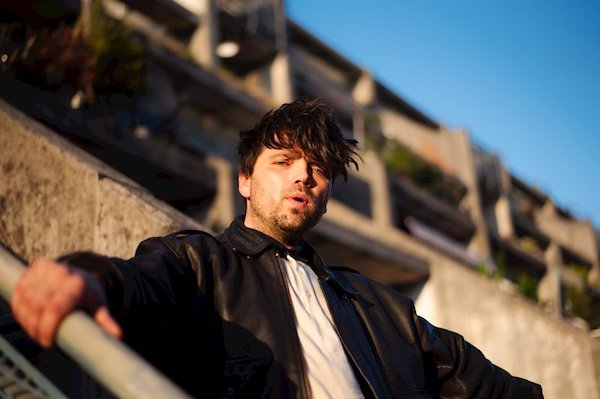
Luke Marzec photo by Natalia-Bjerke
Luke Marzec Builds On Lived Experiences for Debut Album Something Good Out of Nothing


Luke Marzec is a British multi-instrumentalist and singer/songwriter who also works in a collaborative way with musical groups, as well as hosting a mixed-genre jam event. Though he has previously created EPs, his first full-length album, Something Good Out of Nothing, will be arriving in two parts, with Part A having landed on March 28th, 2025, and Part B arriving this coming summer.
Marzec’s extensive experience as a live performer in jazz bands and beyond have built up a passion for collaborative improvisation at live events, however, the songs on the new album were written mainly in seclusion. While this is very much a studio album, Luke Marzec chose to work with long instrumental takes and drums that preserve organic elements, bringing together his two interests of analog approaches and electronic innovation. I spoke with Luke Marzec about how he conceived of the “Part A” and “Part B” set up for Something Good Out of Nothing, his approach to live performances, and how some of these songs got their start, grounded in the natural landscape and lived experiences with friends.
Americana Highways: Is there anything general that you can share about how you picked this group of songs for Part A of your album? To me, having a Part A and Part B sounds like a vinyl record.
Luke Marzec: Exactly, yes. I have thought about it in terms of vinyl. Finding the track order for something is a really interesting process, and the thing that comes before a song and comes after it really shapes your perception of that music. I was going through so many options, and a friend suggested that I think of it like a vinyl, with two halves to it. Things then started becoming a lot clearer, because there’s a start and a finish, twice, as you turn it over. There’s even a break when you turn the vinyl over.
I went through different iterations of the order, it became clear what would be the last track on the album, because of how that song finishes. That was obvious to me. Then, it was nice to think of different ways to pace the thing. Modern attention to music is single-based, but it was really fun doing it as an album.
The first half has two of the more sensitive songs, and I thought it might be good to start with a bigger bang, then ease you into it. Then, with the second half, I think that’s all a go.
AH: How did you pick the songs for the album out of the wider body of material that you’ve been recording? I understand that you’ve got lots of material from the same songwriting period.
LM: The truth is that I had demoed lots of material, so I have a big cache of demoed material. This is my first experience recording everything out of the box, with full drum takes, and trying to track as many instruments as possible with long takes rather than doing any copy and pasting, or sample-based work. I think, out of those demoes, I started with one, and then thought, “What next?” And I followed my nose. Then, when I started to have a body of material, I started thinking about balancing material that would go well together. I think it was almost incidental how it started, working with a drummer, and then, later, it was finding balance. Some things came in later. The first track, that’s out now, “I Can’t Get You Out of My Mind,” was actually the last to be recorded, since I needed another punchy, up-beat one.
AH: When I look at Part A, I think I can see a lot of intention in the way the songs are presented. I like the way that it’s structured as a listening experience.
LM: I showed it to a couple of friends whose taste I really value, and going through the process, you don’t necessarily want to think about the audience. But it’s quite nice that they agreed with three of the songs on that side. It was really nice that they liked the songs that were my favorites as well. I do think it’s a nice shape.
The first song of the album also has quite a long introduction per modern standards, and is the lead single. I was really tempted to cut it, and cut it, and cut it down to as brief a composition as possible. I do like brevity, but I really liked the idea of having a record in my hand, and having this psychedelic intro to this first track. Then it goes into a big beat. I thought that was a nice start to a record.
AH: Did you write the songs primarily in isolation, or do you usually refine them through live performance?
LM: Mainly in isolation, though I was collaborating with my drummer friend, David. But there are a couple songs that I sang along, particularly the guitar song, “Red Boletes” which I sang hundreds and hundreds of times. This is primarily a studio album. Now, I’ve begun playing out more, at little open mics in various towns and cities, and I’m having my first band rehearsal coming up. The live and the studio versions will be different.
For the live show, I’ve chosen a group of musicians who I want to feel ownership over this material as well. I’m probably going to give them much less prescription than you might suspect. I don’t want them to have to play everything like it’s written. When I do start gigging more, the live will be a different thing, as I’m telling people online. They will be reinterpreted live, and for the different instruments that I’ll have with me. I’m really excited to give them a different breath of life.
AH: I would have been surprised otherwise, since I see that jamming and improvisation is part of your life, and you’ve been playing various instruments for a long time.
LM: Oh, yes. Playing live, you need to play to the room. I was brought up as a Jazz musician, and we used to do a lot of function gigs, like weddings, parties, and private shows. You’d have to play to the acoustics of the room, too. I like the really arrange on the fly when I’m leading a band live, because if an audience digs a groove, they will respond by the way that they move, and the energy, and all of the responses they give. So you have a bigger intro, or a bigger outro.
That’s the most fun thing about live, crafting something on the spot. I think that’s what’s best, when there’s that conversation, or that electricity. I was a great process for me to be able to Produce this album on my own, and I bloody loved it, but for live, I want the musicians to feel like there’s part of them in what we’re playing.
AH: Do you think you’re more sensitive to being inclusive in that way because you’ve been in performance groups yourself, as a player, rather than a band leader or solo artist? You seem to have an assumption that music is made, primarily, together.
LM: It’s inclusive, not necessarily for any altruistic reasons, but because that’s how music is made, and how it’s made best. I’ve not always been the lead. It’s quite nice, sometimes, to be told what to do. [Laughs] Just take the load off for people. But the real magic happens when you have good leadership that gives space and trust for you to be you, and it’s the best magic, when you’re in the moment, being yourself. The main thing I’ve been thinking about for live, is that you have to choose the right time.
AH: I was thinking about that. Who you work with is the key to success.
LM: Exactly. Then you don’t really need to direct anyone. I’ve played a lot live with the guys who will be doing this in various incarnations and projects. I’ve been daydreaming of what kinds of things they will be doing, and how they will react to it. I will also be trying a lot of new material, as well, so I’m finding this group who will help craft the new songs as well.
AH: When you mentioned the guitar song, “Red Boletes,” I realized that I’m glad that you included it on Part A. Because for people this spring, they will only hear Part A, and “Red Boletes” hints at the range of sound on this album coming up on Part B, too. It shows such a different mood, so that’s a nice diversity.
LM: It’s bare-naked. It’s basically got no production to it. I just wanted to record it to show the fireside song that it was. There’s many reasons for that, but part of my did just want to deliver it in the way that I know that song. It was written with a close friend, out in nature, with a guitar, and we’ve been singing that song for years. I’ve been playing it out. I only tried to record it once, and that was the second take. I felt that it sounded like the song that I know, so that was it. I wanted to include it, and its contrast, and balance.
AH: I think the vocals on that song are therefore really important. It suggests, to me, the way in which you think of vocals as an instrument. It shows your thinking there.
LM: It’s also a purely story-telling song. It’s five verses, elaborating on stories, so it is all about the vocal and that story, especially live. Since you have someone’s attention live already. When someone gets to the end of the first half of the album, it’s like, “Let’s sit and pause for six and half minutes and hear some stories.”
AH: It’s cool that a song that’s had such a long life for you has finally been recorded. Had it changed much over time?
LM: I’ve worn it like a jacket so often, but we made it in three days, with a friend. So I just didn’t stop, and it was on my mind for three days, working the lyrics out. We spent three days, walking up and down a river, with a guitar, and we’d sit down and work on it. Right now, I’m actually much more extensive with my writing, and if a verse just comes out, I’m happy with that. But at the time, I was much more cracking the whip, and saying, “We can do better!” I can get quite hyper-focused and intense, and I’m actually trying to learn to be a bit slower, and trying to maintain focus for longer periods less intensely.
AH: “Growing Up With You” has come out most recently. Where does what one fit in terms of what we’ve just been talking about? Was it written in a more focused period, or more leisurely?
LM: That one was something that was on my mind for quite a long time. For maybe a month, every day I’d be working on it. It was bugging me. For a long period of time, I’d go melodramatically up to Dartmoor, in the Devon, and sit on the moors on a high point. I’d look out at a nice view, and there were a couple of stories that I was trying to get down in that song. One of them starts with “Driving back from fellowship at sunsets.” And the second verse mentions walking back at daybreak. I was trying to write about two experiences that I had with friends, and I just wanted to get the words right, and tell as much of the story with as few words as possible.
That one did take quite a long time, but it was really nice to complete it. It was a couple of years ago when I wrote this, I think just post-Covid, and it was the first time in a while that I’d gotten together with my oldest friends. We had some big, great reunions in the countryside, with starry skies, and fires. I think that meant a lot to all of us. I think because of that subject, I was really taking my time, and trying to make sure it said how it seemed to me. It mentions a big storm that we watched coming in. That song does mean a lot to me, and so do they.
Thanks very much for chatting with us, Luke! Follow along with Luke Marzec here: https://www.instagram.com/lukemarzecsworld/