


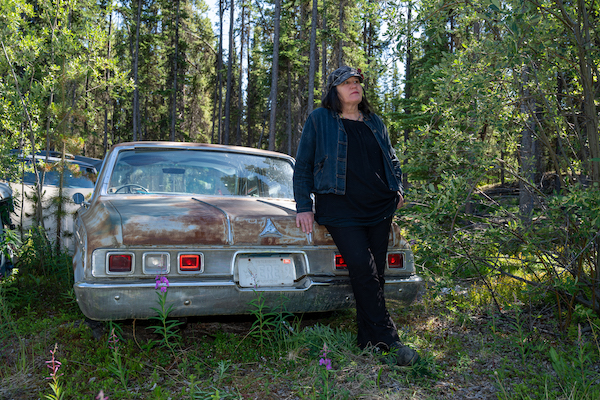
Kim Beggs Makes a Powerful Statement from Northern Canada on Beneath Your Skin


Kim Beggs possesses a voice as distinctive as her songwriting approach, and on her recently released seventh album Beneath Your Skin, Beggs’ talents are fully realized as never before. Familial history, survival, and the natural world are themes Beggs explores throughout the album’s 13 songs. Each is an interpersonal conversation between Beggs and her continually growing audience, making Beneath Your Skin the most dramatic album of Beggs’ career to date. She observes the world with acute vision, clearly demonstrating that her convictions are on the side of humanity.
Born in Quebec and raised mostly in Ontario, Beggs found herself in the Yukon more than 30 years ago. After earning a red seal journeyman carpenter certificate, Beggs started writing songs and performing, discovering elements of her personality that only emerged once she embraced living in the far north. She celebrates two decades as a recording artist in 2024, a span of time during which she has come to be regarded as an artist possessing the rare ability to weave informed observations into compelling songs replete in imagery and figurative allusions. Through exploring her world—the people, emotions and events—Beggs has earned nearly a dozen Canadian Folk Music and Western Canadian Music Awards nominations.
Songs of light and shadows remain her signature trait, and on Beneath Your Skin Beggs embraces the darkness of our world, while ensuring hope illuminates each song.
Americana Highways: Congratulations on your new album Beneath Your Skin. How does it feel to have it out in the world?
Kim Beggs: It feels fantastic! It was a long time coming; I had released a seven-song EP in 2022 but I still had so many more songs I wanted people to hear. I am so very proud to share Beneath Your Skin.
AH: What was the songwriting process like in general?
KB: I write best under pressure. I usually start writing lyrics first, in a spoken word rhythm style to get the ideas out. I think of it as letting the ice cube tray overflow or puking it out and then picking out the best bits to carry on with. I don’t always know what I’m going to write about until later on. Sometimes not for years and even then, time evolves the meaning of everything. Do we ever really know what is around the next bend?
Songs are always a bit gruelling to finish. I have to get them just right. One of the things I appreciate and enjoy about recording an album is that it really pushes me to get the songs into their best state. The deadline for recording makes me work my hardest right up until I lay down the final vocal. It’s important to me to have that flexibility when making a record. Sure, it’s about getting the best vocal, but it’s also about getting the best lyric and melody.
AH: You worked with the renowned Montreal producer Howard Bilerman (Leonard Cohen, Godspeed You! Black Emperor, The Weather Station) on the record. How did that come about?
KB: Howard Bilerman is awesome. We met at the Banff Centre for the Arts in 2018 where he was the sound engineer/producer on site for the Singer Songwriter Residency that I was a part of. He has been incredibly supportive of my craft and let me know he would love to work with me on an album. And he gave me a great deal by offering a week for free.
AH: You also got some other notable names to contribute, specifically Charlotte Cornfield. How did she become involved?
KB: I thought I met Charlotte for the first time when we started recording the album. It turns out we had met a few years before when she booked me at the Burdock in Toronto when I was on tour in support of one of my previous albums. I wasn’t familiar with her music but I have since become a huge fan. It was Howard Bilerman who brought her to the project. He is good connector of people and spirits.

AH: How important was it for you to include so many accomplished female musicians on the record?
KB: Over the seven solo albums I have recorded, there have been many accomplished women who were part of those albums. With exception to my old-time duo the Blue Warblers where we are both women, Beneath Your Skin was the first time that women were the core of the band.
It was refreshing to have such a safe space for communication with Charlotte Cornfield and Lilah Larson. It provided so much room to express my values and be heard. A big part of what made this experience possible is that fact that Howard is a very forward thinker and had the vision that brought us all together in a room for this very special time.
AH: Many of the songs are heartbreaking in terms of how they address some interpersonal relationships. Was it cathartic for you to get these thoughts on tape?
KB: I have always been a bit of a ‘shock absorber’ in life. It’s how I keep my balance as I walk through this world. I am also extremely empathetic. My empathy causes me to be a little bit of a bruise. Indeed, it was cathartic to lay these songs down. I revealed more rawness than usual in many of these songs.
I often don’t get to finish my thoughts when communicating in conversation. I have what my family calls the ‘Beggs pause,’ which I got from my Dad. It’s easier for the men in my family though. I take my time to express my thoughts and sometimes come in through the back alley to get there—kind of like the way I am answering your questions right now—and I read the newspaper from back to front too. Most often, people don’t have enough time. That is why I write songs. I have the time to make them short and sweet.

AH: The first song you’ve made a video for, “House For Slaughter,” deals with environmental catastrophe in a pretty direct way. What was writing that song like?
KB: While I naturally gravitate toward poetic expression, it was a challenge to convey the message without having too many ‘secrets’ woven in or be too preachy. I like to connect with listeners through their hearts more than their minds.
Writing ‘House For Slaughter’ was profound. It started with intent; I brought the idea to a co-writing session I had with Shawnee Kilgore set up by The House of Songs, a great organization that helps songwriters from around the world to collaborate. They set me up with many songwriters over two weeks in Texas and Arkansas. It was the songs I co-wrote in Texas that really struck the right chords on my path. Two of those songs are included on this album.
AH: Some of the songs also give a sense of the path that your career has taken over the past 20 years. How would you basically describe that?
KB: In a word, unexpected. Being a performing artist was never a dream for me. I was extremely shy and had major stage fright. So, I challenged myself to confront that by acting in community theatre, several years before I started writing songs and performing them at the local open mic after I moved to Whitehorse, Yukon. I had some amazing opportunities after I started releasing album. There was momentum, but that was pretty much drained in the few years of the pandemic.
The age of streaming has also had a major and negative impact on how I make my living as a musician. The cost of recording the music goes without saying and now there is a huge pressure on artists to come up with ways to market themselves. The financial risk falls squarely on the artist while the technocrats take all the money from the music. A representative of Spotify said to me directly that they are making honest people out of the pirates.
AH: What are some of the highlights that stand out for you over that period?
KB: I was always known as carpenter Kim, before stepping out into the spotlight as a singer and songwriter, and I’ve been totally OK with that. A journeyman carpenter is what I was and what I am. The Yukon gave birth to me in so many ways when I moved there at the age of 23. I feel like it was a well-known CBC Radio host, Michael Enright, who put me on the national radar. I had played a quiet little bar in Toronto where his son was the bartender. He bought a couple CDs and gave one to his dad. Michael then invited me to be interviewed on his national Sunday morning show. He said my lyrics were high poetry. So many people in the Yukon heard it and I was looked at very differently after that. Bob Harris also interviewed me on the BBC when I toured England a few years later. I have received many wonderful reviews for my albums and songs and I am truly grateful for that.
AH: You’ve lived in the Yukon for quite some time now. What is life like there? Is it as remote as it seems to be for most people?
KB: The Yukon is like a golden sickle in your back. Sometimes you love it and sometimes you hate it. It won’t let go, and it’s incredibly inspiring. I didn’t have many skills when I moved up here. I knew how to pour coffee, plant trees and play a few chords on my guitar. I was way too shy to sing out loud. The Yukon gave birth to many of my skills including becoming a journeyman carpenter and a performing songwriter and recording artist. The Yukon is remote but it draws a lot of interesting people. It is cosmopolitan, actually. There lots of global thinking up here. It’s a two-day bus ride and a two-and-a-half hour flight from Vancouver. It takes three times as long to get to Toronto.
AH: What prompted you to move there in the first place?
KB: I was going to travel the world but I thought I had better learn more about my own country before I started flinging my first world, white ignorant ways around. My older sister was living here, so I decided to visit her for what I thought would be a couple of months. I was also intrigued by family stories and photos from when they lived in the Yukon back in the mid-1960s before I was born. It will be 33 years since I got off the bus on November 29, 1991.
AH: Obviously, with modern technology, artists can live anywhere and still connect with people. Do you feel you’ve had to sacrifice anything by living so far north?
KB: I don’t feel like I sacrificed anything living up here. I had no plans or agenda. I made decisions based on what was needed where I lived. But it is expensive to tour and connect with people outside. I wish I could see everyone I know in person and I miss that very much since the pandemic.
AH: Are there any fellow songwriters you’ve come to admire more as you’ve gotten older?
KB: I have been, and continue to be, a huge fan of Kim Barlow and Anne Louise Genest who both used to live in the Yukon, as well as Natalie Edelson who still lives here. We sat and sang around the same campfire for so many years. I also love the music of Justin Rutledge, Jadea Kelly, Suzie Ungerleider, Townes Van Zandt, Bob Dylan, Joni Mitchell and so many more. I feel like it’s obvious that Neil Young has been a huge influence on my music as well.
AH: As you mentioned, touring has become more challenging. Is that something that still interests you?
KB: Absolutely, I still want to tour. It’s a lot of work booking tours though, and costs have obviously gone way up. Since losing so much momentum over the last four years, I find I am more open to accepting help with bookings. I will be touring across Canada in the spring and can’t wait to get back to touring in the States as well as Europe.

AH: If there’s one song on Beneath Your Skin that you hope connects with people, what would that be?
KB: The song ‘You Been Down My Road’ is a special one to me. It’s my tribute to songwriters past and present who have meant a lot to me and to everyone.
Thanks very much for chatting with us, Kim! Kim Beggs’ Beneath Your Skin, along with the rest of her discography, is available at http://www.kimbeggs.bandcamp.com.