


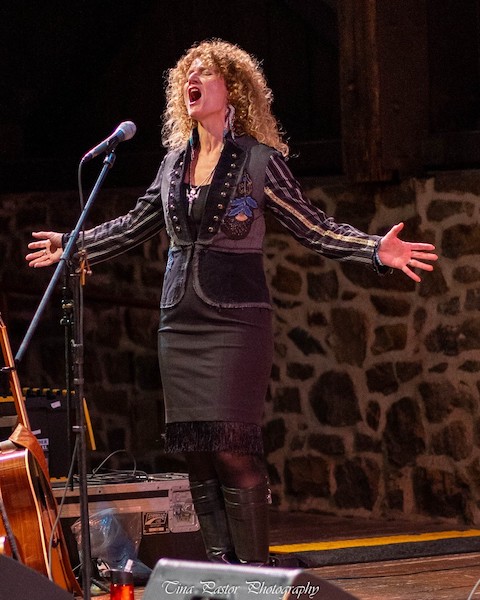
Karyn Oliver on Gathering An All-Female Crew For Cherchez La Femme
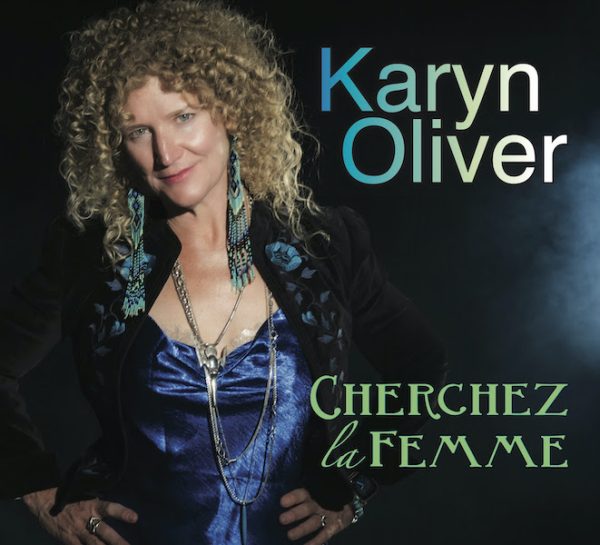
Karyn Oliver has been a songwriter and performer since 2009 and has always drawn from her personal experience to craft her songs. This October, she released Cherchez Le Femme with a very special twist, however, by seeking out and including all female crew for the entire process of creating and releasing the record. The reasoning was clear and simple: women don’t get enough work in music and only by consciously changing that can we improve the lives of these highly skilled artists. The result is a powerful album conveying many ideas that are close to Karyn Oliver’s heart, but you often get the feeling that there’s something a little “extra” going on when it comes to the energy and the passion of the players who were recruited for this special project.
As Karyn Oliver says, this album is both personal and political in its very make-up, whether it’s through songs about confronting relationship struggles from an internal female perspective or whether it’s taking on the nature of truth and where and how we preserve it in our world. I spoke to her about the practicalities of making Cherchez La Femme, which may encourage others on a similar road, and also about some of the songs on the album that tap into such deep wells of emotion.
Americana Highways: Has there been conversation around this album, about the idea of having an all-female contributor list?
Karyn Oliver: Yes, and those reactions have definitely been mixed, depending on who you’re talking about. Obviously, women across the board are saying, “Yes! We need to do this more!” Because otherwise, you get left out of the mix completely. That’s just still true. A couple of male reviewers have said something like, “I don’t know why that’s necessary anymore.” And my response to that is, “They are not paying attention.”
AH: I can’t believe they’d say that in print at this point! Crazy.
KO: They usually follow it up with, “But the caliber of women on here are such that they’d be hired anyway. I’d hire them.” Yeah, but they don’t. Maybe they are hitting the wrong note there. They still like the record, but we get this backhanded response. But unfortunately, women quit music because they can’t get gigs and can’t get hired. I don’t want them to quit!
AH: There is a brick wall argument to this, when people say, “Yes, but I’m hiring based on the ability of the person, not on their gender.” So they refuse to take it into account. But if everyone on an album is the same gender, what’s going on there?
KO: Right, are they saying that there aren’t women who would be capable of doing this job? But what it just comes down to is that they really didn’t look.
AH: I was about to get into that. The myth would be, “It would be difficult to actually find a woman for each of these roles, large and small.” How difficult was it for you to find everyone for this record?
KO: There were some challenges, I will say that. Some of the roles, like rhythm section, were not hard at all. Luckily, having been a woman in this business for a long time, I know a lot of women musicians. The drummer and bass player were friends of mine, thought I had never hired them for my records. I knew all three of the guitar players. I know a ton of singers. The hard one was the horn section. Realistically, it wouldn’t have been difficult at a different time, but because this was happening mid-pandemic, everyone had to be able to record themselves. Everyone had to have the gear, technology, and know-how to do their tracking. I know a trombone player who’s a songwriter, but she wasn’t someone who could record herself. But we got it done!
AH: That’s a really good point, that even though a lot of people have home studios these days, certain musical trajectories are less likely to have a home studio or be familiar with self-recording. If you’re an instrumentalist who’s usually a side-person, you might not have that. It’s a lot to expect of people.
KO: It is. I suspect it would have been difficult to find even male horn players who could record themselves. Who plays the horn in an apartment building? [Laughs] Yeah, I’m going to record my tuba! That will go over well with the neighbors.
AH: Was the writing of these songs and the idea of working with all women connected, or is this an album you were ready to make anyway?
KO: It was a little of both. I would have made a record anyway, and most of this stuff would have been on it. When you’re ready to make an album, you often have far more material than you need. Once we made the decision to work with only women, that sort of gathered together the songs for us. I don’t know that it was even conscious, but that did influence what songs we decided to use.
All of these songs probably have a female perspective, because I’m female, and I wrote them. I get asked a lot by guys, “Why don’t you write things from a male perspective?” And I say, “Because everybody does, and it’s not really needed.”
AH: I do think that the relationship songs on this album, for instance, could be from any gender perspective. They are quite open, and I appreciate that. But I agree that I can sense a female perspective here, and that makes sense to talk about what you know about.
KO: Right, I’m not going to deliberately pull that stuff out. I appreciate that you think the relationship songs are more open, because I think that, too. I don’t know that I did that deliberately, but by and large, I like to leave things as open as possible so people can relate to it.
I think a lot of the songs on this record are deeply personal and yet highly political, and that in and of itself led them to be better handled by an all-female cast. Because there’s a level of trust there. These are things I’ve discovered while doing this project, because I’ve mostly recorded with men all along in my life. But when I started hearing what I was getting back from people, I knew that this project was a completely different animal. Women just approach it differently. I can’t really articulate how that is, but you can hear it.
AH: I’m just going to speculate wildly here, and I don’t know that this is true of your situation, but I can imagine that when you’re handling things that are often not talked about, or lack representation in music, and you’re working with an all-female group, there’s going to be that little bit extra they give back. They contribute extra in terms of energy because it hits an emotional chord for them. That’s just something that occurs to me.
KO: I think you hit the nail on the head. I think that’s exactly right. Because these are issues that will definitely resonate with women, I think they also respond to it in a way that men might not. They definitely gave me a level of commitment and work ethic that was above and beyond, every single time!
AH: Do you think that you see differences in sound on this collection of songs versus your previous collections? Or does that relate to who you worked with each time and discoveries that are made?
KO: I definitely think this record sounds a lot different than my previous recordings and a huge part of that really does come down to Catherine Etzel, who I produced the album with. She just has a very unique sensibility and she has a very clear vision. She knows exactly what she’s looking for, and so do I, but it aligned a lot of the time. A lot of times, she’d send me a working tape of where she felt things should be heading, and it would be things that I wouldn’t have thought of, but made me think, “Oh!” She’s incredible and I really loved working with her. It’s a bit more of a Pop sound and yet broader sensibility than what I had had before.
AH: That’s how I felt about the album. It’s an interesting place between pop and more roots style music, but it’s all very gently, subtly handled. It almost feels genre-less, but if you sink down into the layers a little, you can find those aspects.
KO: I’m happy with “genre-less” because my writing is pretty much all over the map, genre-wise. If you grow up listening to everything, you’re going to want to write everything.
AH: That really sums up a lot of long conversations I’ve had about this lately. I saw that this album started with a Kickstarter campaign. Had you used Kickstarter before?
KO: I did another fundraiser a couple of albums ago, which wasn’t with Kickstarter, but it was a similar sort of thing. It’s something I’ve always been kind of loathe to do, but I’ve come to understand that this is the model now. That is how you make a record because the record no longer pays for itself.
AH: Did the planning work out okay for you financially?
KO: I had already done some recording, so I was just recouping. I didn’t raise as much as was spent, but it was a help. It worked out and without that assistance, I would not have been able to make the record, let alone promote it.
AH: One of your songs that was released earlier on was “Cry Hallelujah” and I found it interesting how much emotion you convey there and how you navigated the use of religious language. It helps express something that feels bigger than us, which is a very human situation.
KO: I consider myself to be a spiritual person, but I definitely don’t subscribe to dogma of any kind. But I agree. I think everybody turns to that kind of language at some point, regardless of what they believe. It’s just part of our vernacular because the language has been such a big part of human history. The language seeps into everyone. Everyone has their moments.
AH: We all do a lot of things that we don’t fully understand whether they gel with our public persona or not.
KO: Rituals are rituals and bring a lot of comfort to people regardless of their beliefs. I have a lot of Jewish friends who don’t profess belief but participate in rituals.
AH: Absolutely. It can also be about being part of a community. What brought about the image of one’s face in that song? That seems quite significant.
KO: That connects to the idea that the way that we perceive someone’s face changes when we recognize them, when we see their humanity. And that includes yourself. So there’s a line, “I never saw your face before” and also, “I never saw my face before.” Because we’re just as brutal to ourselves until we recognize our own humanity and give ourselves a little bit of a break. That’s where that line comes from.
AH: There are a lot of truisms about making peace with ourselves, before we can make peace with others, but it’s totally true that a lot of the judgements that we place on others are ones that we’re silently placing on ourselves. That’s part of the whole cycle and problem.
KO: Absolutely.

AH: One of the songs with a third-person storytelling feel is “Truth.” I’d love to know more about this story. Is that something that was prompted by seeing an existing story?
KO: Kind of. That one is kind of an allegory because truth is sort of the woman in the song, but also, truth is just truth. That song draws a lot on imagery from the holocaust in Nazi Germany and the burning of literal truth. But I didn’t get too specific with it because it keeps happening and it’s still happening now. It was my way of saying that truth is really hard to hang onto, and hard to spread, but luckily also very difficult to kill.
Way back in the days of the founding fathers, they were saying, “Lies get half way around the world before truth has a chance to put its pants on.” I’ve always thought that was a brilliant line. That was way before the internet! It’s accelerated, if anything. That’s really the kernel of the song. The spreading of lies, and fear, and the othering of people in order to manipulate them.
AH: That is quite a political song in a way, as you said earlier about the album, but it shouldn’t be.
KO: Right, this should not be controversial! We should all be agreeing on this one. Unfortunately, truth in and of itself, is political and controversial.
Thanks very much for speaking with us, Karyn Oliver! Find more details and information on her website here: https://www.karynoliver.com/
Enjoy our coverage of the album here: REVIEW: Karyn Oliver “Cherchez La Femme”