


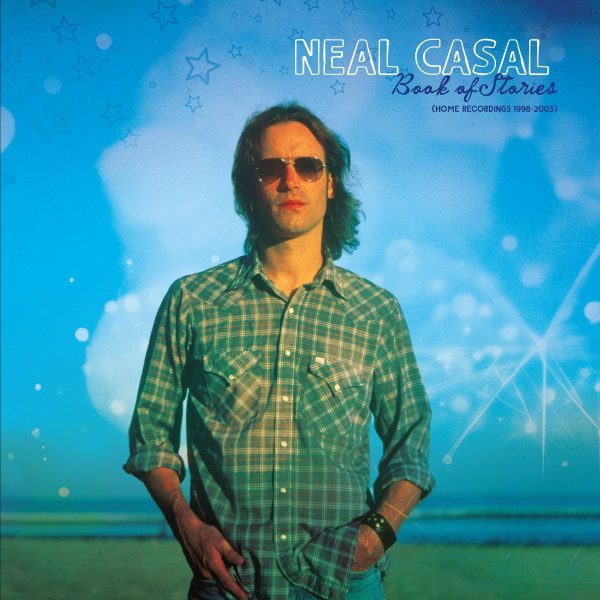
Neal Casal – Book of Stories (Home Recordings 1998-2003)
When Neal Casal died in 2019 at the age of 50, the Americana, folk and roots-rock community lost one of its most admired and respected musicians. A gifted singer-songwriter, guitarist and photographer, Casal built an impressive career both as a solo artist and as a collaborator, working with artists including Ryan Adams & The Cardinals, Chris Robinson Brotherhood and Hard-Working Americans. Renowned for his lyrical guitar playing, thoughtful songwriting and understated artistry, he left behind a body of work that continues to inspire musicians and listeners alike.
Book of Stories (Home Recordings 1998-2003) is a fascinating archival release drawn from a collection of previously unheard recordings made by Casal at home during a particularly creative period of his life.
I should confess from the outset that, although Neal Casal’s name was vaguely familiar, I had never knowingly heard any of his music before approaching this album. Listening to a posthumous release is one thing; listening to one by an artist whose work is entirely new to you feels rather different. It invites a degree of caution and reflection.
Posthumous albums occupy a curious and often uncomfortable space. It is easy to view them cynically as attempts to continue monetising an artist’s legacy. The posthumous catalogues of artists such as Jimi Hendrix and Marc Bolan have, at times, blurred the line between celebration and exploitation. Yet for dedicated fans these releases can be deeply meaningful, offering one final connection with an artist they love. It is a delicate balance. Would Neal Casal himself have wanted these recordings released? The honest answer is that none of us can know.
The story behind Book of Stories is, however, refreshingly uncomplicated. The twelve tracks were recorded between 1998 and 2003 as Casal taught himself the art of home recording using an Otari eight-track analogue machine gifted to him by producer Jim Scott. Captured during late-night sessions in New Jersey and later Los Angeles, the recordings showcase not only Casal’s gifts as a songwriter and guitarist but also his abilities as a multi-instrumentalist, with bass, drums and additional guitar parts played and layered by Casal himself.
Crucially, these recordings do not sound like scraps rescued from the cutting-room floor. Rather, they offer an intimate glimpse into an artist developing his craft away from the expectations of record labels, audiences and collaborators. Across eleven original compositions and a moving interpretation of Tom T. Hall’s “Joe, Don’t Let Your Music Kill You,” we hear a musician exploring ideas, refining arrangements and quietly documenting his creative life.
After several listens I began to get a better sense of Casal’s voice and songwriting style. Because he performs virtually everything himself, there is little sense of a band dynamic or collaborative energy. These recordings feel very much like solitary works, and perhaps that is their appeal. Approached as sophisticated home recordings rather than fully developed studio productions, they reveal considerable charm and craftsmanship.
That said, my reaction was something of a mixed one. There are several strong songs and attractive performances here, but relatively few moments that feel truly revelatory. The album has a warm, inviting analogue sound throughout, although at times I found myself wishing for a little more edge, spontaneity or interaction from other musicians.
The closing interpretation of Tom T. Hall’s “Joe, Don’t Let Your Music Kill You” is particularly poignant given Casal’s story. It is an outstanding song in its own right and receives a thoughtful, affecting performance.
The opening track, “Muscatine”, is arguably the album’s strongest moment. A beautifully realised performance, it combines memorable songwriting with confident musicianship and immediately establishes the high standard that Casal was capable of achieving on his own.
“Leave My Loving Cup Behind” is another highlight, sounding complete and fully formed without needing additional embellishment. The arrangement is understated yet entirely satisfying.
“Where Does The Time Go” was one of the album’s few minor disappointments. Its title immediately brought Sandy Denny’s magnificent “Who Knows Where The Time Goes?” to mind, and while the comparison is undoubtedly unfair, Casal’s song never quite comes into focus for me. It feels more like a first pass at an idea than a finished work, lacking the assurance and completeness found elsewhere on the record.
“It’s Got Me Down” brought to mind the work of Josh Rouse. The melody, gentle groove and layered overdubs combine effectively to create one of the album’s most enjoyable tracks.
“How Many Times” is another well-constructed song, although the keyboards sit a little too prominently in the mix for my taste. The vocal harmonies are excellent, however, and lend the song a flavour that occasionally recalls Rufus Wainwright.
I was also particularly taken with “Good News.” Despite its brevity, and despite retaining the kind of imperfections that many modern productions would edit away, it captures an intimacy that feels entirely genuine. The rough edges become part of its charm.
And perhaps that is the key to understanding Book of Stories. We cannot be entirely certain whether these recordings were intended as finished masterworks or simply as personal documents, ideas captured for future consideration. As far as I am aware, none of these songs were released during Casal’s lifetime, which inevitably colours how we hear them.
In an era where home recording technology allows musicians to create studio-quality albums from a spare bedroom using Logic, Pro Tools or GarageBand, there is something uniquely appealing about hearing analogue home recordings made three decades ago. Comparisons with celebrated DIY recordings such as Bruce Springsteen’s Nebraska or Paul McCartney’s debut solo album McCartney may be ambitious, but they illustrate the enduring fascination of hearing artists create outside conventional studio environments.
Ultimately, Book of Stories is less a lost masterpiece than a compelling historical document. Dedicated Neal Casal fans will almost certainly find it essential listening, while newcomers will discover a talented songwriter whose gifts perhaps shone brightest within the broader context of his career. There are moments here, notably “Muscatine”, “Leave My Loving Cup Behind” and “It’s Got Me Down”, that hint at a considerable talent. Other songs feel more exploratory, preserving the sound of an artist working through ideas rather than presenting finished statements. That tension is both the album’s greatest strength and its principal weakness. As a window into Neal Casal’s creative world, however, it remains a fascinating and worthwhile listen.
Find more information here: https://nealcasalmusicfoundation.org
Enjoy our previous coverage here: Various Artists – Highway Butterfly: The Songs of Neal Casal