



photo of the Star Room Boys at the 40 Watt by Jason Thrasher
MAR(R): dinged love and twinkling endurance.
The goods, they bleat, bleeding neon atop the loudest totem so low. Now, some of the greats slip and sluice right down through the underfoot grates without your ears having even countenanced them. Such might be the case with Athens Georgia’s Star Room Boys. Man they frothed and foamed and ran over the cup edge between the late ’90’s and early 2000’s. Serious heart road heat. Something like a mushroom’s aspirin-white, they rose from the solo cupped and dog haired lawn to save you from your headache and heartgasp. They were around. Truly round. Such orotund sound. And they left their hearts out in the sardine spit motels near where you surely stopped for gas last Tuesday. Here and gone and people went apeshit for them for a time. Then just as quick faded and swallowed up in some swelled seam of time like kleenex in milk. The Star Room Boys broke in 2008. And Dave Marr vanished from the lonely hearts clubs.
My bar for good music is will it save you or change you a little? Chip at the eyetooth of your soul a little? Listen to “Cocaine Parties.” Listen to “Both Our Towns.” The one from the Star Room Boys’ first record, the second from their second and last. If lines like “with your faraway eyes and cigarette ashes so long” or “all your pretty little lies were like the sweat upon your thighs that just dried up while we slept without a sound” don’t stick in your craw and readjust how you swallow things, reshape what’s headed down to suffer and sustain you, then I am afraid you are reading this with a supersonic binocs in heaven.

The band was tight: all crooning, all plaintive, all snap-buttoned-bourbon-hole-bucketed-asphalt-hearted: lord how John Neff’s pedal steel cried. But it’s Marr’s finely hewn, supple, exacting poetry that carries the night on the back of the day. He’s pure poet. Understands how words hinge and the molten nature of language. Gets into your DNA and remaps you out of lost. Says my ten PBR per day brother-in-law Eddy, who has heard it all, who once played a burned Star Room Boys’ CD so many times that it burned, literally melted into the CD player in the farm Ford: wouldn’t burp back out: faint whiff of puling plastic in there: says Eddy: “it’s the saddest embrace; it’s the voice; it’s the voice.”
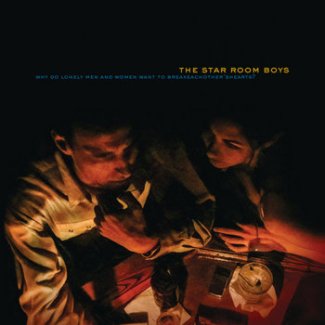

The Star Room Boys just recently rereleased their debut album Why Do Lonely Men and Women Want to Break Each Other’s Hearts? in September; a deluxe reissue of their 1999 album via Strolling Bones Records. Musicians on the album are Dave Marr (vocals/songwriter), Philip McArdle (guitar), John Neff (pedal steel), John McMahon (bass), and Bob Fernandez (drums). Originally produced and mixed by Davie Barbe, the reissue was remastered. We had a chance to sit down with Dave Marr for a chat some time ago that was never put to print. Enjoy.
Americana Highways: Could you say a little about your upbringing: in Chicago was it?
Dave Marr: I did grow up in Chicago – south side as a boy, and north side in high school. Irish Catholic-ish family, but not enthusiastic. The south-side neighborhood was idyllic in its way but also ugly and small. My folks sent me to public school because the Catholic school was really racist. They got divorced when I was about 10 and my dad moved to Gary, so I spent a lot of time there for the next few years. I moved in with him my freshman year in HS, and we went back to Chicago, the north side. That’s where I met the friends I got into music and started playing with.
AH: And how it was that you ended up in Athens?
DM: I met a girl who had moved to Chicago from Athens, dated her for a year before she decided to move back, and decided to move with her. We broke up a year later but we’re still friends.
AH: When I talk about performance of poems I talk a lot about persona; how I have woven a mask in a way from some of the mannerisms of some of my favorite singers: Chris Whitley and Greg Brown et al. How did you come to your way of singing? Was there a conscious persona effect at play, or do you feel like your singing approach came to you organically from pickling yourself in the songs of your favorite singers?
DM: It’s weird. When I was a kid I only imitated other singers (mainly the Beatles, Elvis, maybe the Bee Gees as a joke [at the time – now I love them!]) when I sang, and I think imitating other singers was the only way I ever showed any of my friends that I could sing at all. I think when I first started singing in bands – first in the Chicago band Mantis, in which I only sang a little bit, and then in a more up-front way when I started writing songs and singing in the Star Room Boys – I was still doing that a little bit or maybe a lot.
When I sang country songs, I was definitely learning how to do that from Gram Parsons and Dwight Yoakam, and for sure the combination of soulfulness and precision that Sam Cooke had – then later from Merle Haggard, Lefty Frizzell, George Jones, and even later from Billy Joe Shaver, then non-country people like Jay Farrar and Richard Thompson and Frank Sinatra. As far as whether there was a persona in play, I guess I’d say maybe there was early on, but I tried to get away from that as I became more comfortable as a writer and wanted to get my own songs across.
I’ll also say that the idea of persona gets pretty close to the reasons I’ve moved steadily away from straight country songwriting, to the point where I no longer think of my music as country. I feel like it’s perfectly within my rights to write and sing a country song anytime I want – there’s at least one on my new album – without having to be saddled as a country artist who has to work within the set of tropes (lyrical or vocal) that define that genre. I wrote a bunch of songs in the Star Room Boys whose subject matter was along the scale of romantic misery and what to do about it.
I think I did a pretty good job with those songs, but that’s not where I’m at anymore. I’m happily married and have a wonderful daughter, and I’m not heartbroken and I haven’t recently been betrayed. Those aren’t the only things to worry about in life, but that’s the stuff I felt moved to write country songs about, especially early on (the second SRB album was largely about non-romantic kinds of misery). I’m really glad that I don’t feel that way anymore, and faking it would be so stupid and pointless. When I started writing songs again after not doing much of it for a long time, I realized that I didn’t want to limit myself to country songs even as broadly as I had at the time of the second SRB album. I’m not saying my “persona” is any different between then and now, but it’s a pretty blatant fact that it’s been 14 years or so and I’m a pretty different person. I’m concerned about different things and I hope that’s obvious.
AH: And the barnacle question to that question: could you say a little something about your most enduring favorite singers across your listening life?
DM: Enduring! That’s the key, right? I’m gonna say Sam Cooke straight off, even at the risk of claiming influence from somebody who just knew how to sing a million times better than me. Every time I hear him, he’s perfect. I’m not a very good natural singer – I have a pretty narrow range and really shaky pitch – so I have been really inspired by Merle Haggard, whose greatness as a singer (despite his beautiful voice and perfect pitch) has always seemed to me to be mostly about bringing a song across with as little drama as needed. He does that with his emotional control and with his phrasing.
I’ve always wanted to be a modest singer because of Merle Haggard, and Willie Nelson, too. (On a separate note, Willie, like Dylan, doesn’t deserve his “mediocre singer who sings ‘right'” tag – neither of those guys have ever sang a note they didn’t want to.) Lately I’ve appreciated people who are willing and able to work outside of what would seem like the natural boundaries of their voices (does that make them modernists? God.), like Will Sheff, Jeff Mangum, Will Oldham and Jeff Tweedy. Neil Young has always done that, too, and Van Morrison. Bruce Springsteen a little too, I guess. I’ve listened to all of those guys a lot for a long time, but I’ve only recently thought I could do some of what they do.
Who else? Richard Thompson is a great singer. Otis Redding might be the best singer I’ve ever heard. Dylan, Hank Williams. Mick Jagger for sure. Lennon? Brian Wilson? Sandy Denny, Dusty Springfield. Aretha? Diana Ross is purity. If I’ve listed mostly dudes here, it’s because I guess most of the women singers I like are way more accomplished than I could ever be and have totally different approaches, so I don’t really feel influenced by them, though I probably am anyway. I’ve been turned on to Karen Dalton lately, she’s got a really raw style that I love.
AS: You have one of the great voices I have ever heard; pretty well every time I play your music for friends, they turn to glue while they listen; your singing is arresting, and your lyrics are also damn dynamic poetry. So, what about writers? Who is up there on your writer totem?
DM: I love books by Sherwood Anderson (“Winesburg, Ohio” is one of my favorite things ever), Chester Himes, Dashiell Hammett, Raymond Chandler, James Baldwin, William Saroyan, John Fante, David Goodis, Lawrence Durrell, Chekhov, um… shit. I guess my favorite writers are all dudes – that kind of sucks. And I’m a terrible neophyte when it comes to poetry. (I’ve been slowly consuming your books, though, loving them. More on that in a future communication…)
Haggard definitely taught me how to write with high emotion and understatement at the same time. Curtis Mayfield embodies eloquence and perfect intelligence and grace. Vic Chesnutt had the best vocabulary and command of it of any songwriter I’ve ever known. Carole King and Joni Mitchell have some perfect lyrics, and so does Paul Simon. I mean, shit – Dylan, obviously. Will Oldham? Another of my favorite songwriters ever, for lyrics and melody, is Scott Miller, who died just a few years ago. He turned my head around permanently.
AS: Could you say a bit about your relationship with film? How it perhaps informs the scoring of your song(s)?
DM: I love movies – I studied film in college, I wrote a column on film for the Athens alt weekly for a few years, and I’m on the board of the local nonprofit arthouse theater. I’ve at various times had serious designs on wanting to make movies, and maybe I will yet – I’ve just never been able to get myself to do the work.
I guess I have similar standards for what I think are good songs and films, but they’re relatively simple: mainly, they have to produce a serious emotional effect by making a little world that feels organic, honest, and internally cohesive. That might sound pretentious, but I only mean that as much as I’m just about equally turned on by “Stranger Song,” “Good Vibrations” and, I dunno, “Pressure Drop,” I think the best films of Hou Hsiao-Hsien and Wes Anderson and Ernst Lubitsch are all perfect while hardly following any of the same rules. They’re all completely successful at what they’re trying to do, and it was something really worth doing.
So the important fact is just that, like a whole lot of people, I’ve seen a lot of movies and felt their effects, both good and bad. (Figuring out what you don’t like about art is really important, obviously.) Can anybody watch a bunch of Jean Renoir movies without it changing the way they see humanity? Shit, he might be the best example I can come up with of art having the ability to make you a better person, which is basically my core faith.
AS: Is songwriting for you a lightning of the mind? Or more like cooking maple sap down to maple syrup?
DM: It’s generally a fast-moving thing. I generally don’t have things in mind in advance of writing. If I feel the energy to write a song I sit down with a guitar and a notebook and something to record with, and I try to find a little melody and a worthwhile phrase or lyrical goal, then work from there – figure out whether I’m in the beginning, middle, or end, write some more music and words, build a structure that seems like it will work, and fill it out. It’s always late at night, I’m always drinking, and I almost always finish before I go to sleep. Then, usually, I send the recording to at least a couple of my friends, just to ensure that I’m committed to it and as a sacrament. (The twin sacrament comes the next day, when I get to reckon with what I’ve put out of myself at 3 a.m. That ensures that I’ll revisit it and tighten it if necessary.)
There are rare occasions when I’ll put down fragments and abandon them, then either expand them or unite them later, and I have no problem revisiting a problem line or two, even leaving a little bit of that kind of stuff in progress after I’ve already “finished” the song. But I don’t tend to agonize over songs for multiple sessions – for me, that seems to be a way to make a song that’s thin, unfocused, dissolute.
AS: Virginia Woolf talks a lot about moments of nonbeing versus moments of being; most of life she says is wrapped up in nonbeing but now and then we come out of the wool of nonbeing and have these shocks in life, when we are really feeling seeing tasting hearing. Are there a few small little anecdotes crystallized in yr memory–moments of being–from the days when you (A) were thinking of forming the Star Room Boys and (B) out on the road with the Star Room Boys. Moments that stand out as pretty excellent ways of summing up those movements in the band’s trajectory?
DM: A: My friend Doug Hollingsworth and I went to an open audition to be extras in the movie “Cobb,” which was filmed partly in Athens around 1993. When we got out of that, it was about 3 pm, so instead of going back to work we went to the bar and started drinking a bunch of tequila sunrises. We boldly predicted to one another and everybody else around that we would be stars. We had just rented a practice space so we could start the country band we’d been talking about for about a year, so even though we didn’t have an actual band together yet, we started psyching ourselves up to have a few more drinks and go down to our “star room” and begin the project by ourselves. We did, and I don’t remember it, but it was awesome. We didn’t get parts in the movie.
B: This one is also really blurry. This was years later, after Doug had left the band and we’d become the permanent lineup and put out our first album. I’d told the guys in practice one night that I was trying to write a song called “Cocaine Parties,” and Philip McArdle said, only sort of joking, “If you write a song called ‘Cocaine Parties,’ I will quit the band.” A few weeks later we were playing a show somewhere – Asheville? – and after our set and an encore people were still hanging around and wanting us to play more. I told the band I’d finished that song and we could play it on the fly – it was easy! They laughed at me but said OK. We told the people we’d do one more in a minute, and we went to get drinks, pee, tune up, etc. When I got back to the stage, each member of the band had gotten somebody in the audience to play his instrument for him, and all of these strangers were ready to go. So I showed them how the song went and we wrestled through it. It wasn’t great, but Philip didn’t quit.
Thank very much for chatting with us, Dave Marr. More information is available here on their website: https://starroomboys.com and here: https://starroomboys.bandcamp.com/album/why-do-lonely-men-and-women-want-to-break-each-other-s-hearts