


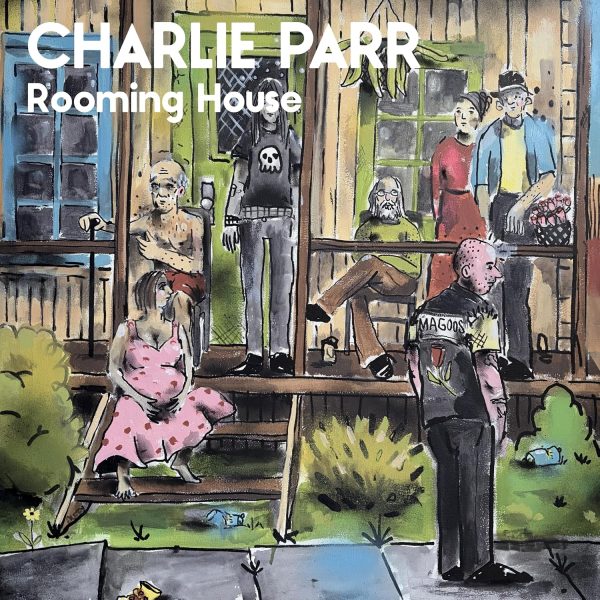
In a lengthy note that accompanies Rooming House, his poignant 20th album, roots musician Charlie Parr talks about the struggles of people who can’t afford to see a doctor and who say things like “at least it’s warmer in jail.” Adds the singer: “The safety net is laughable. A net with holes large enough to lose entire neighborhoods through has nothing to do with safety.”
Observations like that are what prompted this concept album, which describes the intertwined lives of the residents of a Duluth, Minnesota rooming house. “The folks here, in this record, they know about that net,” Parr writes. “They’ve tumbled through it time and time again. They’ve held on to the edge, trying not to fall through, working long-hour jobs for short pay. Unaffordable insurance premiums. Unaffordable illnesses.”
The stories Parr tells in Rooming House are not entirely bleak, however, because besides describing his characters’ troubles, he shows their empathy. They create makeshift families and help one another through hard times.
If Parr’s fictitious characters seem true to life, that’s probably because he had so many real-life experiences to draw on when writing about them. A native of Duluth, which still serves as his home base, he says his own mother grew up in a one-room home during the Depression. And Parr himself spent years living in Minnesota rooming houses.

The bluesy music that limns the world of one such house—which the folksinger recorded in just two days in Minneapolis—is as stripped down as Bruce Springsteen’s Nebraska. Skillfully playing acoustic guitar, Parr is accompanied only by drummer Dave King, from the avant-garde jazz group the Bad Plus, except on one track, which also features Minnesota-based cellist Jacqueline Ultan.
The album opens with a song about a man whose mother abandoned him when he was 12 in the rooming house where he still lives. Next comes the title cut, where we meet all the house’s residents as they cook dinner together. Another song focuses on a new mother who can’t afford her own place. “Daycare takes all of her pay,” Parr sings, “and “her tips barely pay for their room.”
“(What’s So Funny About) Universal Healthcare?” (whose title echoes the name of a Nick Lowe song that Elvis Costello famously covered) offers the first-person tale of a man with a terminal illness. “I know I should get to a doctor,” he says, “but I ain’t got a dime.” Then he recalls a buddy who went to prison, where he received medical treatment, a warm bed, and plenty of food. “He says there’s room for me,” confides the ailing man. “All I gotta do is get caught by the police for doing some crimes.” So that’s what he does.
Concludes Parr in his liner notes: “These folks here, in this record, have no idea what’s wrong. Or how to help. They are sick with the longing to make everything better…This house could be anywhere. These things could happen to anyone.”


Bruce Cockburn Revisits His Influences
Canadian singer and guitarist Bruce Cockburn has written hundreds of songs over his long career, but on his 39th album, The Blood of Others, he serves up only covers.
“What began back in the eighties as a vague notion grew over time into a strong desire to put together a collection of material, written by others, that I found sticking to the edges of my musical landscape,” Cockburn says. “The accumulation of these songs started in the sixties, before I’d even begun to try to create my own.”
It’s an outstanding set, one that simultaneously showcases his good taste in music, his interpretive skills, and his diverse influences, which range from folk and jazz to gospel and rock.
All the tunes affected the 81-year-old Cockburn during his formative years, so it’s not surprising that the newest of them is more than 60 years old. That’s fellow Canadian Ian Tyson’s masterful 1961 composition, “Four Strong Winds,” which, like the rest of the 15-track program, garners an elegantly phrased, acoustic performance.
Among other highlights are “As Time Goes By,” the standard that features in Casablanca; the traditional “Fare Thee Well”; Billie Holiday’s “God Bless the Child”; a version of “That’s All Right” that bears more relation to the Arthur “Big Boy” Crudup original than the Elvis Presley cover; and “You Belong to Me,” the frequently interpreted 1950s ballad that provided hits for Jo Stafford and the Duprees.

An Auspicious Bluegrass Debut
Ethan Setiawan and his band, Fine Ground, are off to a strong start with their debut album, Little Storms. Setiawan is a virtuoso mandolin player and excellent singer whose work sometimes sounds redolent of Ricky Skaggs. His gifted Boston-based bandmates, three of whom also sing, add guitar, bass, fiddle, and banjo. Recorded live in the studio in just two days, their record is rooted in bluegrass but also draws on jazz, classical music, and other genres.
Setiawan composed four of the 10 selections, including “The Harbor Walk, which he wrote by the harbor in Belfast, Maine, “The Wind in the Strings,” which germinated during a visit to Scotland’s Isle of Skye, and “Ancient Grains,” a sprightly instrumental. Among the other selections are “I Didn’t Try Hard Enough,” by Scottish folk singer Kris Drever, “Tall Pines,” which Bill Monroe has recorded, and “Across the Great Divide,” one of the best songs by the late Kate Wolf.

______________________
Jeff Burger’s website, byjeffburger.com, contains more than four decades’ worth of music reviews and commentary. His books include Dylan on Dylan: Interviews and Encounters, Lennon on Lennon: Conversations with John Lennon, Leonard Cohen on Leonard Cohen: Interviews and Encounters, and Springsteen on Springsteen: Interviews, Speeches, and Encounters.